
Pridwen Myth Meaning & Symbolism
The story of King Arthur's mystical shield, a vessel of divine protection and a mirror of the soul's journey toward wholeness.
The Tale of Pridwen
Hear now, and listen well, by the whispering reeds of Avalon. In the days when the world was younger and the veil between the seen and unseen was thin as morning mist, there was a king. Not merely a king of men and lands, but a king of the idea of Britain itself—Arthur Pendragon. His sword, Excalibur, was born of the lake, a blade of terrible light and decisive justice. But a king who only strikes is a storm that destroys its own harbor. He needed a vessel to receive, to endure, to make sacred the space around him.
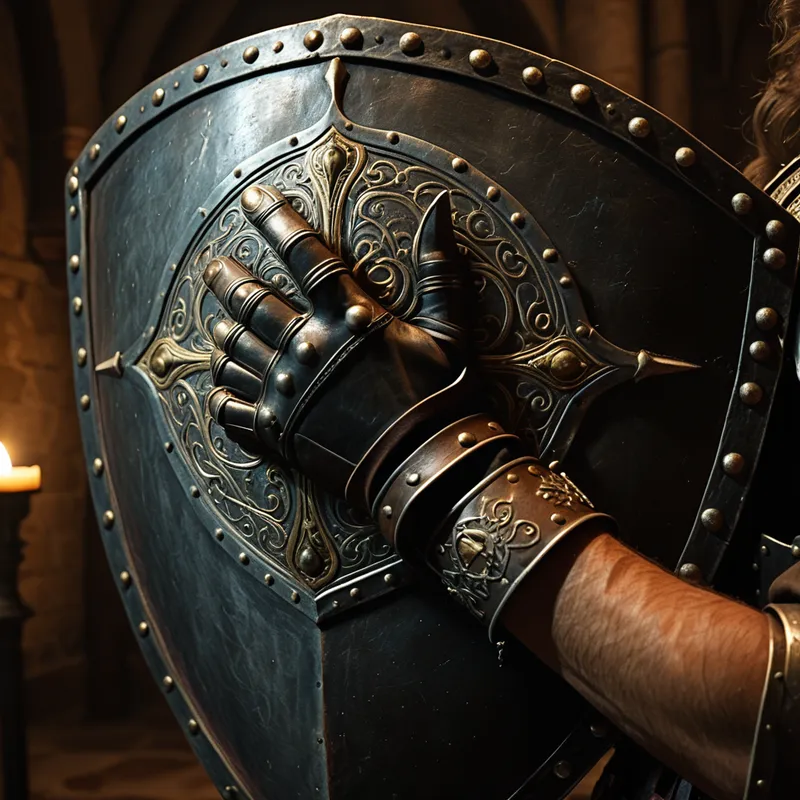
This vessel was Pridwen. Its making was not told on any mortal anvil. Some say it was a gift from the Lady of the Lake herself, brought forth from the same watery depths as the sword. Others whisper it was forged in a twilight realm by hands that knew the weight of stars. It was not a shield of brute oak and iron alone. Upon its face was painted the image of the Blessed Virgin Mary, a declaration that the king placed his personal defense under divine protection.
But Pridwen was more than a holy icon. In its polished surface, in the depth of its boss, lay a secret. It was said that when Arthur gazed upon it in the quiet before battle, he did not see his own weary reflection. He saw the land—the green hills of Logres, the dark forests, the winding rivers. He saw the faces of his people. In its curve, the whole of Britain was held, as an egg is held in a nest. In the great, terrible battle of Camlan, when brother fell upon brother and the dream of the Round Table shattered, it was Pridwen that stood between Arthur and the final darkness. It absorbed the blows that were meant for the heart of the realm. And when the wounded king was borne away to Avalon, the shield, scarred and stained, went with him—not as a tool of war, but as a testament to what had been defended, and what was worth saving.
Cultural Origins & Context
The name Pridwen emerges from the earliest, most primal layers of the Arthurian cycle, found in the cryptic Welsh poem Preiddeu Annwfn (“The Spoils of Annwfn”) and the seminal Mabinogion. Here, Arthur is not yet the chivalric monarch of later French romance, but a figure straddling the world of Celtic myth and nascent history. In these texts, Pridwen is listed among his chief treasures, alongside his spear Rhongomyniad and his sword. This triad—sword, spear, shield—represents the complete arsenal of the sovereign: active force, piercing will, and receptive protection.
The myth was carried by bards and cyfarwyddyd (storytellers) in the halls of Welsh princes, serving a crucial societal function. Pridwen was not just Arthur’s shield; it was the shield of the Pendragon, the title meaning “head dragon” or chief leader. Its story reinforced the sacred contract of kingship: the ruler’s person is synonymous with the health and integrity of the land. His protection is the people’s protection. The image of the Virgin Mary, added as the tales were Christianized, fused older Celtic notions of sovereign goddesses and protective spirits with the new faith, making Arthur a defender of Christendom itself. The myth was a narrative anchor, holding fast the idea that true leadership requires not just the power to conquer, but the sacred duty to shelter.
Symbolic Architecture
At its core, Pridwen is an archetypal symbol of the individuated Self’s boundary. It is the “skin” of the psyche, the vessel that contains and defines the emerging totality of the person.
The shield is not a wall that isolates, but a membrane that mediates. It receives the blows of the world, transmuting raw impact into conscious experience.
Excalibur is the directed, conscious will—the ego’s capacity to cut, decide, and act. Pridwen is its necessary counterpart: the unconscious, receptive, containing function. The painted Virgin signifies the transformative, nurturing aspect of the psyche (the anima in a man, or the Self in a woman) that makes protection sacred, not merely defensive. It symbolizes the capacity to hold suffering, to bear insult and injury without shattering, and to do so under the aegis of a higher, integrative principle.
The shield’s reflective quality is its most profound feature. It does not show Arthur himself, but his realm—his externalized soul. This mirrors the psychological truth that our sense of Self is often first perceived through our relationships, our creations, and our responsibilities. We see who we are by looking at what we have chosen to protect and contain.
The Dreamer’s Resonance
When the symbol of Pridwen surfaces in modern dreams, it rarely appears as a medieval artifact. It manifests as the dreamer’s personal “vessel of containment.” One might dream of a suddenly impenetrable window during a storm, a child’s perfectly round, unbreakable toy, a circular room that feels utterly safe, or even one’s own skin becoming like polished, resilient metal.
Such dreams often arise during periods of intense psychological bombardment—stress, criticism, emotional conflict, or the burdens of responsibility. The psyche is signaling the activation of the protective, containing function. The dream asks: What are you using to shield your core? Is it brittle denial, a thick wall of isolation, or something that can receive impact without breaking you? The somatic sensation accompanying these dreams is often one of a sudden, solid calm at the center of chaos, a grounding. It is the body recognizing the possibility of sacred containment, of holding space for the Self amidst life’s battles.

Alchemical Translation
The alchemical journey is one of transmutation: turning base lead into spiritual gold. In this opus, Pridwen represents the vas or philosophical egg, the sealed container in which the great work takes place. Arthur’s journey with Pridwen models the individuation process for the modern individual.
First, one must receive the vessel. This is the often-overlooked step of creating a conscious, resilient psychological space—through therapy, ritual, art, or disciplined introspection. It is the “yes” to the container before the contents are known. Then comes the painting of the image—the invocation of a higher, guiding principle (be it an ideal, a faith, a profound value) onto that container. This sanctifies the struggle, making it meaningful.
The alchemy occurs in the scarring. Each blow the shield absorbs—each failure, grief, or betrayal endured consciously—does not merely damage; it imprints the vessel with the unique pattern of a life fully lived.
Finally, at the journey’s end, as with Arthur sailing to Avalon, the shield is not discarded. It is integrated. The battles are over, but the vessel remains, now identical with the Self. The once-external protection has become the innate, unshakable boundary of a realized being. The modern seeker’s task is not to find an invulnerable shield, but to forge, through conscious endurance, a Pridwen of their own—a soul-structure that can reflect their entire world and hold it, sacred and whole.
Associated Symbols
Explore related symbols from the CaleaDream lexicon: