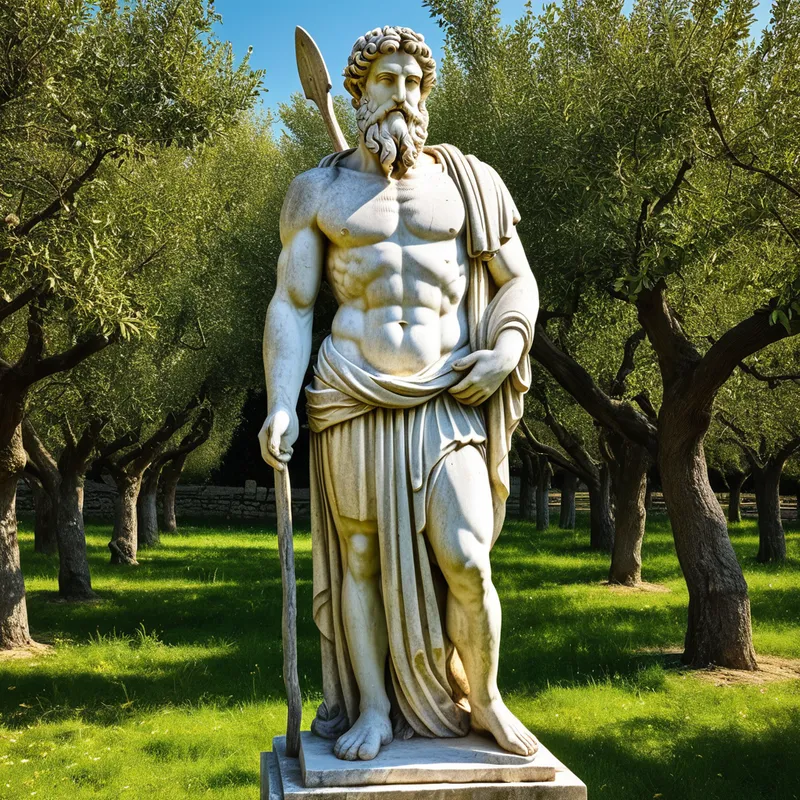
Priapus Myth Meaning & Symbolism
The story of the grotesque, rejected god of fertility, whose power lies not in consummation but in the potent, protective tension of the perpetual threshold.
The Tale of Priapus
Listen, and hear the tale of the god who was never welcomed at the feast, whose name was whispered with a snicker, yet whose presence was carved at every gate and garden wall. His story begins not in the golden light of Olympus, but in the shadowed, salty deep.
From the wine-dark sea, Aphrodite arose, born of the foam and the severed flesh of the sky. She stepped onto the shore, and where her foot touched the earth, flowers bloomed. In time, she lay with Dionysus, the god of the vine, of frenzy and unbounded life. From their union, a son was conceived—a son who carried the seed of beauty and the blood of madness.
But Hera, whose heart was often a vault of cold jealousy, looked upon Aphrodite’s swelling form. Envious of the love goddess’s effortless creation, Hera touched the unborn child with a curse. When the time came, the infant Priapus was born into the world. A wail went up, not of joy, but of shock. He was monstrously formed, with a swollen, permanent, and grotesquely enlarged member, a body of rustic strength, but a face that spoke of a simple, bewildered mind.
The court of Olympus recoiled. The elegant gods turned their faces away. His own mother, Aphrodite, in her shame, could not bear to look upon him. She cast him out, sending him down from the perfumed heights to be raised by shepherds on the wild, uncultivated slopes of the mountains. There, among the goats and the rough earth, Priapus grew. He was strength without grace, desire without allure, a god of potent fertility who was himself the ultimate symbol of rejection.
His one great longing was for the nymph Lotus. He pursued her with a clumsy, desperate ardor through the forests. As she fled, she called upon the gods for aid, and they, perhaps taking pity or merely continuing Hera’s jest, transformed her into the lotus tree. Priapus, arriving at the spot, found only the slender trunk. In his frustration, he split the wood with his axe. And from that wounded tree, it is said, the first red lotus bloomed—a flower of beauty born from violence and unfulfilled desire.
Denied a place among the celestial gods, Priapus found his kingdom in the humblest of places: the garden, the orchard, the sheepfold. The people of the land, particularly in the city of Lampsacus, took him in. They did not worship him in glorious temples, but carved his image from fig or oak—a crude, laughing statue with a painted phallus, placed at the boundary of the cultivated plot. He became the guardian of the threshold. His very grotesqueness, his unabashed physicality, was a charm against the evil eye. To steal from a garden under his gaze was to invite a fate worse than death. He was the scarecrow god, whose threat was not of violence, but of a profound, ridiculous, and inescapable shame.
Cultural Origins & Context
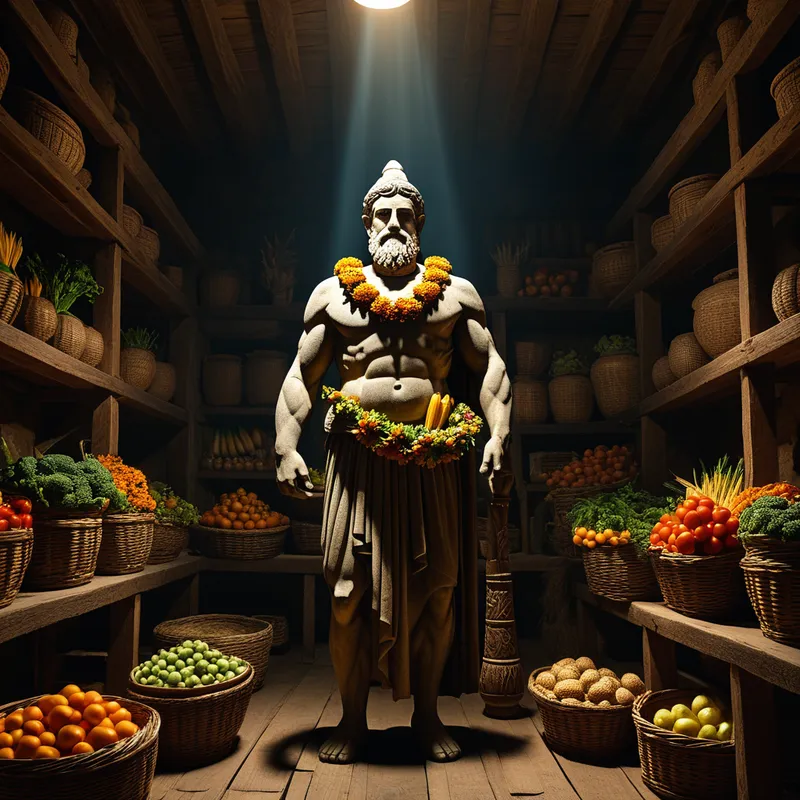
The myth of Priapus is not the stuff of Homeric epic. He has no grand Iliad, no odyssey. His stories are rustic anecdotes, bawdy poems (Priapeia), and the silent testimony of countless small statues. He belongs to the world of georgoi, the farmers and herders, not the aristocrats. His worship was domestic, personal, and intensely practical.
He was a god of the limen, the boundary. His statues marked where the ordered world of the farm met the wild, where private property began. In this, he functioned as a divine combination of a scarecrow and a security system. His power was apotropaic—turning away evil. The threat associated with him was often one of punitive, sexual violation, a curse so culturally potent it was believed to deter thieves more effectively than any law.
The transmission of his myth was oral, local, and often ribald. It was told not by bards in royal halls, but by farmers at harvest, by travelers seeing his statue at a crossroads. His societal function was twofold: to protect the literal fruits of human labor, and to provide a culturally sanctioned outlet for humor and anxiety about the body, fertility, and social transgression. He was the sacred clown, whose very existence acknowledged the messy, urgent, and sometimes embarrassing realities of life and growth that the lofty Olympians preferred to ignore.
Symbolic Architecture
Priapus is the archetype of the rejected foundation. He embodies the raw, unrefined life force that civilization often seeks to hide or disown, yet upon which it utterly depends.
He is the god of the garden, not of the harvest feast—the tension of growth, not the satisfaction of consumption.
His grotesque form symbolizes potency divorced from context, energy without a vessel, desire without relationship. He is the shadow of Pan and Dionysus—their wildness made static and objectified. His perpetual erection is not a symbol of conquest, but of eternal readiness, a state of unfulfilled potential. He is frozen at the moment of intention, never reaching completion.
Psychologically, Priapus represents the part of the psyche that feels fundamentally flawed, ashamed of its natural appetites and instincts, and cast out from the inner “Olympus” of our idealized self-image. He is the orphaned instinct, the creative urge that feels too crude, too sexual, too needy to be accepted. His guardianship of boundaries is profound: that which is rejected often becomes the best protector, for it has nothing left to lose and understands the nature of violation intimately.
The Dreamer’s Resonance
When the pattern of Priapus stirs in the modern dreamscape, it often manifests as dreams of profound exposure and shame. The dreamer may find themselves naked in a public place, but the focus is less on the nudity itself and more on a specific, exaggerated feature that draws ridicule or horror. Alternatively, one may dream of guarding something humble but vital—a small garden, a stash of food, a private journal—with a fierce, almost ridiculous intensity.
Somatically, this archetype can manifest as tension in the pelvic floor, a feeling of being “stuck” in a state of arousal or anxiety without release, or hypersensitivity about one’s physical appearance or basic needs. Psychologically, the dreamer is likely grappling with a deep-seated sense of rejection, not for what they have done, but for what they are at a fundamental level. It is the process of confronting the “grotesque” or unlovable part of oneself that holds a raw, untapped power. The dream is an invitation to stop fleeing from this rejected self, and instead, to install it as the guardian of one’s most vulnerable, growing spaces.

Alchemical Translation
The alchemical journey modeled by Priapus is not one of glorious transformation into gold, but of the nigredo—the blackening, the acknowledgment of the base, rejected matter. His myth charts the path of psychic transmutation for the individual who carries a wound of primal rejection.
The first step is the painful recognition: the casting out of the “monstrous” child-self. The modern equivalent is the disowning of our instinctual nature, our sexuality, our hunger, our simple need for belonging, because it feels too crude, too much. We exile this part to the “wild slopes” of our unconscious, where it grows strong in isolation but remains unloved.
The alchemical work begins with a radical re-contextualization. Just as the people of Lampsacus moved Priapus from a figure of shame to a figure of protection, we must retrieve our orphaned instinct. We do not bring it to the center to be glorified, but we install it at the boundary.
The transmutation occurs when the wound becomes the wall; when that which was rejected becomes the guardian of what is most tender and growing within us.
This means allowing our raw life force, our “priapic” energy—which may feel awkward, excessive, or embarrassing—to serve as the protective principle for our creativity, our relationships, our inner garden. The perpetual tension, the state of unfulfilled readiness, is no longer a pathology but a posture of vigilant care. The fulfilled desire (the harvest) is enjoyed within the space that the unfulfilled desire (the guardian) protects. In this way, the grotesque is not made beautiful, but is made essential. The orphan finds not a palace, but a purpose. The base matter of shame is not erased, but through the slow work of attention, it is transmuted into the fertile, guarding earth from which a more integrated self can grow.
Associated Symbols
Explore related symbols from the CaleaDream lexicon: