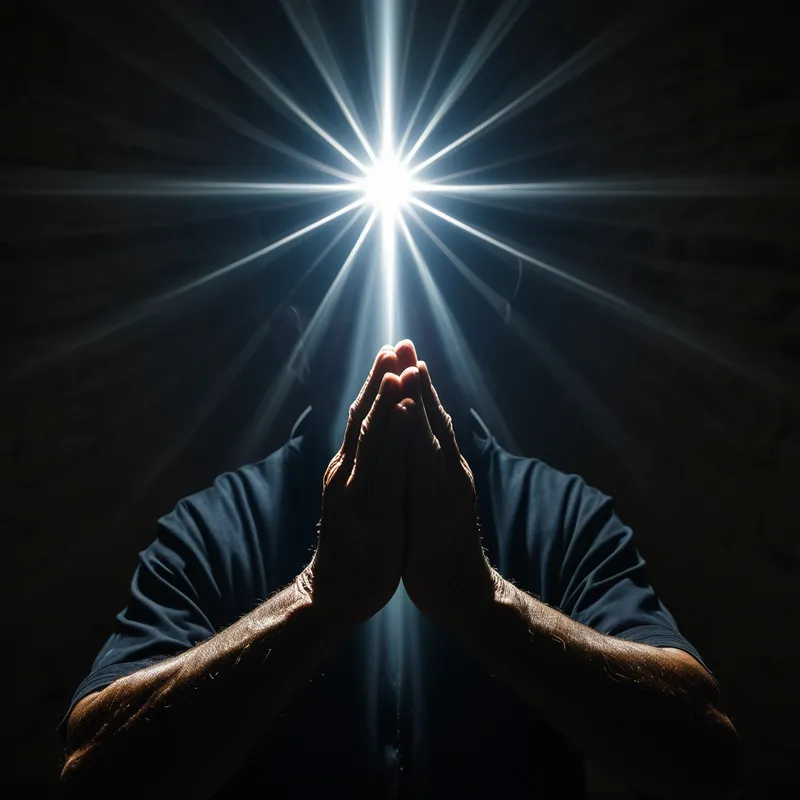
Praying Hands Myth Meaning & Symbolism
A tale of two brothers, one artist, and a profound sacrifice immortalized in the gesture of prayer, symbolizing devotion, surrender, and the sacredness of human labor.
The Tale of Praying Hands
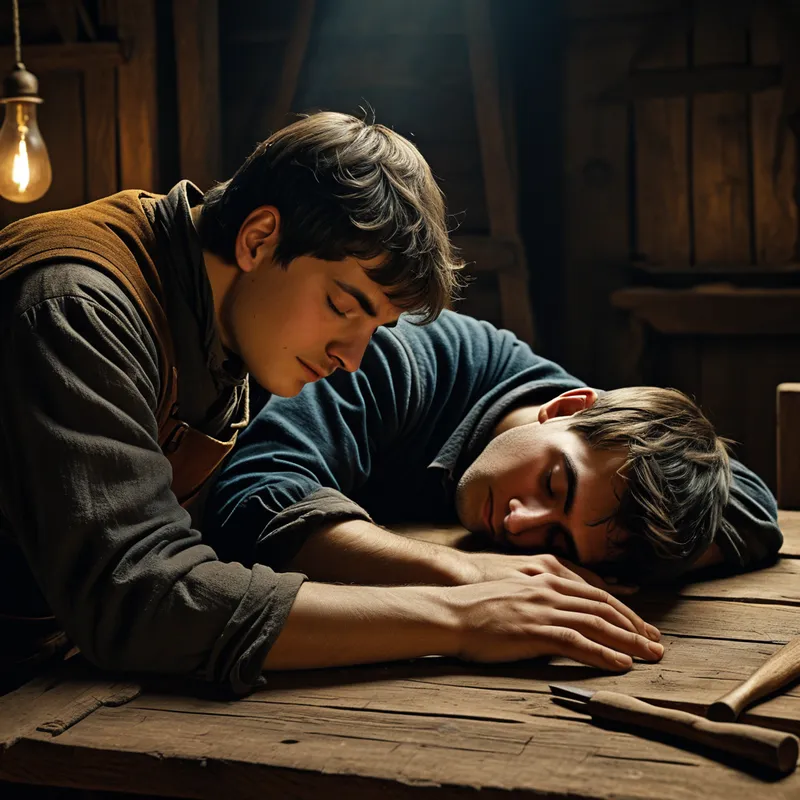
In the deep, mineral heart of the German lands, where the air was thick with the smell of damp earth and burning tallow, there lived two brothers bound by a love as hard and real as the rock their father mined. Their names were Albrecht and Albert. From a young age, a fire burned in Albrecht’s heart—not for gold or glory, but for the silent language of line and form, for the capturing of divine light on parchment. His hands, it was said, were meant to hold a quill, not a pickaxe.
But dreams are costly guests in a poor man’s house. Their father, a man worn thin by the mine, could send only one son to the distant city of Nuremberg, to the hallowed halls where artists were forged. Two souls, one chance. The brothers, by the guttering light of their hearth, made a pact as solemn as any vow sworn on an altar. They would toss a coin. The winner would go to the city and learn. The other would descend into the dark, into the belly of the mountain, and with the sweat of his brow and the strength of his back, pay for the other’s glory.
The coin spun, a flash of silver in the firelight. It fell. Albrecht’s fate was cast: he would go to Nuremberg. Albert’s smile was sad but sure. He clasped his brother’s artist-hands in his own, already rough, and said nothing. For four long years, Albrecht drank deep from the well of mastery. His name began to be whispered in awe. And for four long years, Albert descended into the perpetual night of the mine. The rock dust etched itself into his skin; his hands grew broad, knotted, and scarred—hands that wrestled sustenance from the unyielding stone to feed a dream that was not his own.
When Albrecht returned, triumphant, it was time to reverse the pact. Now Albert would go to the city, and Albrecht would labor for him. But at the celebratory feast, Albrecht called for a toast to his brother, the true artist of the family. He asked Albert to show the table the hands that had made his art possible. Slowly, Albert raised his hands. They were ruined. The bones, once straight, were now twisted from years of crushing labor; the joints were swollen, the skin a map of old wounds and fresh calluses. These hands could never hold a delicate brush, could never trace the subtle curve of a saint’s cheek. The sacrifice was absolute and irreversible.
Overcome, Albrecht fell to his knees. He took his brother’s wrecked hands in his own, and with tears blurring his vision, he gently pressed them together into the ancient posture of supplication and gratitude. “No, brother,” he whispered, his voice thick. “Your hands have prayed for me all these years. Now, I shall pray with them. I will paint these hands, just as they are, so that the whole world will see not a miner’s ruin, but a saint’s devotion. They will see your prayer, and it will be my masterpiece.”
Cultural Origins & Context
The story of the Praying Hands is not a myth drawn from scripture, but a legend born from the soil of late Medieval and early Renaissance Germany. It is intimately tied to the life of Albrecht Dürer (1471-1528), one of the North’s most celebrated artists. While the specific, poignant narrative of the two brothers is likely apocryphal—a hagiographic tale woven around a famous man—it is grounded in a tangible artifact: Dürer’s 1508 preparatory drawing, Betende Hände (Praying Hands).
The tale functions as a powerful parable of the emerging Renaissance values, where the individual’s labor and genius were beginning to be celebrated, yet remained framed within a deeply Christian worldview of sacrifice, fraternal love, and vocation. It was passed down not in sacred texts, but in folk tradition, art history books, and sermons, serving to sanctify the concepts of hard work, familial duty, and the idea that great art is often built upon unseen, humble foundations. The story gave a soul to a famous image, transforming a study of anatomy into an icon of invisible love.
Symbolic Architecture
At its core, the myth is not about art, but about the sacred economy of the [soul](/symbols/soul “Symbol: The soul represents the essence of a person, encompassing their spirit, identity, and connection to the universe.”/). The praying hands are the central archetypal [image](/symbols/image “Symbol: An image represents perception, memories, and the visual narratives we create in our minds.”/), but they are not merely a [gesture](/symbols/gesture “Symbol: A non-verbal bodily movement conveying meaning, emotion, or intention, often symbolic in communication and artistic expression.”/) of piety. They are a [vessel](/symbols/vessel “Symbol: A container or structure that holds, transports, or protects something essential, representing the self, emotions, or life journey.”/) containing multiple, layered sacrifices.
The hands that pray are first the hands that labor. The gesture of surrender to the divine is built upon the foundation of surrender for another.
Albert’s hands symbolize the [persona](/symbols/persona “Symbol: The social mask or outward identity one presents to the world, often concealing the true self.”/) of the [caregiver](/symbols/caregiver “Symbol: A spiritual or mythical figure representing nurturing, protection, and unconditional support, often embodying divine or archetypal parental energy.”/), utterly consumed in service. His sacrifice represents the ultimate subjugation of personal ambition for the sake of another’s wholeness. Psychologically, he embodies the part of ourselves that we relegate to the shadows—the mundane, laboring, sustaining self that we deem unglamorous, yet which makes all our aspirations possible.
Albrecht, in turn, represents the realized creative [spirit](/symbols/spirit “Symbol: Spirit symbolizes the essence of life, vitality, and the spiritual journey of the individual.”/). His [journey](/symbols/journey “Symbol: A journey in dreams typically signifies adventure, growth, or a significant life transition.”/) is one of individuation, but it is an individuation purchased with another’s flesh. His act of immortalizing the ruined hands is the critical [moment](/symbols/moment “Symbol: The symbol of a ‘moment’ embodies the significance of transient experiences that encapsulate emotional depth or pivotal transformations in life.”/) of recognition—[the ego](/myths/the-ego “Myth from Jungian culture.”/) acknowledging its [debt](/symbols/debt “Symbol: A symbolic representation of obligations, burdens, or imbalances that extend beyond financial matters into psychological and moral realms.”/) to the sacrificed self. The painted hands become a [mandala](/symbols/mandala “Symbol: A sacred geometric circle representing wholeness, the cosmos, and the journey toward spiritual integration.”/), a [symbol](/symbols/symbol “Symbol: A symbol can represent an idea, concept, or belief, serving as a powerful tool for communication and understanding.”/) of the reconciled whole: labor and art, sacrifice and glory, the [human](/symbols/human “Symbol: The symbol of a human represents individuality, complexity of emotions, and social relationships.”/) and the divine, forever joined at the palms.
The Dreamer’s Resonance
When the image of praying hands surfaces in a modern dream, divorced from its Christian context, it signals a profound somatic and psychological process. It rarely appears as a simple act of religious beseeching. More often, the dreamer may find their own hands clasped tightly, unable to separate them, or they may see another’s hands—perhaps aged, scarred, or strangely luminous—in this posture.
This is the [psyche](/myths/psyche “Myth from Greek culture.”/) working with the archetype of the pact. The dreamer is likely at a crossroads where a part of them feels sacrificed—their own creativity, freedom, or joy—to sustain another role: the responsible career, the demanding relationship, the endless caretaking. The praying hands in the dream symbolize the tension between this silent, sustaining labor and the soul’s yearning for its own expression. It is a somatic image of holding two conflicting realities together in a tense, sacred unity. The dream asks: What part of you has gone into the mines for the sake of another? And is it now time to bring that part into the light and honor its prayer?
Alchemical Translation
The myth models the alchemical process of coniunctio oppositorum—[the conjunction](/myths/the-conjunction “Myth from Alchemical culture.”/) of opposites. The base material ([prima materia](/myths/prima-materia “Myth from Alchemical culture.”/)) is the brothers’ shared, impoverished life. [The first stage](/myths/the-first-stage “Myth from Alchemical culture.”/), [nigredo](/myths/nigredo “Myth from Alchemical culture.”/), is Albert’s descent into the literal and psychological darkness of the mine, a dissolution of his personal dream.
The transmutation occurs not in the fire of ambition, but in the quiet waters of recognition. The gold is not the fame of the artist, but the redeemed value of the sacrifice.
The albedo is the moment of revelation at the feast, where the ruined hands are shown. This is the washing clean of illusion, where the true cost is seen in the clear, harsh light of day. The citrinitas is Albrecht’s inspired resolution to paint the hands—the integration of [the shadow](/myths/the-shadow “Myth from Jungian culture.”/) (the laborer) into the conscious work of the ego (the artist). Finally, the [rubedo](/myths/rubedo “Myth from Alchemical culture.”/) is the creation of the icon itself. The masterpiece is the symbol of wholeness. The praying hands are the [Philosopher’s Stone](/myths/philosophers-stone “Myth from Alchemical culture.”/)—the point where the leaden weight of sacrifice is transmuted into the golden light of sacred meaning.
For the modern individual, the alchemical instruction is clear: Your wholeness depends on honoring your own sacrifices and the sacrifices made for you. Individuation is not a solo journey of egoic [triumph](/myths/triumph “Myth from Roman culture.”/). It is a sacred reconciliation. It requires you to kneel before the calloused, forgotten, or wounded parts of your own soul, to press them together in an attitude of deepest respect, and to say, “This, too, is my prayer. This, too, is holy. This labor has made me.” The act of bringing that recognition into your conscious life—through art, through gratitude, through changed action—is the final, rubedo stage of creating your own masterpiece of self.
Associated Symbols
Explore related symbols from the CaleaDream lexicon: