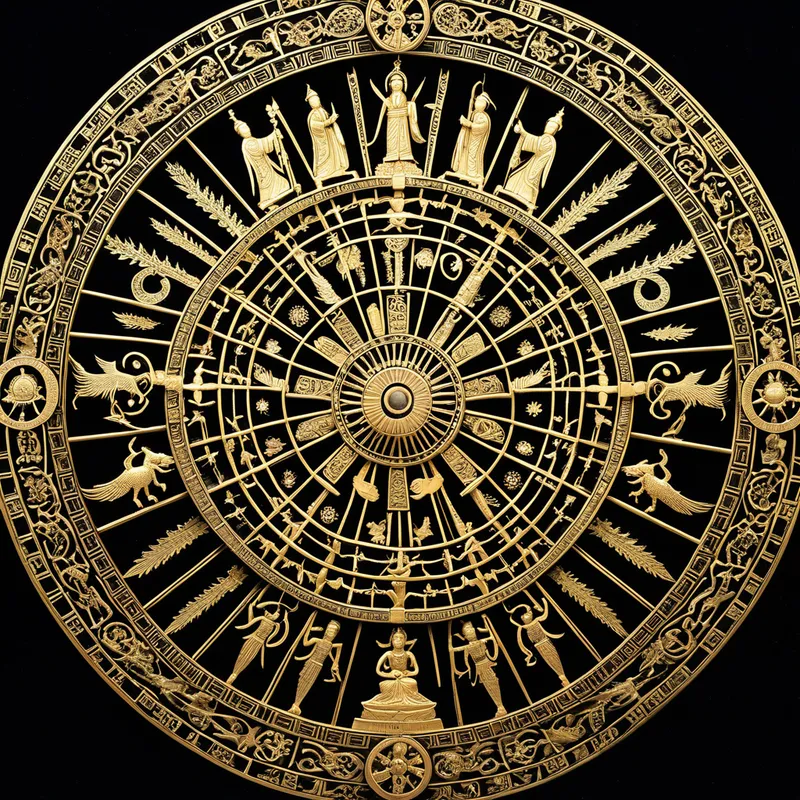
Pratītyasamutpāda Myth Meaning & Symbolism
A cosmic narrative of how all things, from suffering to liberation, arise and cease in an endless, interdependent dance of cause and condition.
The Tale of Pratītyasamutpāda
Listen. In the deep silence beneath the Bodhi tree, a truth was not found, but seen. It was not a thing to be grasped, but a pattern to be witnessed—a pattern written in the very marrow of existence.
The prince-turned-ascetic, his body worn to its essence, turned his gaze inward, into the abyss of his own becoming. He did not see gods or demons first. He saw a chain. Not of iron, but of light and shadow, of action and consequence, stretching backward into the mists of time and forward into the unborn future. This was the vision of Pratītyasatpāda.
He saw, with the clarity of a dawn that ends an age of night, how life—this whirlwind of joy and anguish—is spun into being. It begins not with a bang, but with a blindness. Avidyā, a veil over the eye of the soul. From this unknowing, a subtle shaping arises, the latent impressions of karma, like potter’s hands hovering over wet clay. Then, consciousness flickers into being, aware yet already colored. Name and form coalesce—the blueprint of a self and a world. The six senses unfold, portals to experience. Contact happens: eye meets form, ear meets sound, and a spark is struck.
From that spark, feeling—sweet, bitter, or neutral—floods the being. From feeling, thirst—Taṇhā—a fire in the heart. This thirst tightens its grip, becoming clinging, a frantic grasping at life itself. This clinging gives birth to becoming, the furious momentum toward a new existence. And from becoming, birth is inevitable—the painful, glorious eruption into a new life. And with birth, the whole weary caravan follows: aging, sorrow, lamentation, pain, grief, despair… and death. And from death, the veil of Avidyā descends once more, and the wheel turns, groaning under the weight of its own endless revolution.
But the seer under the tree did not stop at the despair of the turning. He followed the chain in the other direction. He saw that if this arises, that arises. And with a stillness that shattered universes, he saw that if this ceases, that ceases. He traced the links backward, from death to birth to becoming to clinging to thirst… all the way back to the source. And he saw that when the veil of Avidyā is lifted, the entire dreadful, beautiful apparatus grinds to a halt. The chain falls away, not into nothingness, but into a peace so profound it has no name. This was his great awakening: the vision of the arising and the ceasing, the dreadful wheel and the path of its unbinding.

Cultural Origins & Context
This is not a myth of gods on mountaintops, but the core ontological discovery of Śākyamuni Buddha. It is the foundational insight that formed the bedrock of all subsequent Buddhist thought. The narrative of the twelve links (Dvādaśāṅga) was not passed down as a fable for entertainment, but as a diagnostic map and a prescription for liberation.
It was taught orally for centuries by monks and nuns, often visualized in the iconic Bhavacakra, held in the clutches of Yama, the lord of death. This image served as a constant, public teaching on monastery walls: This is the machinery of your suffering. Here are its cogs. And here is how it stops. Its societal function was radical: to demystify suffering, to remove its aura of fate or divine punishment, and to present it as a comprehensible, and therefore breakable, process. It placed the responsibility for bondage, and the power for release, squarely in the hands of the individual.
Symbolic Architecture
The myth of Pratītyasamutpāda is the ultimate symbolic architecture of the psyche-in-the-world. It is not a linear story but a holographic law.
The self is not a noun, but a verb—a temporary confluence of streams in the endless river of conditionality.
Each link is both an event and a psychological state. Avidyā represents the primal, unconscious ground of our being, where we mistake the transient for the eternal, the composite for the solid. Taṇhā is the engine of the ego, the addictive contraction around pleasure and the violent rejection of pain. Upādāna is the crystallization of that addiction into identity—“I am this desire, this opinion, this story.”
The entire chain is a master symbol of Saṃsāra itself—not as a place, but as a process of perpetual, conditioned becoming. Psychologically, it maps how a momentary impulse of ignorance can snowball, through the gravity of habit, into a lifetime of patterned suffering. It shows that our neuroses, our fixations, our deepest sorrows are not random punishments, but are built, link by logical link, from the raw material of our misperceptions and reactions.
The Dreamer's Resonance
When this myth stirs in the modern unconscious, it rarely appears as a Buddhist wheel. It manifests as the dreamer trapped in a loop—reliving the same argument, fleeing the same pursuer, or standing helplessly as a sequence of inevitable events unfolds. It is the dream of dominoes falling, of gears meshing, of being a passenger in a vehicle you cannot steer.
Somatically, this can feel like a tightening in the chest, a knot in the stomach—the physical imprint of Upādāna, of holding on. Psychologically, it signifies the dreamer confronting a karmic pattern. The dream is showing the architecture of a particular suffering: See? This feeling of abandonment (vedanā) leads to this desperate search for validation (taṇhā), which leads to this unhealthy relationship (upādāna and bhava). The dream presents the chain not as philosophy, but as lived, felt experience. To dream of breaking the chain—of a thread snapping, a lock opening, a wheel stopping—indicates a profound moment of psychological readiness to interrupt an ancient, automatic sequence.

Alchemical Translation
The alchemical work modeled by Pratītyasamutpāda is the transmutation of blind causality into conscious choice. It is the ultimate individuation process: not toward a bigger, better ego, but toward the dissolution of the ego as a fixed thing and its recognition as a flowing process.
Liberation is not an escape from the chain, but the luminous understanding of its every link. To see the mechanism is to stand outside its compulsive turning.
The modern seeker engages in this alchemy through mindful awareness. The first alchemical fire is applied at the link of Sparśa and Vedanā. In the gap between stimulus and reaction, between a sight and the feeling it provokes, the alchemist inserts consciousness. They ask: Can I feel this feeling without immediately thirsting for more or less of it? This breaks the automatic progression to Taṇhā.
The second, and most profound, operation is at the root: illuminating Avidyā. This is the Magnum Opus—the replacement of ignorance with insight (Prajñā). It involves a relentless inquiry: What if I am not this solid, separate self? What if this pain is not mine to own, but a pattern to observe? This is not an intellectual exercise, but a somatic, lived realization that de-crystallizes identity.
The triumph is not a heroic slaying of a beast, but a quiet cessation. It is the psychic equivalent of a complex machine, once fueled by the coal of craving and ignorance, now recognizing its own design and switching itself off. What remains is not emptiness, but freedom—the freedom of a phenomenon that knows itself to be a temporary, interdependent event, and thus can participate in the dance of life with grace, compassion, and without clinging to the turning of the wheel. This is the nirvanic state: the chain, fully understood, becomes a garland of liberation.
Associated Symbols
Explore related symbols from the CaleaDream lexicon: