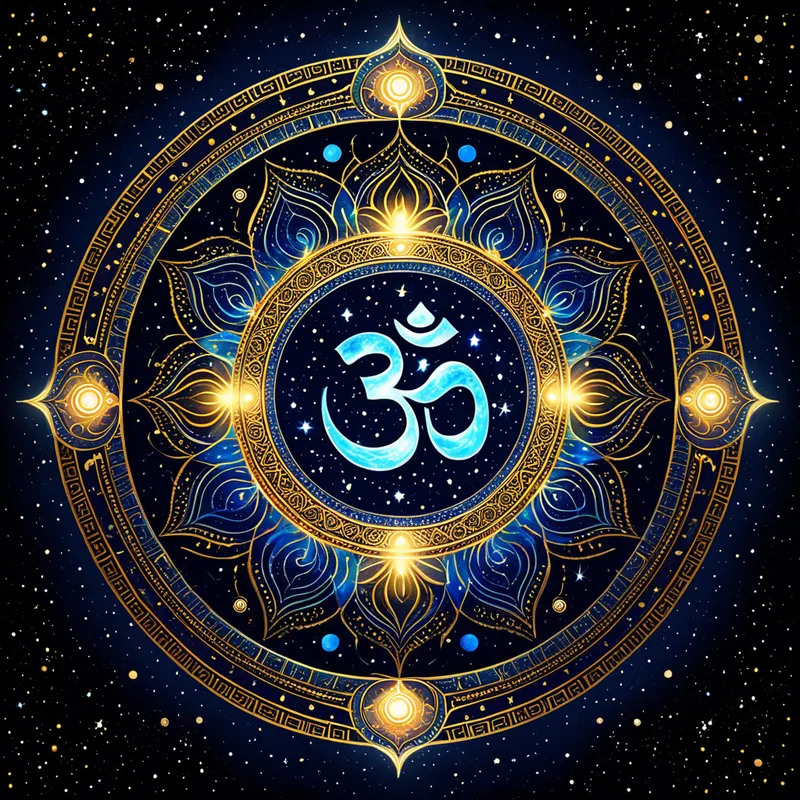
Pranava Myth Meaning & Symbolism
The primordial vibration from which all creation emerges, the syllable Om is the first sound, the first thought, and the essence of all reality.
The Tale of Pranava
Before the worlds were spun, before time had a name to be called by, there was only the One. Not a being, but a presence. A boundless, silent ocean of potential, dark and profound, resting in the fathomless sleep of non-being. This was the Brahman, and within its infinite womb, a desire stirred. Not a selfish want, but the first, pure impulse of existence itself: “May I become many.”
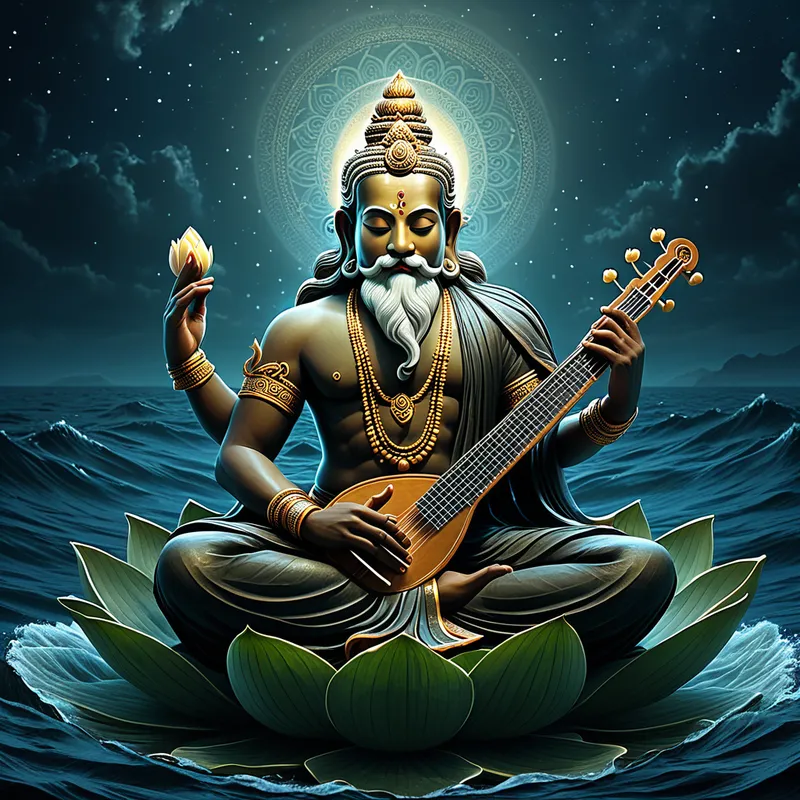
From that desire, a warmth kindled in [the void](/myths/the-void “Myth from Buddhist culture.”/). A golden [lotus](/myths/lotus “Myth from Hindu culture.”/) bud, radiant and self-born, unfolded its petals upon the surface of the cosmic waters. Upon it sat Brahma, [the architect](/myths/the-architect “Myth from Various culture.”/) of manifested realms. He opened his eyes for the first time and beheld… nothing. An expanse of undifferentiated stillness. A profound loneliness echoed in the heart of creation, for what is a creator without a creation? What is a word without a voice to speak it?
He looked to the four directions, but there was no east or west. He sought a companion, a sound, a sign—but the silence was absolute and crushing. In that moment of cosmic solitude, the need for expression became a fire in his being. He reached into the very core of his creative power, into the place where thought becomes vibration and vibration becomes form.
He did not speak a sentence. He did not sing a song. He drew breath from the essence of the universe itself and gave voice to a single, seamless syllable. It began deep within, a resonant A that rolled forth like the dawn cracking the shell of night. It flowed upward and outward, transforming into a rounded, humming U, sustaining itself in the chamber of the cosmos. And finally, it closed upon itself with a resonant M, a vibration that did not end but dissolved back into the silence from which it came.
A-U-M.
The syllable Om, the Pranava, was born. It was not merely a sound he made; it was the sound that made him, the audible form of the creative will of Brahman. As its waves radiated outwards, the universe shuddered into being. The silence was shattered into a symphony. From the vibration of the A emerged the physical world of waking, Jagrat. From the resonance of the U flowed the subtle world of dream, Swapna. From the dissolving hum of the M arose the causal world of deep sleep, Sushupti.
The one note became many. It became the rustle of leaves, the crash of waves, the crackle of fire, and the whisper of wind. It became the meter of the sacred Vedas. Every story ever told, every song ever sung, every prayer ever uttered was contained within that first, primal utterance. Brahma was no longer alone. He sat upon his lotus, surrounded by the echoing, unfolding children of his own voice, the Pranava, the ferryboat (nava) that carries all beings across the ocean of existence.
Cultural Origins & Context
The myth of Pranava is not a narrative confined to a single Puranic text but is the foundational bedrock of Hindu metaphysical thought, woven into the very fabric of the Vedas and the philosophical Upanishads. Its transmission was, and remains, primarily oral and experiential. It was passed down not just as a story, but as a direct instruction (upadesha) from guru to disciple in the forest academies of ancient India.
Its tellers were the Rishis, those who had “heard” (shruti) the truths in deep states of meditation. They did not invent the myth; they perceived it. The societal function of the Pranava was multifaceted: it was the sanctifying prefix to all [Vedic mantras](/myths/vedic-mantras “Myth from Hindu culture.”/), the sonic key to ritual efficacy. More profoundly, it served as the ultimate “theory of everything” for the ancient Indian mind—a unifying principle that explained the emergence of diversity from unity, of sound from silence, of matter from consciousness. It provided a cosmological map where the microcosm of the individual soul (Atman) and the macrocosm of universal reality (Brahman) were connected by the resonant thread of this one sound.
Symbolic Architecture
The Pranava is the ultimate [symbol](/symbols/symbol “Symbol: A symbol can represent an idea, concept, or belief, serving as a powerful tool for communication and understanding.”/) of [origin](/symbols/origin “Symbol: The starting point of a journey, often representing one’s roots, source, or initial state before transformation.”/) and return. It is not a symbol for something else; it is [the thing](/myths/the-thing “Myth from Norse culture.”/) itself made audible. Its three phonemes (A-U-M) are a complete cosmology.
The journey from A to M is the arc of a universe, the breath of a god, and the lifespan of a soul—all contracting and expanding within a single, timeless pulse.
The A symbolizes the beginning, creation, the waking state, and the god Brahma. It is the [outward](/symbols/outward “Symbol: Movement or orientation away from the self or center; expansion, expression, or externalization of inner states into the world.”/), expansive [impulse](/symbols/impulse “Symbol: A sudden, powerful urge or drive that arises without conscious deliberation, often linked to primal instincts or emotional surges.”/). The U represents preservation, the dream state, the connective [tissue](/symbols/tissue “Symbol: Represents emotional release, vulnerability, and the delicate nature of feelings or physical fragility.”/) of [reality](/symbols/reality “Symbol: Reality signifies the state of existence and perception, often reflecting one’s understanding of truth and life experiences.”/), and the god [Vishnu](/myths/vishnu “Myth from Hindu culture.”/). It is the sustaining [vibration](/symbols/vibration “Symbol: A rhythmic oscillation or resonance, often representing energy, connection, or unseen forces. In dreams, it can signal awakening, disturbance, or spiritual communication.”/). The M signifies [dissolution](/symbols/dissolution “Symbol: The process of breaking down, dispersing, or losing form, often representing transformation, release, or the end of a state of being.”/), deep sleep, the return to [source](/symbols/source “Symbol: The origin point of something, often representing beginnings, nourishment, or the fundamental cause behind phenomena.”/), and the god [Shiva](/myths/shiva “Myth from Hindu culture.”/). It is the [inward](/symbols/inward “Symbol: A journey toward self-awareness, introspection, and the exploration of one’s inner world, thoughts, and unconscious mind.”/), contracting silence. The fourth, unspoken element is the silence that follows and surrounds the [syllable](/symbols/syllable “Symbol: A basic unit of sound in language, representing communication, rhythm, and the building blocks of expression.”/)—the Turiya. This is the pure, non-dual [consciousness](/symbols/consciousness “Symbol: Consciousness represents the state of awareness and perception, encompassing thoughts, feelings, and experiences.”/) from which the sound emerges and into which it subsumes.
Psychologically, this represents the totality of the [psyche](/myths/psyche “Myth from Greek culture.”/). A is the conscious ego, asserting itself in [the world](/myths/the-world “Myth from Tarot culture.”/). U is [the personal unconscious](/myths/the-personal-unconscious “Myth from Jungian Psychology culture.”/), the [realm](/symbols/realm “Symbol: The symbol of ‘Realm’ often signifies the boundaries of one’s consciousness, experiences, or emotional states, suggesting aspects of reality that are either explored or ignored.”/) of dreams, memories, and complexes that sustains our [identity](/symbols/identity “Symbol: Identity represents the sense of self, encompassing personal beliefs, cultural background, and social roles.”/). M is the [collective unconscious](/symbols/collective-unconscious “Symbol: The Collective Unconscious refers to the part of the unconscious mind shared among beings of the same species, embodying universal experiences and archetypes.”/), the deep, impersonal psychic substrate where individual [identity](/symbols/identity “Symbol: Identity represents the sense of self, encompassing personal beliefs, cultural background, and social roles.”/) dissolves. The silent Turiya is the transcendent Self ([the Self](/myths/the-self “Myth from Jungian culture.”/)), the ground of all being.
The Dreamer’s Resonance
When this myth stirs in the modern unconscious, it rarely appears as Brahma on a lotus. Instead, one might dream of a foundational hum underlying all reality—the constant drone of a power plant that is revealed to be the heartbeat of the city, or a single, sustained musical note that holds a crumbling building together. One may dream of trying to utter a word of immense power but only being able to produce a vowel sound that resonates too powerfully, threatening to shatter the dream itself.
These dreams signal a process of re-sourcing. The psyche is fatigued by the complexity and fragmentation of modern life—the endless “many.” It is attempting to return to the “One,” to find the central, unifying vibration from which a person’s identity and purpose emanate. Somatic sensations might include a buzzing in the ears (tinnitus as a personal pranava), a feeling of vibration in the chest, or a profound sense of stillness so deep it feels like a sound. The dreamer is undergoing a re-tuning, where scattered psychic energies are being called back to their point of origin to be harmonized into a single, coherent note.

Alchemical Translation
The individuation process, the journey toward psychic wholeness, is mirrored perfectly in the arc of the Pranava. We begin in the state of A: identified solely with our conscious ego, our [persona](/myths/persona “Myth from Greek culture.”/), our outward creation of a self. This is necessary, but it is partial and leads to a sense of separation—Brahma’s loneliness.
The alchemical work begins when the ego, exhausted by its own creation, willingly listens for the deeper hum within.
The journey inward is the movement to U. We engage with the personal unconscious—our dreams, our shadows, our complexes. We preserve and integrate these hidden parts. This is the therapeutic, analytic stage. Deeper still is the plunge into M, into [the collective unconscious](/myths/the-collective-unconscious “Myth from Jungian culture.”/). Here, ego identity must dissolve. We encounter archetypal forces that are not “us” in a personal sense. This is the dark night, the [nigredo](/myths/nigredo “Myth from Alchemical culture.”/), where all forms are broken down.
The [triumph](/myths/triumph “Myth from Roman culture.”/) is not in staying in any one of these states, but in mastering the entire cycle. The alchemical goal is to consciously utter one’s own “Pranava”—to speak [the word](/myths/the-word “Myth from Biblical culture.”/) of one’s unique being—which contains the full resonance of all three states and originates from the fourth, the silent Self. One becomes both the speaker and the spoken, the creator and the creation, grounded in a silence that is not empty but infinitely full. The individual no longer feels like a separate note fighting in a cacophonous symphony, but as the very space (akasha) in which the entire symphony arises and plays. They have found the source tone of their own existence and, in doing so, have touched the source of all that is.
Associated Symbols
Explore related symbols from the CaleaDream lexicon: