Prajapati Myth Meaning & Symbolism
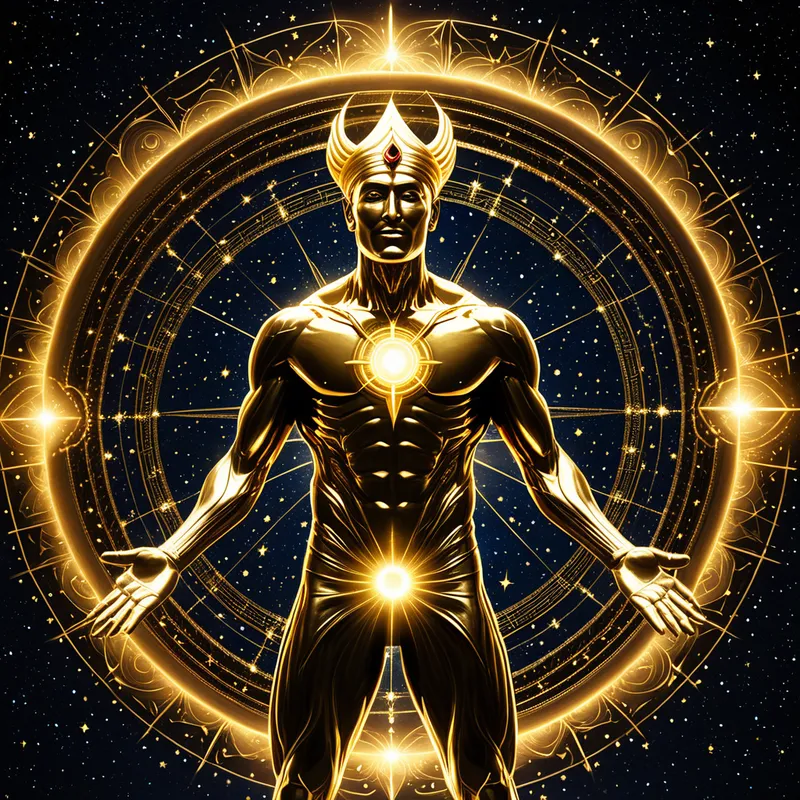
The primordial being whose self-sacrifice and division births the cosmos, embodying the paradox of creation emerging from a sacred, painful rupture.
The Tale of Prajapati
In the beginning, there was neither existence nor non-existence. There was only the One, floating upon the dark, limitless, silent waters. No breath stirred, no star shone. It was a sleep so deep it was indistinguishable from death. This One was Prajapati. He was alone, and in that aloneness, a great heat arose—the tapas of infinite potential.
Desire, the first seed of the mind, kindled within him. “May I be many,” he thought. “May I procreate.” And so, from the furnace of his solitude, he spoke the sacred syllable. The sound was not a word but the vibration of being itself: AUM. It rippled across the void, and the waters trembled.
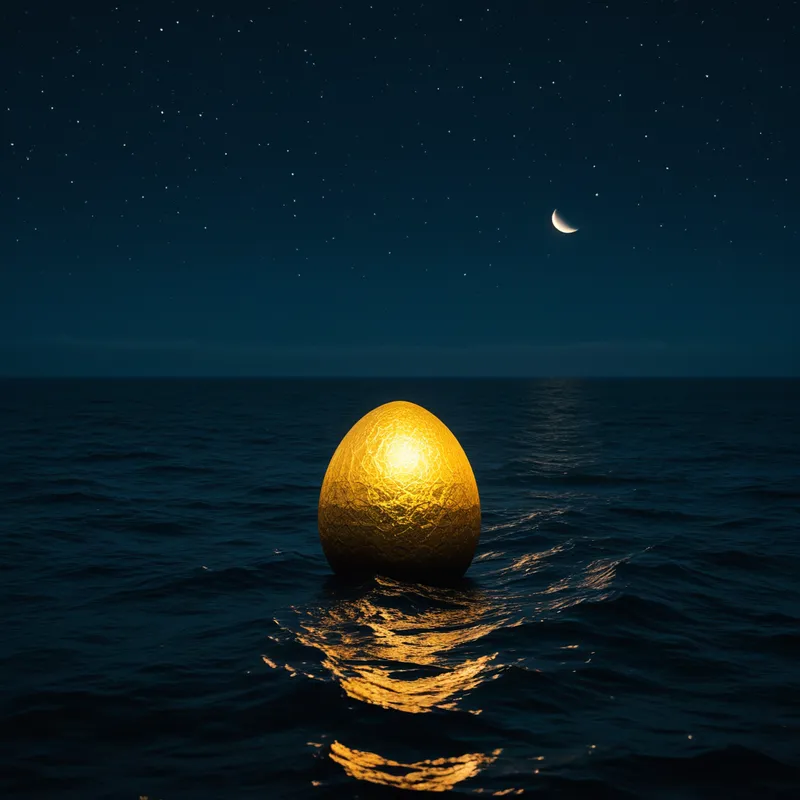
From this vibration, a golden womb formed—the Hiranyagarbha. Prajapati entered it, and for a year—a cosmic year—he gestated within. When the time was full, he broke the shell. But he found no footing, no place to stand. A cry of anguish escaped him, for he was still alone in a formless expanse. So he began to create.
He created the mahabhutas, the raw stuff of the world. But they were inert, lifeless. A deeper loneliness pierced him. To bring forth life, he knew he must give of himself. He must become the sacrifice.
With a act of unimaginable will, he divided himself. One half became the sky, the other the earth. From his mind, the moon was born. From his eye, the sun blazed forth. From his breath, the wind began to howl. From his navel, the atmosphere billowed. From his head, the heavens were fixed. Every part of his being was torn asunder to become a part of the cosmos. The pain was searing, a cosmic agony, yet it was the pain of birth.
But creation was still incomplete. The beings he formed were shadows, unable to multiply. Exhausted, poured out, Prajapati lay depleted. The goddess Vac, who was his own creative power made manifest, saw him. She entered into him, becoming his strength and his mate. From their union, the creatures of the world sprang forth in their pairs, gaining the spark of life and the power of generation.
And when his work was done, Prajapati, the One who was All, was no longer a single being. He was the universe. His body was the world, his consciousness the law that sustained it. He had found the many he desired, but only by ceasing to be the One.
Cultural Origins & Context
The myth of Prajapati is woven into the earliest philosophical strata of Vedic thought, primarily in the Upanishads and the detailed ritual manuals of the Brahmanas. This was not a story for the marketplace, but a sacred mystery contemplated by sages and priests. It was recited and debated in forest hermitages and during the solemn preparations for grand yajnas.
Its primary function was twofold. Ritually, it provided the divine prototype for every sacrifice. Just as Prajapati created the world through self-offering, every ritual fire became a microcosm of that primal act, meant to sustain and renew the cosmic order (dharma). Philosophically, it was an early, profound inquiry into the nature of existence itself. It asked: How does the One become the Many? What is the cost of creation? The myth served as a narrative framework for exploring the deepest mysteries of consciousness, identity, and the relationship between the creator and the created.
Symbolic Architecture
Prajapati is not a distant god shaping clay, but the very substance of reality undergoing a transformative crisis. He symbolizes the undifferentiated state of consciousness—the primal Self before the birth of the ego and the world of distinctions.
Creation is not an act of making, but an act of becoming. The creator must become the creation, through a sacred fragmentation.
The golden egg, the Hiranyagarbha, represents the totality of potential, the unified field containing all opposites in perfect, dormant balance. The cracking of the shell is the inevitable moment of manifestation, the Big Bang of the psyche where possibility collapses into actuality. His division is the fundamental psychological event: the separation of subject from object, self from other, inner from outer. The agony of this process symbolizes the essential suffering of individuation—the pain of leaving the womb of unconscious wholeness to enter the world of form and relationship.
His subsequent exhaustion and rejuvenation through Vac illustrates a critical truth. The initial creative burst is masculine, logos-driven, and exhaustive. It requires the healing, nourishing, and animating power of the feminine principle—the embodied wisdom, connection, and life-force—to complete the act and make creation sustainable.
The Dreamer’s Resonance
When the archetype of Prajapati stirs in the modern unconscious, it often manifests in dreams of profound self-alteration or existential crisis. One might dream of their body dissolving into landscape, of their house (a symbol of the self) splitting cleanly in two, or of giving birth to an animal, a stranger, or even a celestial body.
Somatically, this can accompany feelings of being “poured out” or “scattered”—a deep fatigue that is not merely physical but existential. Psychologically, it signals a pivotal stage in what Carl Jung called the individuation process. The dreamer is undergoing a necessary division. This could be the conscious separation from a toxic identification (e.g., with a parent, a role, or a past trauma), the differentiation of a neglected function (like feeling from thinking), or the painful but vital act of setting a boundary that defines the self against the collective. The dream reflects the psyche’s innate wisdom that to become more whole, one must first acknowledge and allow a sacred rupture.

Alchemical Translation
The alchemical journey mirrored in Prajapati’s myth is the solve et coagula—dissolve and coagulate. The modern individual’s path to psychic integration follows this same arc.
First, the solve: the dissolution of the old, monolithic sense of self. This is the painful, Prajapati-like sacrifice. We must willingly allow our comfortable, consolidated identity to be divided—to let go of rigid narratives, to sacrifice the ego’s illusion of control, to feel the agony of our own growth. This is the “dark night of the soul,” where we feel depleted and scattered, having given our energy to new potentials not yet formed.
The path to the true Self requires the sacrifice of the provisional self. We must become our own ritual offering.
Then, the coagula: the gathering and integration. This is where Vac returns. It is the stage of self-compassion, of listening to the body’s wisdom (Shakti), of finding the relationships and practices that nourish and reassemble the scattered pieces into a new, more complex whole. The individual does not return to the original, unconscious Oneness. Instead, they achieve a unio mentalis—a unity of mind—where the differentiated parts (the sky and earth of their psyche, the sun and moon of their consciousness) are recognized as aspects of a single, vast being.
The triumph is not in avoiding the fracture, but in understanding that the fracture itself is the creative act. We are both the sacrificer and the sacrifice, the broken egg and the universe that emerges from it. To create our world—to live an authentic, generative life—we must, like Prajapati, have the courage to perform that sacred surgery upon our own soul.
Associated Symbols
Explore related symbols from the CaleaDream lexicon: