Powwow Dancers Myth Meaning & Symbolism
A mythic tale of dancers who, through sacred rhythm and sacrifice, restore the world's heartbeat and the connection between earth and sky.
The Tale of the Powwow Dancers
Listen. Can you hear it beneath the wind that scours the plains? A silence so deep it has a weight, a hunger. The world has grown still. The rivers whisper where they once sang; the corn grows thin and pale; the hearts of the people beat slow and heavy with a forgetting. The great drum, the heartbeat of Grandmother Earth, has fallen silent. The connection between the soil underfoot and the star-road above is severed. The world is dying of quiet.
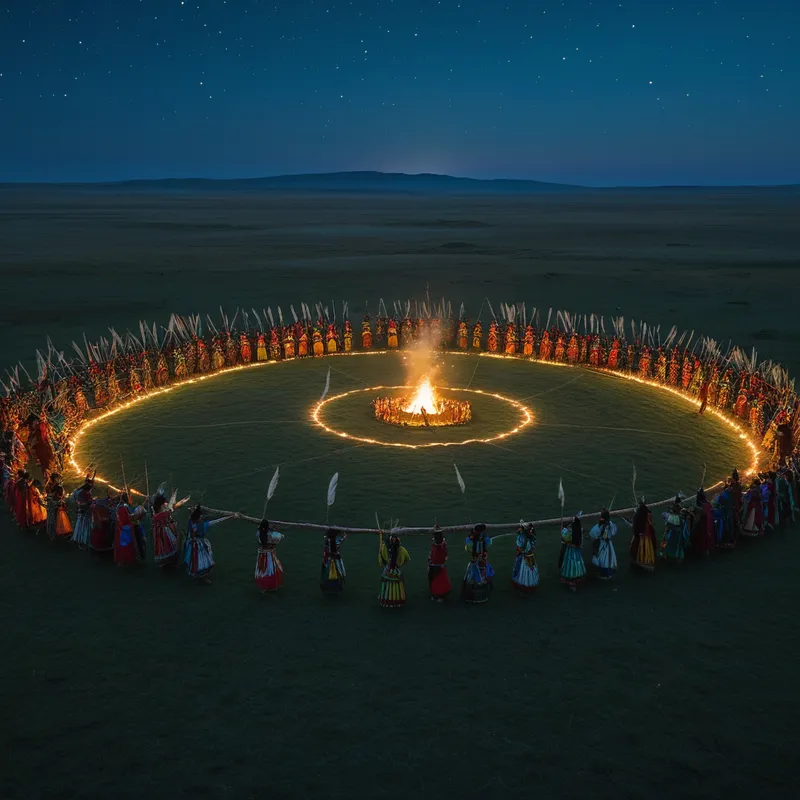
Then, from the edges of memory, they come. Not one, not a few, but a circle of them. The Dancers. They wear the stories of their people: eagle feathers that yearn for the sky, beads that hold the colors of sunset and forest, jingles that are the laughter of rain. Their faces are set not in joy, but in profound resolve. They gather in the great circle where the grass has turned to dust.
There is no drum. No singer to guide them. Only the terrible silence. The lead dancer, a figure whose regalia tells of thunder and endurance, lifts a foot. He brings it down. Thud. A sound not of music, but of a body falling. The earth does not answer. Again. Thud. A second dancer joins, then a third. Their steps are not yet a rhythm, but a stubborn, desperate percussion against the void. They dance not with joy, but against the silence. The dust they kick up is the color of ash.
For a day and a night they dance, their bodies becoming a prayer of motion. Their breath rasps; their muscles scream. The silence pushes back, a physical force. Some falter, their strength spent, and are gently carried from the circle. Their sacrifice becomes part of the dance. The remaining dancers, moving as one soul now, find a pulse not outside, but within. The rhythm emerges from the memory in their blood, from the echo of the lost heartbeat in their own chests. Boom-da… Boom-da… Boom-da…
As the new sun stains the horizon, their synchronized feet strike the earth in perfect time. And on the hundredth, the thousandth, the uncountable strike—the earth answers. A deep, resonant BOOM shudders up from the world’s core, a single, mighty beat that rolls across the plains. The dancers do not stop. They have become the drumstick, and the land the drumhead.
With each stomp now, the answering beat grows stronger, clearer. Where their feet fall, green shoots uncurl from the dust. The dry riverbeds gurgle with the memory of water. The people, watching from the edge of despair, feel a forgotten vibration in their own breasts. The dancers are no longer just men and women; they are conduits. Their dance stitches the torn fabric of the world back together, thread by rhythmic thread. They dance until the heartbeat is steady, until the connection is forged anew, and only then, as the sun sits high, does the last dancer slow, and stop, and smile—a weary, world-making smile. The silence is gone. In its place is the enduring song of a world remembered, its pulse now safe in the feet and hearts of all who witnessed the dance.

Cultural Origins & Context
The narrative of dancers restoring the world’s balance is a profound archetype found across many Native American traditions, though not tied to a single, monolithic “Powwow Dancer” myth. The modern powwow is a vibrant, intertribal gathering of song, dance, and social fellowship, its roots deep in older, ceremonial dances specific to individual nations. Stories of dance as a sacred, world-sustaining act belong to this ceremonial realm.
These narratives were traditionally held and transmitted by oral historians, elders, and ceremonial leaders. They were not mere entertainment but functional cosmology. Told in specific contexts—perhaps before a major ceremonial dance or during teachings about responsibility—the story served as a living map of reality. It taught that order is not a given; it is a practice. The community’s rhythmic participation in ceremony through dance was understood as an active act of co-creation with the cosmos, a necessary duty to maintain harmony, bring rain, ensure harvest, or heal the sick. The dancers in the myth model the ultimate responsibility: to give of one’s own physical essence—one’s breath, sweat, and stamina—to fuel the heartbeat of existence itself.
Symbolic Architecture
At its core, this myth is about the power of intentional, rhythmic action to repair a broken connection. The silent world represents a state of psychic and spiritual disconnection, a depression of the life force where meaning has drained away.
The dance is not an expression of a pre-existing rhythm; it is the stubborn, creative act that births the rhythm from the void of its absence.
The Drum is the symbol of the primal pulse, the animating principle of life and unity. Its silence is the ultimate crisis. The Dancers themselves symbolize the embodied will. They do not pray for intervention; they become the intervention through their disciplined, collective movement. Their regalia is not costume but ensouled symbolism—each feather, bead, and bell a tangible connection to the animal, mineral, and elemental powers they are invoking and aligning with.
The initial, awkward, exhausting steps represent the hardest phase of any transformative endeavor: acting without external validation, creating momentum from a standstill. The faltering dancers embody necessary sacrifice; their energy is not wasted but added to the collective pot. The final, unified rhythm that awakens the earth illustrates a profound psychological truth: when the individual will aligns with a deeper, archetypal pattern (the world-heartbeat), personal action gains transcendent, world-renewing power.
The Dreamer’s Resonance
To dream of such dancing in a modern context often signals a profound somatic and psychological process. The dreamer may find themselves in a vast, empty space, compelled to move or stomp, feeling a desperate need to “wake something up.” This is not a dream of graceful performance, but of urgent, sometimes clumsy, activation.
Somatically, this can correlate with a felt sense of stagnation, of being “out of rhythm” with one’s own life. The body in the dream is trying to reconnect to its own innate, biological cadence—the heartbeat, the breath—which has been overridden by the arrhythmic demands of modern stress. Psychologically, the dream points to a deep-seated need to repair a severed connection: perhaps to the body itself, to a sense of purpose, to community, or to a lost sense of the sacred. The exhausting effort in the dream mirrors the real psychic work of initiating change from a place of inertia or depression. The dream is the unconscious insisting, through the metaphor of the dance, that the dreamer must move to feel alive again, to re-establish the pulse of their own existence.

Alchemical Translation
For the modern individual navigating the path of individuation, this myth is a masterful model of psychic transmutation. The “silent world” is the inner landscape of the fragmented self, where the ego is disconnected from the animating pulse of the Self. The crisis is one of meaning and vitality.
The alchemical work begins with the first, lonely, exhausting stomp into the dust of one’s own neglected psyche. This is the commitment to therapy, to journaling, to any practice that feels fruitless at first. The “regalia” one must don is the authentic identity—the values, talents, and truths we have neglected to “wear.” The sacrifice of the faltering dancers represents the necessary surrenders on this path: old defenses, comforting illusions, and outdated self-concepts whose energy must be relinquished to fuel the deeper work.
The moment the earth’s drum answers is the moment of inner alignment, when conscious effort finally synchronizes with the autonomous, guiding rhythm of the unconscious Self.
The sustained, unified dance that follows is the lifelong practice of integration. It is the daily, rhythmic effort of honoring one’s truth, tending one’s relationships, and engaging with the world from a place of reconnected vitality. One does not simply find their purpose or rhythm; they dance it into being through consistent, embodied action. The myth ultimately teaches that we are not just inhabitants of the world, but its active drummers and dancers. Our conscious, willful participation is the very force that sustains the harmony of our inner and outer universes.
Associated Symbols
Explore related symbols from the CaleaDream lexicon: