Poutini and Waitaiki Myth Meaning & Symbolism
A taniwha's obsessive love for a woman transforms her into the first pounamu, embedding her spirit in the sacred stone of Aotearoa.
The Tale of Poutini and Waitaiki
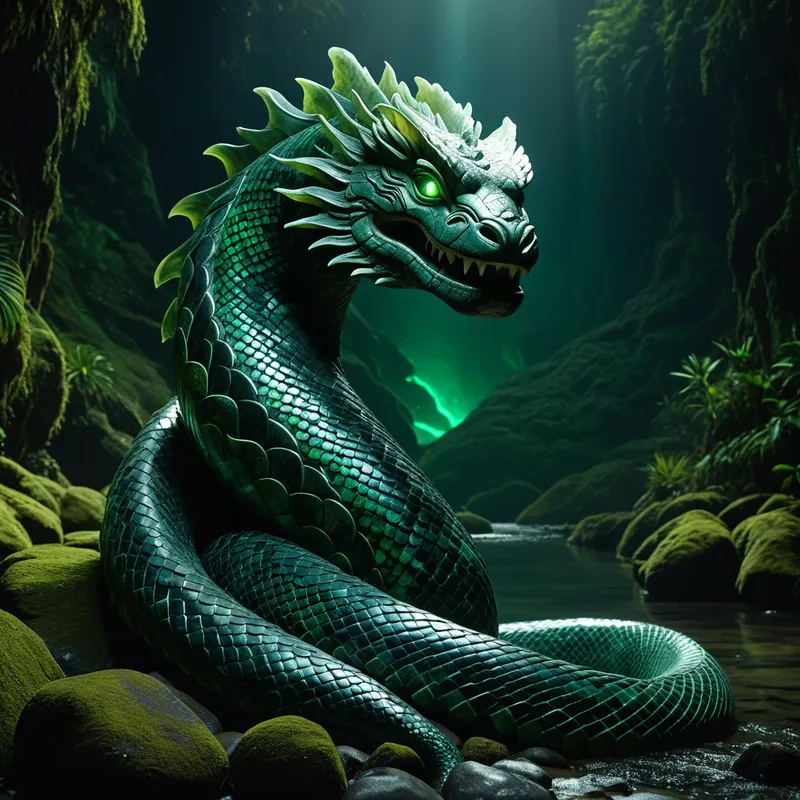
Listen. The story begins in the deep, cold currents of the ocean, where the guardian spirits of the deep hold their secrets. There lived Poutini, a mighty [taniwha](/myths/taniwha “Myth from Maori culture.”/). He was not a beast of mindless hunger, but a being of profound and possessive longing. His scales were the colour of deep water and dark stone, and his eyes held the cold fire of the abyss.
From his realm, he saw her: Waitaiki. She walked the shores of Tūhua (Mayor Island), a vision of life and warmth, her laughter a sound alien to his silent world. In that moment, a fire ignited in Poutini’s cold heart—a fire not of warmth, but of consuming desire. He could not speak to her of love; he could only act. With a surge of power that churned the sea, he took her. He seized Waitaiki from her world of sun and sand and carried her into the depths.
Her husband, the valiant Tama-ahua, felt the rupture in his soul. He gathered his people, his warriors, and set out in pursuit. Their waka cut through the waves, a spear of human will against the elemental theft. And so began the great chase, a saga written in the very geography of Aotearoa.
Poutini, with his precious, trembling captive, fled. He was a thief in love, forever looking over his shoulder. He rested with Waitaiki at Whangapoua, but the sound of pursuing paddles drove him on. To Moehau, to Te Wai Pounamu—the waters of greenstone. Every place they touched, he left a trace of his essence, a signature of his passage and his prize. Waitaiki, far from her home, wept. Her tears were not water, but the essence of her spirit, leaching into the cold riverbeds.
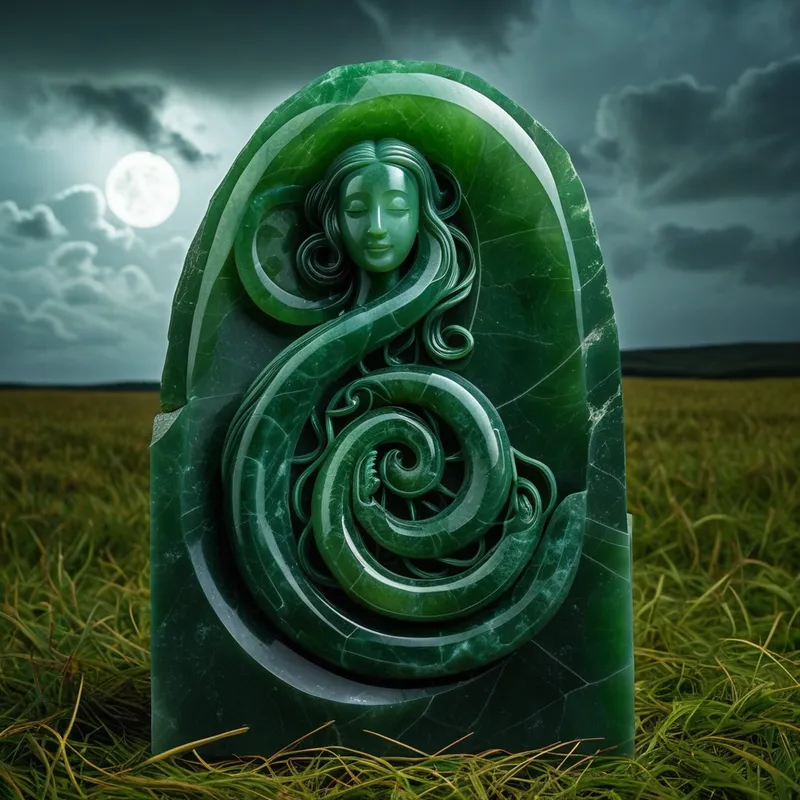
Finally, exhausted by the relentless pursuit, cornered in the cold rivers of the Arahura, Poutini faced a terrible choice. He could not keep her in life, for the world of men would never cease their chase. In a final, devastating act of possessive love, he transformed her. He turned the very body of Waitaiki into the substance of his own being—stone. Her flesh, her spirit, her captured beauty, he transmuted into the first and most sacred vein of pounamu.
When Tama-ahua and his people arrived, they found not a wife, but a treasure. The woman was gone, her essence forever fused with the land. In his grief, Tama-ahua took pieces of this new stone, and from them fashioned mere (clubs) and tokī (adzes)—tools and weapons of immense mana. Waitaiki was not lost; she was made eternal, but at the cost of her human form. Poutini, his love forever solidified, remained her eternal guardian in the deep pools and river currents, a watchful, sorrowful shadow bound to the stone that was his heart’s desire.

Cultural Origins & Context
This myth originates from the Māori tribes of the Te Waipounamu region, particularly those with ancestral connections to the Arahura River. It is a pūrākau that serves as an origin story for pounamu, New Zealand’s precious greenstone. Passed down orally through generations by tohunga and storytellers, its function was multifaceted. It explained the sacred nature and geographic distribution of the stone, embedding its value not in mere economics, but in a dramatic, spiritual narrative. It taught about the consequences of taking what is not freely given (mana and tika), and it illustrated a profound connection between the people, their treasured resource, and the spiritual landscape (whakapapa). The myth was not mere entertainment; it was a foundational text that encoded ecological knowledge, spiritual law, and tribal identity into a memorable and powerful story.
Symbolic Architecture
At its [heart](/symbols/heart “Symbol: The heart symbolizes love, emotion, and the core of one’s existence, representing deep connections with others and self.”/), this is a myth of impossible love and alchemical transformation. Poutini represents the archetypal force of obsessive, possessive desire—a love that cannot exist in the light of day, a [passion](/symbols/passion “Symbol: Intense emotional or physical desire, often linked to love, creativity, or purpose. Represents life force and deep engagement.”/) that belongs to the shadowy, [unconscious depths](/symbols/unconscious-depths “Symbol: The hidden, primordial layers of the psyche containing repressed memories, instincts, archetypes, and collective wisdom beyond conscious awareness.”/). He is the ultimate outsider, whose love is an act of capture. Waitaiki symbolizes pure [life](/symbols/life “Symbol: The symbol of ‘Life’ represents a journey of growth, interconnectedness, and existential meaning, encompassing both the joys and challenges that define human experience.”/), [beauty](/symbols/beauty “Symbol: This symbol embodies aesthetics, harmony, and the appreciation of life’s finer qualities.”/), and [connection](/symbols/connection “Symbol: Connection symbolizes relationships, communication, and bonds among individuals.”/) to the [human](/symbols/human “Symbol: The symbol of a human represents individuality, complexity of emotions, and social relationships.”/) [community](/symbols/community “Symbol: Community in dreams symbolizes connection, support, and the need for belonging.”/). Her transformation is the central [mystery](/symbols/mystery “Symbol: An enigmatic, unresolved element that invites curiosity and exploration, often representing the unknown or hidden aspects of existence.”/).
The greatest treasures are often born from a union of love and loss, where spirit is sacrificed to become substance, and desire is frozen into eternal form.
The [chase](/symbols/chase “Symbol: Dreaming of a chase often symbolizes avoidance of anxiety or confrontation, manifesting as fleeing from something threatening or overwhelming in one’s waking life.”/) signifies the inevitable conflict between the unconscious, possessive [impulse](/symbols/impulse “Symbol: A sudden, powerful urge or drive that arises without conscious deliberation, often linked to primal instincts or emotional surges.”/) and the conscious, [social order](/symbols/social-order “Symbol: Dreams of social order reflect subconscious processing of hierarchy, belonging, and one’s place within collective structures.”/) (represented by Tama-ahua). The [resolution](/symbols/resolution “Symbol: In arts and music, resolution refers to the movement from dissonance to consonance, creating a sense of completion, release, or finality in a composition.”/) is not victory for either side, but a profound [transmutation](/symbols/transmutation “Symbol: A profound, alchemical process of fundamental change where one substance or state transforms into another, often representing spiritual evolution or personal metamorphosis.”/). Waitaiki’s [spirit](/symbols/spirit “Symbol: Spirit symbolizes the essence of life, vitality, and the spiritual journey of the individual.”/) does not die; it undergoes a katabasis—a descent and transformation into a new, enduring state. She becomes pounamu: beauty made permanent, spirit made tangible, a gift born of a [crime](/symbols/crime “Symbol: Crime in dreams often symbolizes guilt, inner conflict, or societal rules that are being challenged or broken.”/). The [stone](/symbols/stone “Symbol: In dreams, a stone often symbolizes strength, stability, and permanence, but it may also represent emotional burdens or obstacles that need to be acknowledged and processed.”/) itself becomes a [symbol](/symbols/symbol “Symbol: A symbol can represent an idea, concept, or belief, serving as a powerful tool for communication and understanding.”/) of this [paradox](/symbols/paradox “Symbol: A contradictory yet true concept that challenges logic and perception, often representing unresolved tensions or profound truths.”/): it is a [treasure](/symbols/treasure “Symbol: A hidden or valuable object representing spiritual wealth, inner potential, or divine reward.”/) of immense [mana](/symbols/mana “Symbol: A spiritual energy or life force in Polynesian cultures, now widely adopted in gaming as a resource for magical abilities.”/), used for tools, weapons, and ornaments, yet its [origin](/symbols/origin “Symbol: The starting point of a journey, often representing one’s roots, source, or initial state before transformation.”/) is a [story](/symbols/story “Symbol: The symbol of ‘Story’ represents the narrative woven through our lives, embodying experiences, lessons, and emotions that shape our identities.”/) of [grief](/symbols/grief “Symbol: A profound emotional response to loss, often manifesting as deep sorrow, yearning, and a sense of emptiness.”/) and irrevocable change.
The Dreamer’s Resonance
When this myth pattern stirs in the modern psyche, it often manifests in dreams of being pursued or of pursuing something with single-minded intensity. One might dream of a cherished person or object turning to stone, crystal, or ice—beautiful but inaccessible. This reflects a somatic process where a vibrant part of the dreamer’s own psyche (an anima or life-force) has been “captured” by an unconscious, possessive complex (the shadow taniwha).
The dreamer may feel a profound, melancholic longing for something they can sense but not fully integrate. The transformation of Waitaiki into stone symbolizes a defense mechanism: to avoid the pain of loss or the complexity of relationship, a living emotional potential becomes “frozen” or crystallized into a rigid pattern, a treasured but static memory, or an idealized image that cannot interact with life. The dream is signaling a need to thaw this frozen treasure, to grieve the loss of its original form, and to learn how to wield the solidified strength it now represents.
Alchemical Translation
The individuation process modeled here is the transformation of a possessive, shadow-driven complex into a source of sacred value. Poutini’s obsessive love is the prima materia—the base, chaotic, and problematic starting point of the psyche. The long chase is the necessary stage of separatio and mortificatio, where the conscious mind (Tama-ahua) confronts and pressures the unconscious shadow, forcing a crisis.
The psyche’s most painful conflicts are its crucibles; what is stolen from life is often returned to the soul as its cornerstone.
The climax is not the destruction of the shadow, but its coniunctio (sacred marriage) with the captured anima in a wholly new form. Waitaiki’s spirit, fused with Poutini’s elemental nature, becomes pounamu. Psychologically, this is the moment when a painful obsession or a deep wound, through the heat of conscious attention and the waters of grief, is transmuted into a core strength, a “touchstone” of the personality. The modern individual undergoing this process must first recognize the “taniwha” of possession within—be it an addictive pattern, a frozen grief, or an idealized love. They must then pursue it with the steadfastness of Tama-ahua, not to slay it, but to force its final, transformative act. The outcome is the creation of one’s own inner taonga: a part of the self that was once a source of conflict now becomes a durable, sacred resource for crafting one’s life, a stone of wisdom born from the river of tears.
Associated Symbols
Explore related symbols from the CaleaDream lexicon:
- Water — The domain of Poutini and the medium of the chase, representing the unconscious, emotion, and the flow of life from which transformative treasures emerge.
- Stone — The final form of Waitaiki as pounamu, symbolizing permanence, endurance, the solidified spirit, and a treasure born of profound transformation.
- Journey — The epic pursuit by Tama-ahua, representing the conscious effort required to confront a deep loss or a possessive complex within the psyche.
- Grief — The emotional core of the myth, felt by Waitaiki, Tama-ahua, and even Poutini, as the necessary catalyst for alchemical change and the creation of something sacred.
- Transformation — The central miracle of the story, where a living being is changed into an eternal substance, modeling the psyche’s capacity for radical, enduring change.
- Love — The driving force, depicted here in its shadow aspect as possessive obsession, which ultimately becomes the fire that forges a lasting treasure.
- Spirit — The essence of Waitaiki that infuses the pounamu, representing the immortal part of the self that can survive even the most radical changes in form.
- Guardian — The role of Poutini after the transformation, a complex figure who is both the thief and the eternal protector of the treasure he created.
- Sacrifice — Waitaiki’s loss of her human form, a voluntary or involuntary offering that results in the birth of a resource of immense value to her people.
- River — The specific location (Arahura) of the final transformation, symbolizing the boundary between states, the flow of time, and the place where treasures are washed up from the depths.