Potter's Vessel Myth Meaning & Symbolism
A prophet watches a potter reshape a flawed vessel, revealing a divine metaphor for the soul's potential for destruction and glorious, purposeful re-creation.
The Tale of Potter’s Vessel
Hear now a word that came not with thunder from the mountain, but with the quiet, turning whisper of a wheel in the dust.
In the days when kings wore crowns of pride and the people’s hearts had grown hard as the stones in the field, [the word](/myths/the-word “Myth from Biblical culture.”/) of YHWH came to the prophet. It did not send him to [the temple](/myths/the-temple “Myth from Jewish culture.”/) courts or the royal palace. It said, “Arise, and go down to [the potter](/myths/the-potter “Myth from Abrahamic culture.”/)’s house, and there I will cause you to hear my words.”
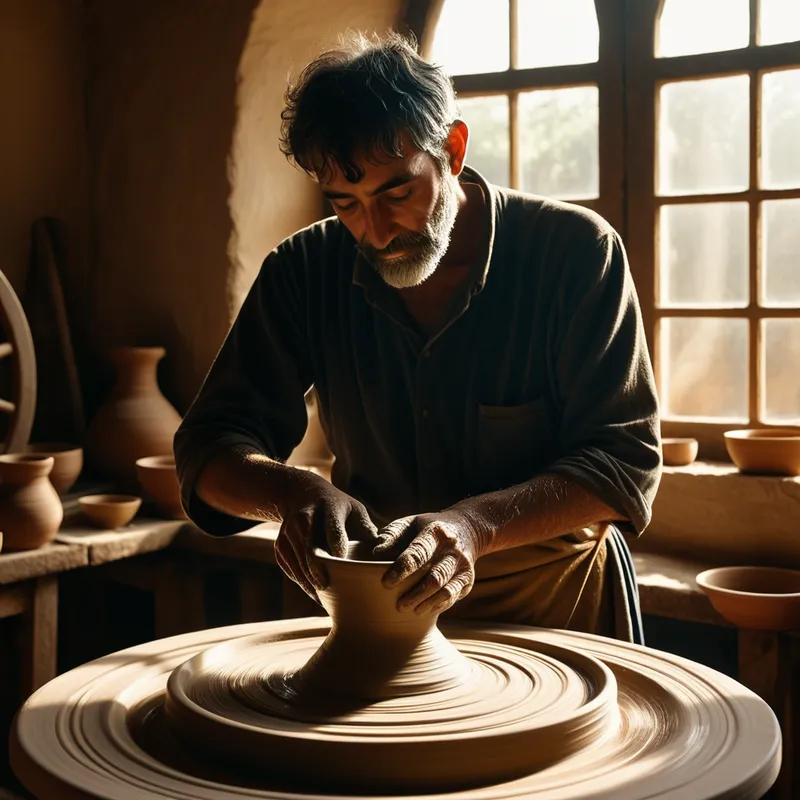
And so he went, his sandals scuffing the dry earth of the lower city, where the air was thick with the smell of damp clay and burning kilns. He entered the dim, cool shelter of the workshop. There, in a shaft of sunlight thick with dancing motes of dust, sat the potter. His back was bent to his work, his arms and tunic smeared with the grey earth of the riverbank. Before him, the wheel spun, a simple disk of wood turned by the steady rhythm of his foot.
Upon the wheel was a vessel. It was being born under his hands. The prophet watched, silent as the clay itself, as the potter coaxed form from the formless. A gentle pressure here, a firm containment there—a rim emerged, then a graceful belly, the curve of a shoulder. It was becoming a jar for oil, or wine, or grain—a [thing](/myths/thing “Myth from Norse culture.”/) of purpose and beauty.
But as it rose, a flaw revealed itself. Perhaps a pebble, hidden deep within the clay, resisted the shaping. Perhaps the consistency was not uniform. [The vessel](/myths/the-vessel “Myth from Alchemical culture.”/) marred. It wobbled, its symmetry broken, its wall growing thin and weak in the potter’s hand.
The prophet held his breath. This was the moment. This was the word.
The potter did not sigh in frustration. He did not cast the flawed work aside. His hands, which had been lifting, now pressed down. With a decisive, yet not violent, motion, he collapsed the vessel. The beautiful curves folded inward, the rim melted away. In an instant, the jar was no more. It was again a lump—a spinning, yielding mass of clay, obedient and full of potential.
And then, without pause, the potter began again. The same clay. The same hands. The same wheel. But a new intention. He reshaped it, working the flaw into the whole, until it became another vessel, as it seemed good to the potter to make.
The prophet stood in the dusty silence, the only sounds the whir of the wheel, the soft slap of wet clay, and the beating of his own heart. He had seen the entire arc of existence: the calling into form, the flaw, the unmaking, and the patient, sovereign re-creation. He needed no scroll, no lecture. The word was written in mud and motion. He turned and walked back into the glare of the sun, the parable burning in his spirit, ready to be spoken to a nation that had become marred in the hand of its Maker.
Cultural Origins & Context
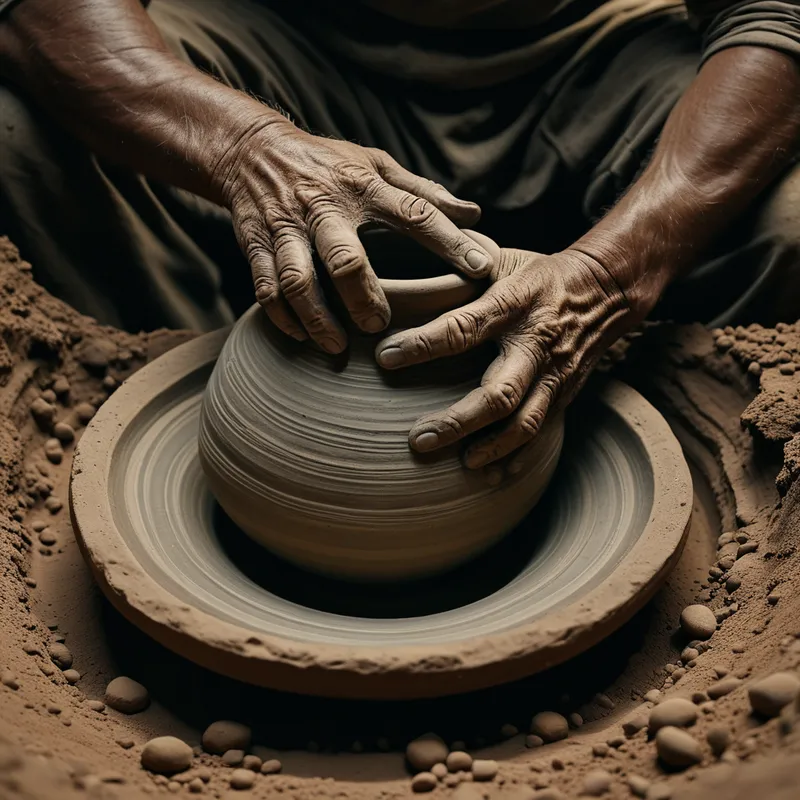
This potent metaphor is delivered in the Book of Jeremiah, chapter 18. Jeremiah’s prophetic ministry (c. 626–586 BCE) unfolded during the death throes of the Kingdom of Judah. He witnessed rampant social injustice, hollow religious ritual, and catastrophic political maneuvering as the kingdom vacillated between rebellion against and submission to the Babylonian empire.
The prophet’s audience was a people clinging to a theology of privileged, unconditional election—the belief that YHWH would never allow His city, [Jerusalem](/myths/jerusalem “Myth from Biblical culture.”/), and His temple to fall, no matter their conduct. Jeremiah’s task was to shatter this dangerous illusion. He did not invent new stories; he anchored his divine warnings in the tangible, everyday reality of his listeners. The potter’s workshop was a common sight, a universally understood symbol of skilled creation. By rooting his message here, Jeremiah bypassed intellectual debate and appealed directly to the communal imagination.
The myth’s function was twofold: to indict and to offer hope. It was a spoken, performative parable, likely repeated in public squares and at city gates. It served as a societal mirror, reflecting back to Judah its own flawed state—the hidden “pebble” of idolatry and injustice that was warping its national form. Yet, within the same image lay the terrifying and merciful possibility of being unmade and remade. The myth asserted that destiny was not fixed; it was relational, contingent on the material’s response to the hands of the Creator.
Symbolic Architecture
At its core, the myth presents a dynamic, non-dualistic [symbol](/symbols/symbol “Symbol: A symbol can represent an idea, concept, or belief, serving as a powerful tool for communication and understanding.”/) of the [relationship](/symbols/relationship “Symbol: A representation of connections we have with others in our lives, often reflecting our emotional state.”/) between sovereignty and plasticity, between the divine will and the [human](/symbols/human “Symbol: The symbol of a human represents individuality, complexity of emotions, and social relationships.”/) [condition](/symbols/condition “Symbol: Condition reflects the state of being, often focusing on physical, emotional, or situational aspects of life.”/).
The vessel is not its own potter, yet the clay is not inert. It must yield to be shaped, yet it contains within it the seeds of its own marring.
The Potter represents the archetypal [Creator](/symbols/creator “Symbol: A figure representing ultimate origin, divine power, or profound authorship. Often embodies the source of existence, innovation, or personal destiny.”/), but specifically as the Sovereign Shaper. This is not a detached clockmaker god, but an intimately engaged artisan whose will and aesthetic are expressed through direct, tactile [interaction](/symbols/interaction “Symbol: Interaction in dreams symbolizes communication, relationships, and connections with others, reflecting the dynamics of personal engagement and social settings.”/). The Wheel symbolizes the turning of circumstances, time, and [destiny](/symbols/destiny “Symbol: A predetermined course of events or ultimate purpose, often linked to spiritual forces or cosmic order, representing life’s inherent direction.”/)—the context in which formation occurs. The [Clay](/symbols/clay “Symbol: Clay symbolizes malleability, creativity, and the potential for transformation, representing the foundational aspect of life and the ability to shape one’s destiny.”/) is the human individual, the [community](/symbols/community “Symbol: Community in dreams symbolizes connection, support, and the need for belonging.”/), or the [soul](/symbols/soul “Symbol: The soul represents the essence of a person, encompassing their spirit, identity, and connection to the universe.”/) itself—possessing innate potential but no inherent, final form.
The pivotal symbol is the Flaw. It is not evil in a cosmic sense, but a fatal [resistance](/symbols/resistance “Symbol: An object or tool representing opposition, struggle, or the act of pushing back against external forces or internal changes.”/) to the shaping [intention](/symbols/intention “Symbol: Intention represents the clarity of purpose and direction in one’s life and can symbolize motivation and commitment within a dream context.”/). It is the hardened [heart](/symbols/heart “Symbol: The heart symbolizes love, emotion, and the core of one’s existence, representing deep connections with others and self.”/), the unyielding pride, the hidden impurity that prevents the [vessel](/symbols/vessel “Symbol: A container or structure that holds, transports, or protects something essential, representing the self, emotions, or life journey.”/) from fulfilling its [purpose](/symbols/purpose “Symbol: Purpose signifies direction, meaning, and intention in life, often reflecting personal ambitions and core values.”/). The myth’s radical psychological [truth](/symbols/truth “Symbol: Truth represents authenticity, honesty, and the quest for knowledge beyond mere appearances.”/) is in the Collapse. This is not annihilation, but a return to potentiality. It is the necessary de-structuring of a dysfunctional ego or a corrupt society so that a new, more integral form can emerge.
The most profound hope is not in avoiding the collapse, but in the character of the hands that perform it. The same hands that shape are the hands that crush, and the same hands that crush are the hands that re-shape.
The Dreamer’s Resonance
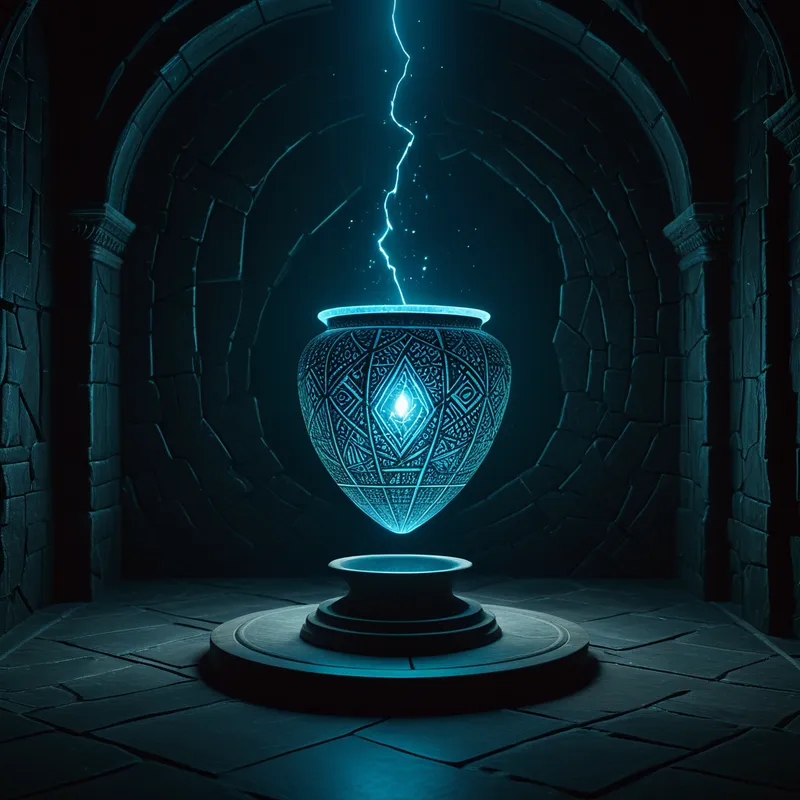
When this myth stirs in the modern unconscious, it often manifests in dreams of profound structural change and yielding. One might dream of their childhood home being gently dismantled brick by brick, or of their own body being molded like soft wax by unseen forces. There is a frequent somatic component—a feeling of being pressed, of boundaries dissolving, or of a deep, central weakness (the “flaw”) that threatens to give way.
Psychologically, this signals a process of ego-relativization. The conscious personality structure (the current “vessel”) has served its purpose but has now developed a fatal rigidity or compromise. The pebble of a repressed complex, an outgrown identity, or an unaddressed trauma is causing a wobble in one’s life. The dream is not a nightmare of destruction, but an initiation into surrender. The [psyche](/myths/psyche “Myth from Greek culture.”/) is presenting the image of the Potter to assure the dreamer that the forces working upon them—often felt as life crises, depression, or sudden loss—are not random, but are part of a reshaping intelligence. The anxiety comes from clinging to the old, marred form, fearing the formless clay stage. The healing is in dreaming the trust to spin upon the wheel.
Alchemical Translation
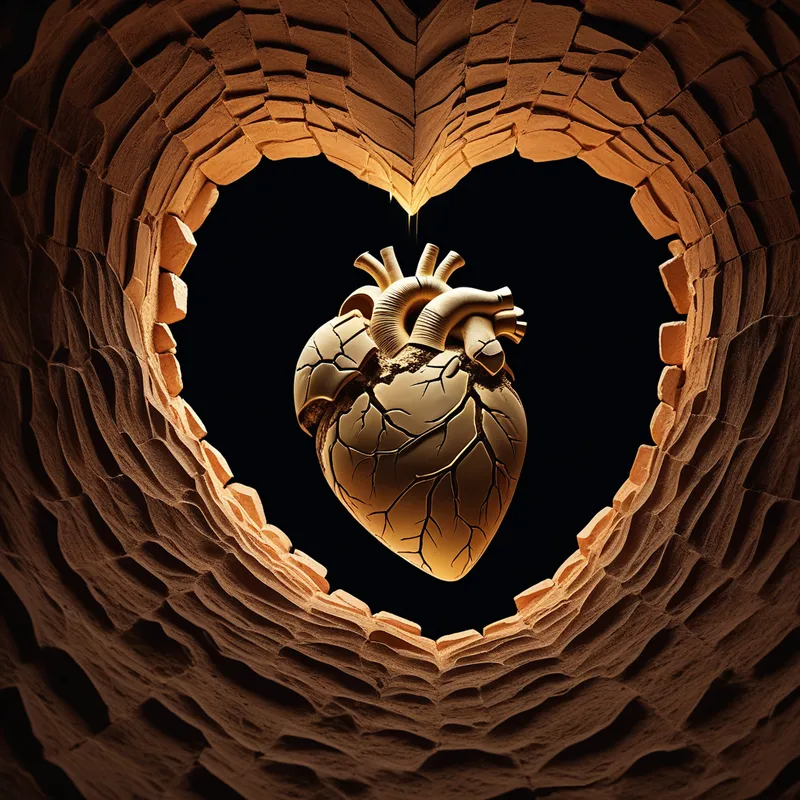
In the alchemy of individuation, the myth of the Potter’s Vessel maps perfectly onto the stage of [Nigredo](/myths/nigredo “Myth from Alchemical culture.”/) and Albedo. The conscious personality’s initial project (the first vessel) is the [prima materia](/myths/prima-materia “Myth from Alchemical culture.”/)—the raw stuff of the psyche that must be dissolved.
The “flaw” is the necessary shadow content that [the ego](/myths/the-ego “Myth from Jungian culture.”/) has tried to build over or ignore. Individuation cannot proceed until this flaw is acknowledged; it is, paradoxically, the key to transformation. The “collapse” is the experience of [the nigredo](/myths/the-nigredo “Myth from Alchemical culture.”/)—the dark night, the depression, the feeling of being reduced to base matter, where all previous structures and identities fail.
The alchemical vessel is not what is being shaped, but the container of the process itself—the trust in the transformative ordeal.
Here, the modern individual must become both clay and, in a sense, the inner witness of the Potter. The “wheel” is the relentless process of life and reflection. The [triumph](/myths/triumph “Myth from Roman culture.”/) is not in maintaining a perfect form, but in developing the plasticity to be unmade. The new vessel that emerges from the albedo is not a flawless, static ideal, but a more conscious, integrated form that incorporates the lesson of the flaw. It is a vessel that knows it is clay, and in that knowing, finds its true strength and purpose. The goal is not to avoid the potter’s hands, but to learn the art of spinning, to yield to the intelligence of the shaping, and to understand that every ending is merely the prelude to a new and more fitting beginning.
Associated Symbols
Explore related symbols from the CaleaDream lexicon: