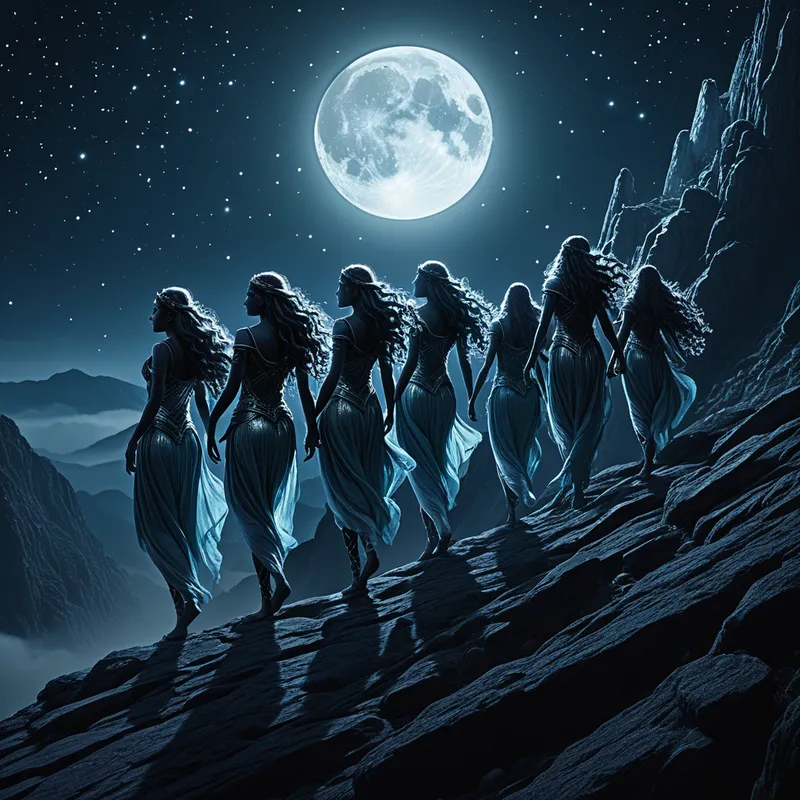
Pleiades Myth Meaning & Symbolism
Seven divine sisters, pursued by a hunter, are transformed into a star cluster by Zeus, becoming an eternal constellation of grief, refuge, and celestial memory.
The Tale of Pleiades
Hear now a tale written not on parchment, but across the vault of night itself. It begins not with a birth, but with a burden—the unbearable weight of a beauty that draws the eye of gods and monsters alike.
There were seven sisters, daughters of the ancient Titan Atlas, who holds the sky upon his weary shoulders, and the Oceanid Pleione, whose name means “to sail.” They were the Pleiades: Maia, the eldest, quiet and wise; Electra, shining with amber fire; Taygete, the long-necked runner; Alcyone, the queen who halts the sea’s fury; Celaeno, the dark one; Sterope, the lightning-flash; and Merope, whose gaze was turned downward in a mortal shame. They moved through the forested slopes of Mount Helicon or the wilds of Arcadia like shafts of moonlight given form, their laughter the sound of clear springs.
But the hunter saw them. Orion, a colossus of bronze and ambition, his heart a furnace of desire. For five, some say seven, long years, he pursued them across the world, his footfalls shaking the earth, his shadow blotting out the sun. The sisters fled, their breath coming in ragged gasps, the green world a blur of terror. They ran until their feet were raw, until the very air seemed to thicken with his presence. They could smell the leather of his quiver, hear the rustle of the pelt upon his back.
In their final, desperate hour, as Orion’s hand seemed to stretch across the horizon to grasp them, they cried out. Not to their father, bowed under the celestial sphere, but to the king of gods himself. They raised their arms, their voices a single, piercing note of purest despair that split the sky. And Zeus heard.
His compassion was not gentle, but absolute. In the space between one heartbeat and the next, as Orion closed in, the world dissolved. The sisters felt not pain, but a sudden, shocking coolness. Their flesh became light; their terror, a fixed and brilliant point. Their flowing hair streamed into tails of cosmic dust, their intertwined arms became beams of connected radiance. He transfigured them, lifting them from the grasping earth into the infinite dark, placing them among the fixed and eternal lights. There, as the cluster we call Pleiades, they found their only possible refuge: to become forever pursued, yet forever out of reach, a glittering knot of sisterhood in the shoulder of the Taurus.
And the hunter? He too was set among the stars, doomed to circle the heavens for all time, chasing a prize he can never hold, a perpetual monument to insatiable desire.

Cultural Origins & Context
The story of the Pleiades is far older than the written word, a seed of narrative carried in the oral traditions of prehistoric Greek peoples. Its primary function was not mere entertainment, but a celestial almanac and a social anchor. The heliacal rising (dawn appearance) and setting of the Pleiades marked critical turning points in the Mediterranean year—the beginning of the sailing season in spring and the start of the harvest and autumn storms in fall. Hesiod, in his Works and Days, a farmer’s practical guide, instructs: “When the Pleiades, daughters of Atlas, are rising, begin your harvest; when they are setting, begin your ploughing.”
Thus, the myth was told by farmers watching the sky, by sailors navigating by starlight, and by poets like Homer and Hesiod who formalized these scattered threads. It served as a mnemonic for the calendar, embedding practical knowledge within a memorable, emotionally resonant family drama. The sisters’ flight and fixation mirrored the cyclical disappearance and reappearance of the cluster itself. Their story transformed the impersonal mechanics of astronomy into a divine, familial saga, making the cosmos intimately knowable and narratively coherent.
Symbolic Architecture
At its core, the Pleiades myth is a profound allegory of trauma, refuge, and the paradoxical nature of salvation. The sisters represent a pristine, collective feminine unity—perhaps an aspect of the psyche in its original, undifferentiated state—that is violently confronted by the archetypal force of obsessive, possessive desire (Orion).
To escape annihilation, one must sometimes consent to a metamorphosis that is also a form of burial. The refuge becomes the monument; the escape, an eternal sentence.
Their transformation into stars is not a reward, but a radical solution to an impossible problem. It is the ultimate sublimation: a translation of embodied life into symbolic, eternal form. They are saved, but at the cost of their earthly vitality, becoming distant, cold, and untouchable. This speaks to the psychological process where a part of the self, to survive a overwhelming threat (be it abuse, grief, or existential terror), “disappears” from conscious, feeling life and becomes a fixed, frozen pattern—a constellation of symptoms, a complex, a memory too painful to touch except as a distant, glittering point of reference.
Orion, forever chasing, embodies the relentless, unintegrated drive—the libido or desire that, when unchecked, becomes a monstrous, destructive pursuit. Their eternal celestial dance maps the psyche’s frozen conflicts: the pursuer and the pursued, locked in a static, archetypal tableau.
The Dreamer's Resonance
When the pattern of the Pleiades emerges in modern dreams, it rarely appears as literal stars. It manifests as the feeling of being part of a close-knit group (siblings, friends, a team) that is under severe, persistent pressure from an external, engulfing force. The dreamer may experience:
- Somatic Sense: A feeling of being “chased” or “hunted” in life, leading to chronic anxiety, a stiffening of the body, or a desire to literally make oneself small and invisible.
- Imagery: Seven of anything—lights, birds, figures, windows—often in a cluster. Recurring dreams of seeking refuge in high places or of transformation into something non-corporeal (light, mist, stone).
- Psychological Process: This is the psyche working through a “freeze” or “dissociative” response to trauma. The dream is pointing to a part of the self that felt it had to cease being “human” and alive in order to survive. The Pleiades dream asks: What in me had to turn to stone, or to cold light, to escape being devoured? Where have I placed my vitality out of reach, even from myself?

Alchemical Translation
The alchemical journey for the individual who resonates with this myth is not about defeating Orion, but about thawing the frozen sisters. The goal of individuation here is a compassionate re-descent.
The first step is recognition: to look up at that cold, beautiful cluster in one’s own psychic sky and acknowledge, “That is a part of me. That frozen light is my own preserved pain.” The second is the painful, gradual work of inviting those star-sisters down from their celestial exile. This means giving warmth to the frozen grief (Merope’s shame, Electra’s lost radiance), allowing the chased nymph to feel her feet on the earth again, even if it is painful.
The alchemical fire is not the forge of the hero, but the gentle, persistent warmth of attention that melts celestial ice back into flowing water.
This process transmutes the eternal, static monument into a flowing, living story. One integrates the memory of the chase (Orion) not as a present threat, but as a past event that shaped, but does not define. The “salvation” of Zeus—the quick fix of dissociation—is undone by the slower, more human salvation of conscious integration. The individual learns that true refuge is not found in eternal, distant perfection, but in the courageous, embodied return to the messy, vulnerable, and beautiful world. The constellation becomes, once more, a sisterhood; the myth, not a fate, but a history one has survived.
Associated Symbols
Explore related symbols from the CaleaDream lexicon: