Plato's Cave Myth Meaning & Symbolism
Prisoners chained in a cave mistake shadows for reality until one is freed, ascending to see the true world and returning with a transformative vision.
The Tale of Plato’s Cave
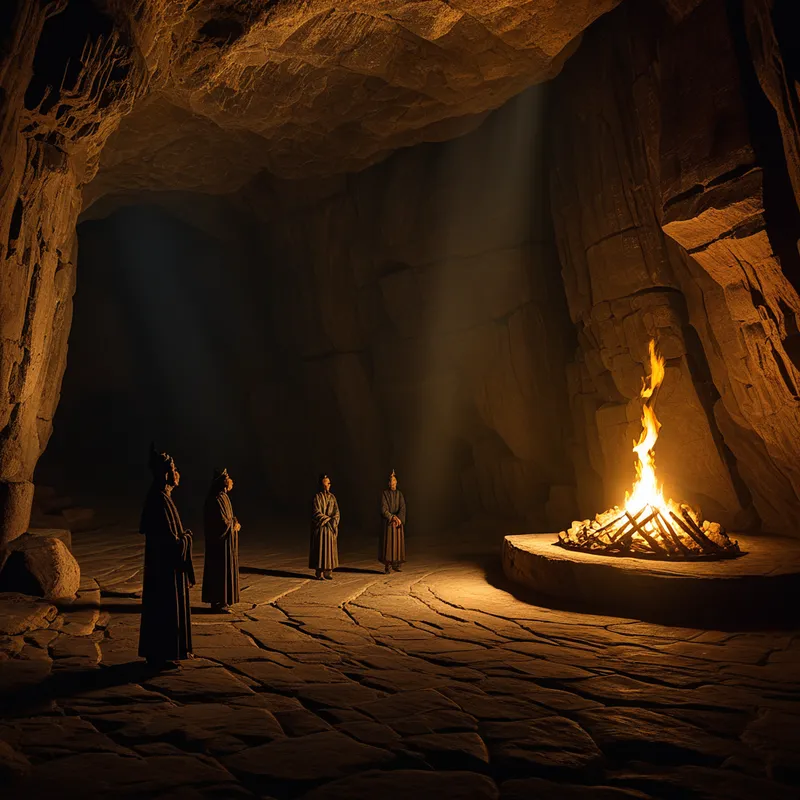
Imagine a deep, subterranean chamber, a womb of stone and damp air. Here, from childhood, a group of people are bound. Not by ropes of hemp, but by chains of iron and habit, fastened at the legs and neck so they cannot turn their heads. They face a blank wall, and behind them, a fire burns on a high ledge. Between this fire and the prisoners runs a low wall, like the screen at a puppet show.
And there are puppeteers. Unseen, they carry before the fire all manner of objects—figures of men and animals, vessels of wood and stone. The firelight casts the shadows of these objects onto the wall the prisoners stare at. The echoes of the puppeteers’ voices bounce off the wall, seeming to come from the shadows themselves.
For these captives, this is the whole of existence. The dance of shadows is reality. They name the shadows, debate their sequences, take pride in predicting which dark shape will follow another. Their world is one of flickering certainty, a consensus built entirely on phantoms.
Then, a rupture. One prisoner is released. The chains are struck off. He is forced to stand, to turn around, to walk towards the fire. The light is agony. His eyes, accustomed only to twilight shades, [water](/myths/water “Myth from Chinese culture.”/) and burn. The objects carried by the puppeteers seem less real than their shadows—blurred, confusing, painful to behold. He stumbles, he resists. He longs for the familiar, comforting wall of shadows.
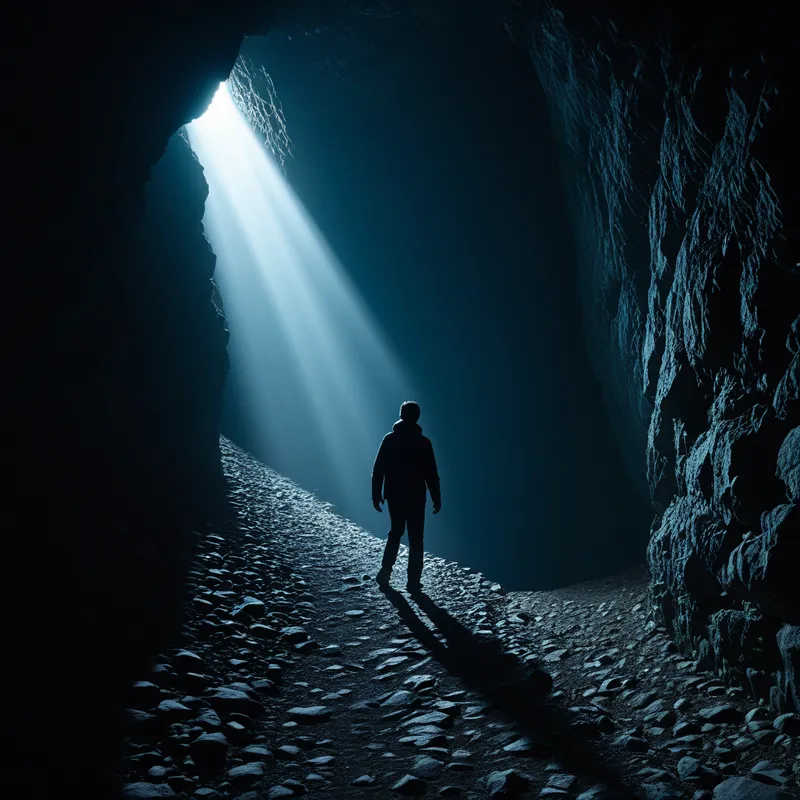
But he is compelled further, dragged up a rough and steep ascent, a passage that leads out of [the cave](/myths/the-cave “Myth from Platonic culture.”/) entirely. He emerges into the open air, into the light of the sun. This is pure torment. He is utterly blinded. He can see nothing at all of the true things around him—the trees, the water, [the sky](/myths/the-sky “Myth from Persian culture.”/). He sees only after-images and pain.
Slowly, painfully, his eyes adjust. First, he looks at shadows again, but now the true shadows of real things cast by the sun. Then he gazes at reflections in water. Finally, he can behold the things themselves: the living world in its vibrant, solid, glorious reality. And last of all, he looks upon the sun itself, not as an image in water, but as it is—the source of all light, the cause of the seasons, the guardian of all that is.
His mind is transformed. He pities his former companions in the cave. Their honors and prizes—for guessing which shadow would come next—seem empty and absurd.
But the story does not end in the light. A duty, a compulsion, draws him back. He descends into the darkness once more. His eyes, now filled with sunlight, are blind in the gloom of the cave. The prisoners, seeing him stumble and struggle to see their “real” shadows, laugh at him. They declare his journey upward ruined his sight, and that it is folly to even try. They resolve that if anyone tried to free them and lead them up, they would seize him and kill him.
Cultural Origins & Context
This is not a myth of gods and heroes in the traditional sense, but a philosophical allegory crafted by the Athenian thinker Plato. It appears in Book VII of his monumental work, [The Republic](/myths/the-republic “Myth from Platonic culture.”/), written around 375 BCE. Plato uses his teacher, [Socrates](/myths/socrates “Myth from Greek culture.”/), as the narrator who presents this “image of our nature in its education and want of education.”
In the context of Greek culture, this was a revolutionary form of storytelling. It moved the locus of meaning from the capricious actions of the Olympian [pantheon](/myths/pantheon “Myth from Roman culture.”/) to the interior journey of the human soul ([psyche](/myths/psyche “Myth from Greek culture.”/)). It was passed down not by bards at a feast, but by students in the Academy, through rigorous dialectic. Its societal function was didactic and transformative: to illustrate the philosopher’s role and the painful process of moving from doxa (opinion/belief) to episteme (true knowledge). It served as a foundational metaphor for Plato’s entire theory of Forms—the idea that the tangible world is but a poor imitation of a higher, perfect, and eternal realm of ideal archetypes.
Symbolic Architecture
The Cave is [the world](/myths/the-world “Myth from Tarot culture.”/) of sensory [appearance](/symbols/appearance “Symbol: Appearance in dreams relates to self-image, perception, and how you present yourself to the world.”/), of conventional [opinion](/symbols/opinion “Symbol: An opinion in a dream symbolizes personal beliefs and thoughts about oneself and the world, often reflecting inner conflicts or uncertainties.”/), and of unconscious identification. We are all born into a particular cave—a [family](/symbols/family “Symbol: The symbol of ‘family’ represents foundational relationships and emotional connections that shape an individual’s identity and personal development.”/), a culture, a set of assumptions—and we mistake its shadows for the limits of [reality](/symbols/reality “Symbol: Reality signifies the state of existence and perception, often reflecting one’s understanding of truth and life experiences.”/).
The chains are not merely physical; they are the ideologies, biases, and unexamined narratives that hold the gaze of the psyche in one fixed direction.
The Fire represents the artificial light of [human](/symbols/human “Symbol: The symbol of a human represents individuality, complexity of emotions, and social relationships.”/)-made culture, the secondary [source](/symbols/source “Symbol: The origin point of something, often representing beginnings, nourishment, or the fundamental cause behind phenomena.”/) that creates the spectacle of shadows. It is the light of the tribe, sufficient for navigating the cave but incapable of revealing [truth](/symbols/truth “Symbol: Truth represents authenticity, honesty, and the quest for knowledge beyond mere appearances.”/). The puppeteers are the shapers of consensus reality—the politicians, poets, advertisers, and even the internalized voices of our ancestors—who cast the images we take for granted.
The painful [Ascent](/symbols/ascent “Symbol: Symbolizes upward movement, progress, spiritual elevation, or striving toward higher goals, often representing personal growth or transcendence.”/) is the arduous [path](/symbols/path “Symbol: The ‘path’ symbolizes a journey, choices, and the direction one’s life is taking, often representing individual growth and exploration.”/) of education (paideia) and philosophy. It is the disorientation that comes with questioning everything you thought you knew. The Sun is the ultimate [symbol](/symbols/symbol “Symbol: A symbol can represent an idea, concept, or belief, serving as a powerful tool for communication and understanding.”/)—the Form of the Good. It is the source of all intelligibility and being. To see it is to comprehend not just facts, but the fundamental principle that makes [knowledge](/symbols/knowledge “Symbol: Knowledge symbolizes learning, understanding, and wisdom, embodying the acquisition of information and enlightenment.”/) and [virtue](/symbols/virtue “Symbol: A moral excellence or quality considered good, often representing inner character, ethical principles, or spiritual ideals in dreams.”/) possible.
The Return is the most psychologically profound and tragic element. It signifies the [philosopher](/symbols/philosopher “Symbol: A seeker of wisdom and truth, representing deep contemplation, questioning reality, and the pursuit of fundamental knowledge about existence.”/)‘s duty, or the enlightened individual’s burden, to re-enter the collective [shadow](/symbols/shadow “Symbol: The ‘shadow’ embodies the unconscious, repressed aspects of the self and often represents fears or hidden emotions.”/)-play. It is a descent into misunderstanding, ridicule, and potential martyrdom—echoing the [fate](/symbols/fate “Symbol: Fate represents the belief in predetermined outcomes, suggesting that some aspects of life are beyond human control.”/) of Socrates himself, who was condemned by Athens for “corrupting the [youth](/symbols/youth “Symbol: Youth symbolizes vitality, potential, and the phase of life associated with growth and exploration.”/).”

The Dreamer’s Resonance
When this myth patterns a modern dream, the dreamer is often at a critical threshold of consciousness. To dream of being chained before a wall of moving shadows speaks to a deep, somatic feeling of being trapped in a life script, a career, or a relationship that feels unreal yet inescapable. There is a claustrophobic quality, a sense that one’s potential is being projected elsewhere.
Dreams of a blinding light, or of struggling up a difficult, dark passage, often accompany periods of intense psychological or spiritual crisis—a “dark night of the soul.” The body may register this as anxiety, vertigo, or a feeling of dissolution. Conversely, to dream of returning to a dark place after being in the light can symbolize the painful reintegration after a transformative experience, the struggle to communicate a new truth to an old part of oneself or to one’s community, often feeling alienated and misunderstood.
Alchemical Translation
The myth of the Cave is a perfect map for the alchemical process of individuation. It begins in the [nigredo](/myths/nigredo “Myth from Alchemical culture.”/)—the blackness of the cave, the state of unconscious identification with the mass. Here, the [prima materia](/myths/prima-materia “Myth from Alchemical culture.”/) (the raw soul) is in its shadow-bound state.
The first alchemical operation is solutio—the dissolving of the old form. This is the breaking of the chains, the painful liquefaction of certainty as one is turned toward the fire.
The ascent is the albedo, the whitening. It is a purification through suffering (mortificatio), a washing in the waters of reflection (literally, in the myth, looking at reflections in water). [The ego](/myths/the-ego “Myth from Jungian culture.”/), attached to [the shadow](/myths/the-shadow “Myth from Jungian culture.”/)-world, must die for a broader consciousness to be born. Seeing the sun is the [rubedo](/myths/rubedo “Myth from Alchemical culture.”/), the reddening or enlightenment—the coniunctio of the soul with [the Self](/myths/the-self “Myth from Jungian culture.”/), the psychic experience of the archetype of meaning.
The return is the final and most crucial stage: the citrinitas or yellowing, often omitted in later alchemy but vital here. It is the making useful of the gold, the [projection](/myths/projection “Myth from Alchemical culture.”/) of the transformed consciousness back into the world. The enlightened one must become the pharmakon—both poison and cure to the stagnant system. This is the ultimate transmutation: not an escape from the world, but the agonizing, necessary task of carrying the light of the sun back into the darkness of the cave, thereby transforming the very meaning of the cave itself. The journey out is for the self; the journey back is for the soul of the world.
Associated Symbols
Explore related symbols from the CaleaDream lexicon: