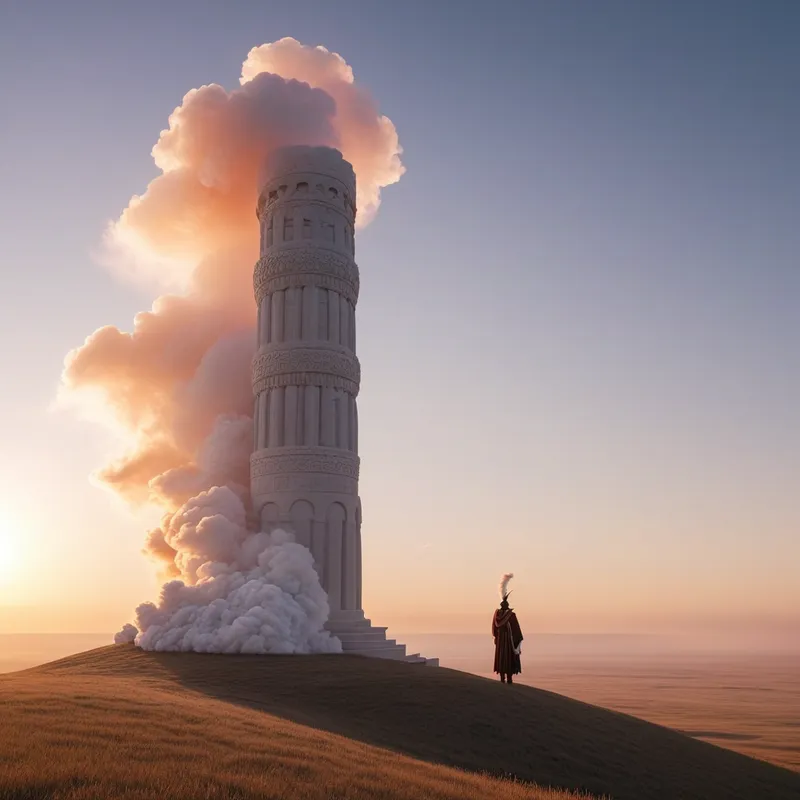
Plains Indian Smoke Signaling Myth Meaning & Symbolism
A myth of a great hunter who learns the language of smoke from the sky spirits, forging a sacred bridge between the human heart and the vast, silent plains.
The Tale of Plains Indian Smoke Signaling
Listen. [The wind](/myths/the-wind “Myth from Various culture.”/) does not speak in words, but in sighs across the endless grass. The sun is a silent watcher. In the time when [the world](/myths/the-world “Myth from Tarot culture.”/) was young and the people were few, scattered like seeds on the breast of Maka Ina, a great loneliness fell upon them. They could hear the thunder’s voice and [the river](/myths/the-river “Myth from Buddhist culture.”/)’s song, but they could not hear each other across the vast, rolling distances. Hearts grew heavy with silence. News traveled on the slow feet of runners, and by the time a warning of danger or a cry for celebration arrived, it was often an echo of a moment already gone.
Among the people was a hunter named Tokaheya. His eyes were sharp, and his spirit was restless. He would climb the highest buttes, not just to scan for buffalo, but to gaze at the impossible horizon, feeling the ache of the space between his fire and the fires of others he knew must be burning out there. One harsh winter, when the snows were deep and the game was scarce, Tokaheya made a desperate journey to a sacred peak, seeking a vision. He fasted, he prayed, and he offered his last piece of dried meat to the spirits of [the sky](/myths/the-sky “Myth from Persian culture.”/).
On the fourth day, weak and trembling, he built a small fire for warmth. As he stared into its heart, a great eagle, [Wakinyan](/myths/wakinyan “Myth from Lakota culture.”/), circled above. A single feather, longer than a man’s arm, spiraled down and landed at the edge of his fire. Then, a voice like distant thunder spoke, not in his ears, but in his bones. “You seek to bridge the distance. Look not with your eyes, but with your breath. Speak not with your mouth, but with the air between earth and sky.”
Confused, Tokaheya watched as the morning mist gathered in the valley below. The sun, newly risen, touched [the mist](/myths/the-mist “Myth from Celtic culture.”/) and it began to rise in twisting columns. The wind caught it, shaping it, pulling it apart. In that moment, he saw it. The mist was a message—formless, then formed, then gone. He looked at his own fire, at the heat-waves shimmering above it. He took the eagle feather and gently laid a blanket of damp grass over the flames. Instead of a roaring blaze, a thick, pure column of white smoke began to rise, straight and true into the still dawn air.
He experimented. A quick lift of the blanket made a short puff. Holding it created a long, steady stream. Two short puffs, a long stream. He found different grasses and woods that made dark smoke or white smoke. He discovered how the wind could be used to bend the message, to send it in a specific direction. He had been given not a tool, but a language. A language written on the wind, spoken by fire and earth, visible to any eye that knew how to see. He descended from the mountain and taught his people. Soon, columns of smoke rose from hilltops across the land—signals of buffalo sighted, warnings of enemy approach, calls for council. The silence of the plains was broken, not by noise, but by a silent, sacred conversation written on the very sky.

Cultural Origins & Context
The practice of [smoke signaling](/myths/smoke-signaling “Myth from Native American culture.”/) was a vital, pragmatic technology of the nomadic Plains tribes, including the Lakota, Cheyenne, Crow, and Blackfoot. While not a single, standardized “myth” in the sense of a Homeric epic, the understanding of its origin and significance is woven into a broader spiritual and cosmological framework. It was less a story told around the fire in one sitting, and more a living knowledge passed down through the teaching of the skill itself.
Elders and scouts, the keepers of this practical lore, would teach the younger generations the techniques—the types of fuel, the use of blankets or hides to modulate the smoke, the meanings of different puffs and columns. Embedded in this instruction was the sacred context: that this was a gift from the spirit world, a way to mimic the clouds and the mist, to participate in the language of the elements. It was a ceremony of connection. The “myth” resides in the action and its intent. The story of a figure like Tokaheya is a composite, a personification of the collective discovery and sacred reverence for this form of communication that bound the scattered human world to the coherent patterns of the natural world.
Symbolic Architecture
At its core, the [smoke signal](/symbols/smoke-signal “Symbol: Smoke signals represent a form of communication often used to convey important messages across distances, symbolizing clarity amidst uncertainty.”/) is a [symbol](/symbols/symbol “Symbol: A symbol can represent an idea, concept, or belief, serving as a powerful tool for communication and understanding.”/) of conscious [intention](/symbols/intention “Symbol: Intention represents the clarity of purpose and direction in one’s life and can symbolize motivation and commitment within a dream context.”/) making contact across [the void](/myths/the-void “Myth from Buddhist culture.”/). It represents the [human](/symbols/human “Symbol: The symbol of a human represents individuality, complexity of emotions, and social relationships.”/) urge to transcend [isolation](/symbols/isolation “Symbol: A state of physical or emotional separation from others, often representing a need for introspection or signaling distress.”/) and create meaning in a vast, often indifferent [universe](/symbols/universe “Symbol: The universe symbolizes vastness, interconnectedness, and the mysteries of existence beyond the individual self.”/).
The fire is the raw, chaotic energy of life and spirit; the smoke is that energy refined into a message, a soul made visible.
The [ritual](/symbols/ritual “Symbol: Rituals signify structured, meaningful actions carried out regularly, reflecting cultural beliefs and emotional needs.”/) involves transformation: solid [wood](/symbols/wood “Symbol: Wood symbolizes strength, growth, and the connection to nature and the environment.”/) (the [body](/symbols/body “Symbol: The body in dreams often symbolizes the dreamer’s self-identity, personal health, and the relationship they have with their physical existence.”/)) becomes fire ([passion](/symbols/passion “Symbol: Intense emotional or physical desire, often linked to love, creativity, or purpose. Represents life force and deep engagement.”/), [life](/symbols/life “Symbol: The symbol of ‘Life’ represents a journey of growth, interconnectedness, and existential meaning, encompassing both the joys and challenges that define human experience.”/) force) becomes smoke ([spirit](/symbols/spirit “Symbol: Spirit symbolizes the essence of life, vitality, and the spiritual journey of the individual.”/), message). This is a sacred [alchemy](/symbols/alchemy “Symbol: A transformative process of purification and creation, often symbolizing personal or spiritual evolution through difficult stages.”/). The message itself is ephemeral; it forms, holds for a [moment](/symbols/moment “Symbol: The symbol of a ‘moment’ embodies the significance of transient experiences that encapsulate emotional depth or pivotal transformations in life.”/) against the infinite blue, and then dissipates. This speaks to the [nature](/symbols/nature “Symbol: Nature symbolizes growth, connectivity, and the primal forces of existence.”/) of all communication and [connection](/symbols/connection “Symbol: Connection symbolizes relationships, communication, and bonds among individuals.”/)—profoundly real yet transient, requiring perfect timing and a receptive witness to complete its meaning. The high [hill](/symbols/hill “Symbol: A hill represents challenges, progress, or obstacles in life’s journey, often symbolizing effort and perspective.”/) or [butte](/symbols/butte “Symbol: A steep-sided, isolated hill or mountain rising abruptly from a plain, symbolizing resilience, isolation, and ancient endurance.”/) is the place of [perspective](/symbols/perspective “Symbol: Perspective in dreams reflects one’s viewpoints, attitudes, and how one interprets experiences.”/), the psychological vantage point where one can see the whole [landscape](/symbols/landscape “Symbol: Landscapes in dreams are powerful symbols representing the dreamer’s emotional state, personal journey, and the broader context of life situations.”/) of one’s [situation](/symbols/situation “Symbol: The ‘situation’ symbolizes the junction between the subconscious and conscious realms, often reflecting the current challenges or dynamics in the dreamer’s waking life.”/) before sending out a call. The wind, an uncontrollable force, represents the unpredictable medium of [fate](/symbols/fate “Symbol: Fate represents the belief in predetermined outcomes, suggesting that some aspects of life are beyond human control.”/) and circumstance through which any intention must travel.

The Dreamer’s Resonance
To dream of creating or seeing [smoke signals](/myths/smoke-signals “Myth from Native American culture.”/) is to dream of a deep, often urgent, psychological process of communication that is struggling to occur. Somatic sensations might include a tightness in the chest (the unsaid [thing](/myths/thing “Myth from Norse culture.”/), the gathered breath), a feeling of being exposed on a high place (vulnerability in expressing oneself), or straining to see something indistinct in the distance (the desire for an answer, for recognition).
This dream pattern often emerges when the dreamer feels isolated with a crucial truth, insight, or need. The unconscious is staging the process of sending a message from the isolated ego-consciousness (the lone figure on the hill) to some other part of [the self](/myths/the-self “Myth from Jungian culture.”/) or to an external “other.” The clarity of the smoke in the dream is key. Thick, white, clear smoke suggests the message is pure and the intent is focused. Weak, scattered, or dark smoke may indicate that the dreamer’s desires or communications are muddied by confusion, anger, or fear. The act of desperately trying to send a signal that no one answers speaks directly to core wounds of abandonment or the fear that one’s essential self is incomprehensible to others.

Alchemical Translation
The myth models the individuation process—the journey of the [psyche](/myths/psyche “Myth from Greek culture.”/) toward wholeness—as a mastery of internal and external communication. The initial state is the “scattered people,” representing the fragmented parts of the self (complexes, archetypes, repressed emotions) living in isolation, unable to coordinate.
The hero’s journey to the sacred peak is the necessary withdrawal into the self (introversion, meditation, active imagination) to confront the silence and seek a unifying principle. The gift from Wakinyan is the influx of symbolic insight from [the collective unconscious](/myths/the-collective-unconscious “Myth from Jungian culture.”/), a new paradigm for connection.
The alchemical work is in the careful, disciplined modulation of the fire. One must not let the inner fire (emotion, passion) rage uncontrolled, nor let it die. It must be regulated with the “damp blanket” of consciousness to produce a coherent signal.
The resulting “language” is the development of a symbolic attitude—the ability to translate raw, internal psychic data (feelings, intuitions, dreams) into forms that can be understood, both by the conscious ego and, metaphorically, by other “parts” of the internal system. Integrating a shadow aspect, for instance, requires first “sending a signal” to acknowledge its existence from the high ground of consciousness. The ultimate [triumph](/myths/triumph “Myth from Roman culture.”/) is not controlling the landscape, but establishing a network of meaning within it. The modern individual completes this transmutation when they can consistently translate their inner truth into authentic expression in the world, creating moments of genuine connection across the psychic distances that separate us, knowing each message is sacred and fleeting.
Associated Symbols
Explore related symbols from the CaleaDream lexicon: