Plagues of Egypt Myth Meaning & Symbolism
A mythic confrontation where ten catastrophic plagues shatter a kingdom's order, forcing the liberation of an enslaved people and the humbling of a god-king.
The Tale of Plagues of Egypt
Hear now the tale of the breaking of the world, when the river of life became a river of death, and the sky itself became a weapon. In the land of Kemet, under the heel of the god-king Pharaoh, a people groaned. They were the Hebrews, bound in the mortar and brick of empire, their cries a silent dust in the air. But their god, YHWH, heard. And he sent a man with a staff and a stutter, a shepherd named Moses, and his brother Aaron, into the jeweled heart of power.
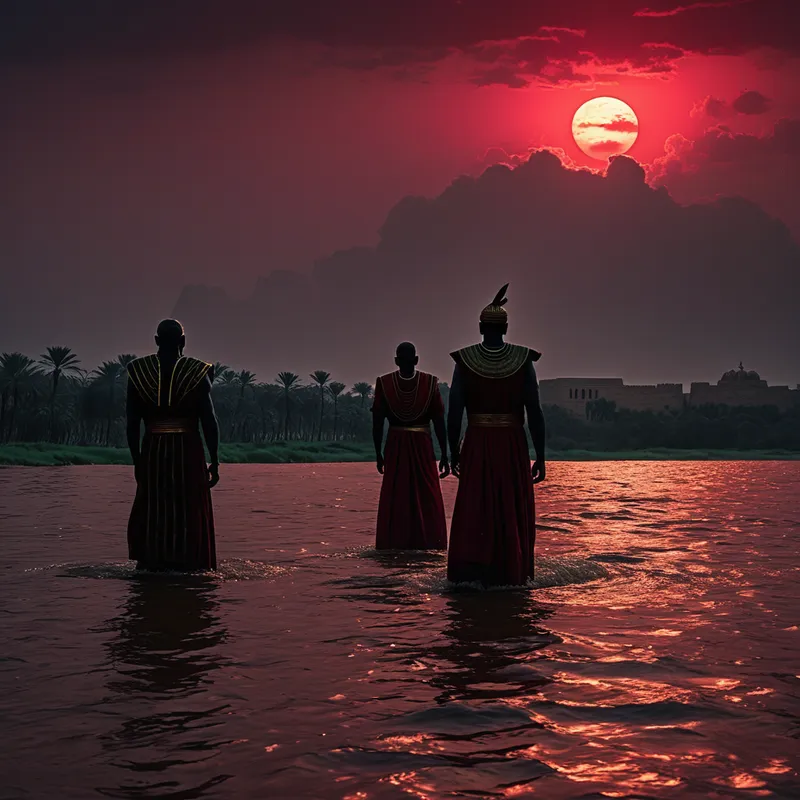
Before the throne of gold and arrogance, they spoke: “Let my people go.” Pharaoh, whose name was a divine breath, laughed. His heart was stone, hardened by the god of the Nile, Hapi. So the staff struck the water, and the lifeblood of Egypt, the great Nile, curdled into a stinking, clotting red. Fish died, and the people gagged on thirst. Still, Pharaoh’s heart did not bend.
Then came the frogs, a seething, croaking blanket from river to bedchamber, a plague of fertility turned inside out. They were scraped into heaps that reeked of rot. Then, the dust became gnats, a biting cloud upon man and beast. Then, flies—not the common fly, but a dense, humming plague that filled the air with corruption, a swarm that honored only the land of Goshen where the Hebrews dwelt.
The hand grew heavier. A pestilence struck the livestock in the field, a selective death that spared the herds of the slaves. Then, boils broke upon the skin of every Egyptian, from Pharaoh to maidservant, an eruption of agony and shame. Then, hail—fire mingled with ice—shattered flax and barley and any man or beast left in the field, a fury from the heavens that tore the sky asunder.
What the hail spared, the locusts consumed. An east wind brought a living darkness that devoured every green leaf, every shred of hope from the earth, leaving a landscape of skeletal trees under a bare sky. Then, a darkness you could feel, a tangible blackness that smothered lamps and courage for three days—a darkness so thick it pressed upon the soul. Yet, in Goshen, there was light.
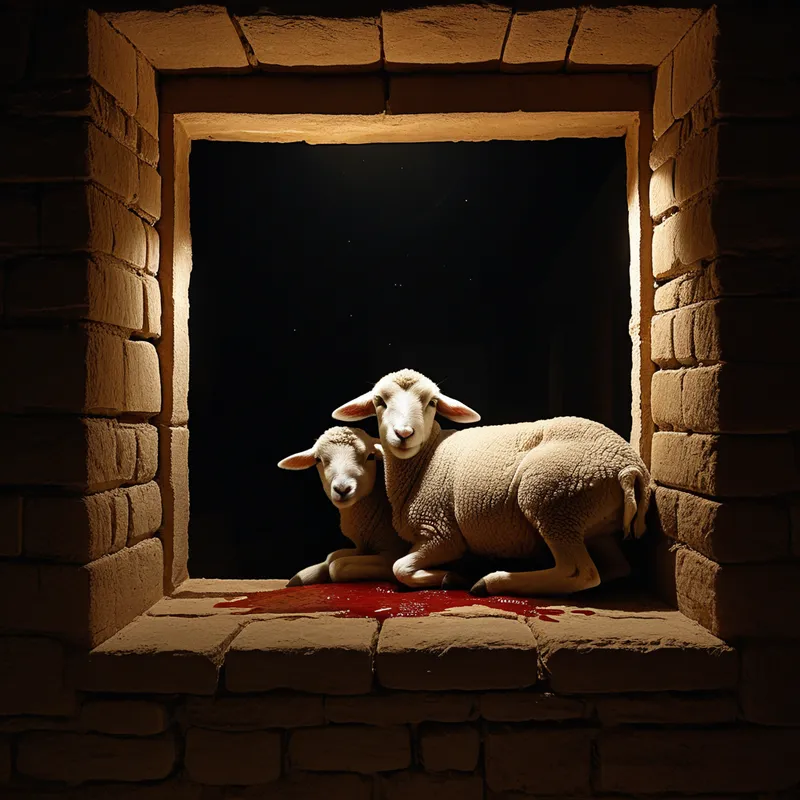
Nine plagues. Nine refusals. The stone heart would not crack. So came the tenth, the unspoken horror. At midnight, the destroyer passed through the land. In every Egyptian home, from the palace nursery to the prisoner’s cell, the firstborn son died. A great cry went up, a sound of ultimate rupture. Only where the blood of a lamb marked the doorpost—a terrible, sacred sign—did the angel pass over.
In that final, terrible silence, broken only by wailing, Pharaoh summoned Moses and Aaron. His voice was the ghost of a king’s. “Go. Be gone.” And in the terror of that night, a people who had known only the weight of bricks took their unleavened dough and fled toward the dawn, leaving a broken kingdom behind them.
Cultural Origins & Context
This narrative forms the pivotal climax of the Exodus story, the foundational national myth of ancient Israel. It was preserved, refined, and transmitted orally for generations before being codified in the Torah, the first five books of the Hebrew Bible. Its primary societal function was etiological and identity-forming: it explained why Israel was a distinct people bound in a unique covenant with YHWH, and it defined that relationship as one of liberation from oppressive systems. The story was told during the Passover (Pesach) ritual, where the question “Why is this night different from all other nights?” prompts the recitation of this very tale, ensuring each generation internalizes the memory of moving from slavery to freedom. It served as a potent theological statement against the dominant Egyptian cosmology, systematically challenging and defeating the deities of the Nile pantheon (the Nile, frogs as symbols of Heqet, the sun as Ra, Pharaoh as a god-king) to establish the supremacy of a god who acts in history for the marginalized.
Symbolic Architecture
The plagues are not random punishments but a meticulously structured de-creation of the Egyptian cosmos. Egypt, represented by Pharaoh, is a psychic state of absolute order, control, and hardened identity—the tyranny of the conscious ego that refuses to acknowledge the deeper Self or the cries of the suppressed aspects of the psyche (the enslaved Hebrews).
The plagues represent the psyche’s catastrophic, yet necessary, dismantling of a false and oppressive order. When the conscious mind (Pharaoh) refuses the call of wholeness, the unconscious (YHWH) responds with escalating, symbolic violence.
Each plague targets a specific pillar of Egyptian life and divinity: the Nile (source of life), the fertility of the land, the health of the body, the agricultural cycle, and finally, the continuity of the future itself in the firstborn. This is a symbolic unraveling. The “hardening of Pharaoh’s heart” is a profound psychological insight: it is the ego’s tragic, reflexive doubling-down in the face of overwhelming evidence that its paradigm is doomed. The final plague, the death of the firstborn, symbolizes the sacrifice of the ego’s most prized future—its legacy, its primary identity—as the ultimate price for its intransigence. The blood on the lintel is the mark of a different consciousness, one that chooses identification with the sacrificial lamb (the innocent, trusting Self) rather than with the unyielding stone of the ego.
The Dreamer’s Resonance
When this mythic pattern erupts in modern dreams, it signals a profound interior crisis. The dreamer may experience sequences of escalating, uncontrollable disasters: their home flooding (Nile to blood), infestations of insects or vermin (frogs, lice, flies), their body breaking out in rashes (boils), or being trapped in impenetrable darkness. Somatic feelings of suffocation, contamination, and inescapable pressure are common.
This is not a prophecy of literal doom, but a depiction of the psyche’s “plague sequence.” The “Egypt” in the dream is the dreamer’s own internal Pharaoh—a rigid mindset, a toxic identification (with work, status, a role), or a suppressed trauma that holds the rest of the psyche in bondage. The plagues are the unconscious forces, long ignored, now rising up to dismantle that tyranny. The dreamer is both the suffering Egyptian and the Moses figure being compelled to confront the seat of their own power. The emotional tone is one of awe, terror, and inevitability. The process feels divine and destructive because it is the autonomous psyche acting to preserve the whole Self, even if it must destroy the current, oppressive configuration of the conscious personality.

Alchemical Translation
The alchemical journey of this myth is the Nigredo—the blackening, the descent into chaos and dissolution that precedes transformation. For the modern individual, the “Exodus” cannot begin until the “Egypt” within is made uninhabitable.
The path to liberation is paved with the shattered icons of one’s own personal pantheon. The gods of security, control, and approved identity must be humbled before the soul can depart.
The process models psychic transmutation in three stages. First, Confrontation (Plagues 1-9): The Self, through symptoms, crises, and overwhelming emotions, systematically attacks the ego’s defenses. This is the “hardening of the heart” phase, where we rationalize, deny, and try to repair the old structure even as it crumbles. Second, The Sacrifice (Plague 10): The ego’s cherished “firstborn”—its central ambition, its foundational self-image, its claim on the future—must be relinquished. This is the dark night, the midnight of the soul. It feels like a death. Third, The Mark of Distinction (The Passover): A new principle is established. One learns to identify not with the unyielding Pharaoh-ego, but with the lamb—the vulnerable, trusting, and resilient core of being that is spared the destroyer’s wrath. This marks the transition from Nigredo to Albedo, the dawn of a new consciousness. The individual leaves the familiar bondage of their old “Egypt” and steps into the uncertain wilderness, carrying only the unleavened bread of a stripped-down, essential self, ready for the long journey of individuation.
Associated Symbols
Explore related symbols from the CaleaDream lexicon: