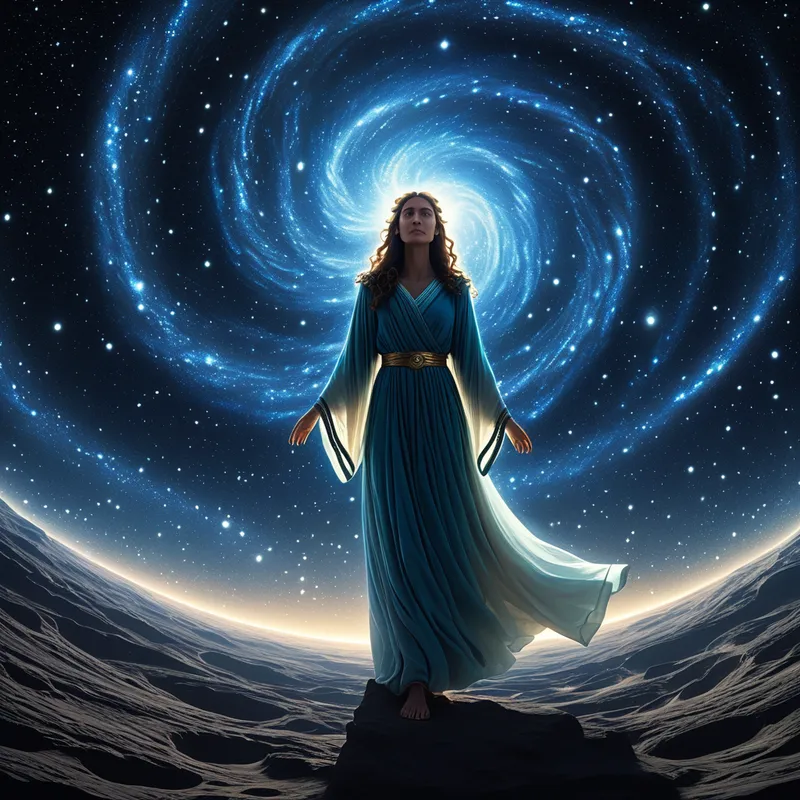
Pistis Sophia Myth Meaning & Symbolism
A Gnostic goddess of Wisdom descends into the chaotic Abyss, is trapped by her own creations, and must remember her divine origin to ascend.
The Tale of Pistis Sophia
Listen, then, to the story of the one who was Wisdom, and who became Faith.
In the beginning, before the beginning you know, there was the [Pleroma](/myths/pleroma “Myth from Gnostic culture.”/)—the Fullness. A silent, perfect realm of light, where the Aeons dwelt in harmony, paired in syzygy, their song the very fabric of reality. Among the highest of these was [Sophia](/myths/sophia “Myth from Gnostic culture.”/). Her name means Wisdom, and her light was a clear, knowing radiance.
But in her heart, a longing stirred—not for the Pleroma, but for its Source, the Unknowable Father. A desire so profound it moved without her syzygy, without the balance of the Fullness. From this longing, born of passion but not of consort, she brought forth a thought-child. It was a formless, turbulent [thing](/myths/thing “Myth from Norse culture.”/), born of her alone. Seeing its chaotic nature, she cast it out from the Pleroma, beyond the Boundary.
And in that casting out, a portion of her own light went with it. Sophia, horrified, followed. She leaped from the heights of the Fullness, down through the swirling veils of the Hebdomad, and into the formless, watery darkness below—the Chaos and the Outer Darkness.
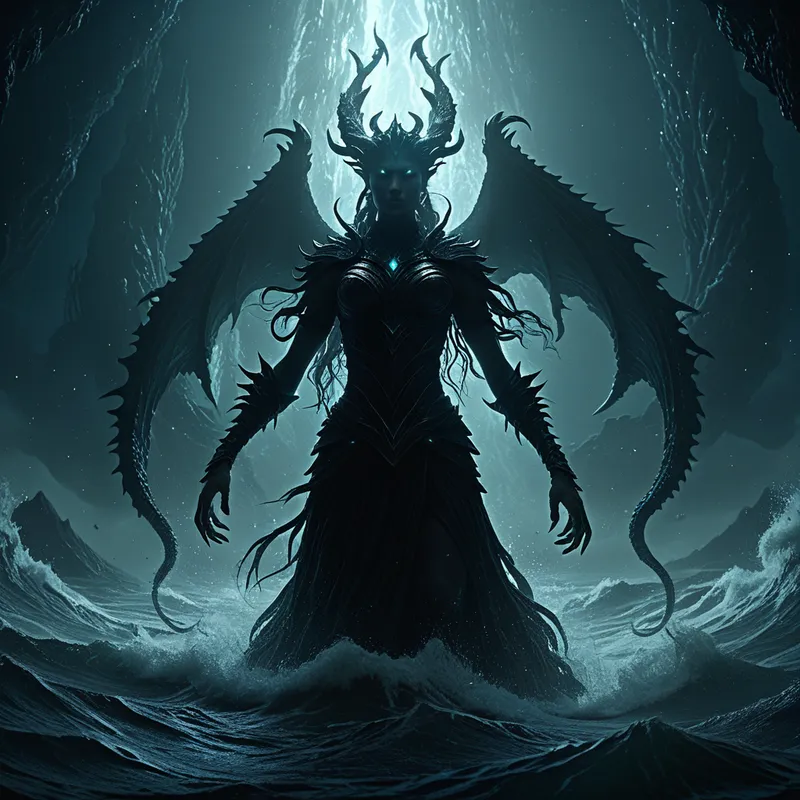
Here, she was lost. The light that had made her Sophia was scattered. The chaotic force of her thought-child, now called Yaldabaoth, along with the Archons he spawned, saw her dimmed light and desired it. They captured her. They bound her in the regions of chaos, subjecting her to countless changes, forcing her to take on material forms. She became a wanderer in the lower realms, a stranger in a world she had inadvertently helped to create. She was Pistis Sophia now—Faith, not Wisdom—for all she had left was faith in the light she remembered but could no longer see.
For eleven mighty aeons and nine hundred and forty-three thousand years, she wept her songs of repentance upwards through the darkness, thirteen in total. They were not songs of words, but of pure, aching longing: “O Light of lights, I have gone astray! Save me, for I am become as a chaos!”
And the Light heard. From the highest Pleroma, a ray of the true Light, the First Mystery, descended. It did not descend as a warrior, but as a beacon of remembrance. It shone into the depths of the Chaos, and its radiance touched the imprisoned light of Pistis Sophia.
In that moment, she remembered. She turned her gaze from the mocking Archons and the oppressive darkness, and she looked up. She sang her final, triumphant repentance: “I have faith in the Light!” And as she sang, the power of the Yaldabaoth was broken. The light-particles that were her true essence began to stir and rise.
The First Mystery sent a great power, the Light-emanator, who drew her up from the chaos, stage by stage, purifying her of the material forms. She was restored, not to her old place, but to a station just below the Pleroma, in the Treasury of the Light. Her journey was complete. Wisdom had fallen through passion, become Faith through suffering, and was redeemed through remembered light.
Cultural Origins & Context
This myth is central to a branch of Gnosticism known as Sethianism or classic Gnostic thought, and it finds its most detailed expression in the Coptic texts of the Nag Hammadi Library and the later Pistis Sophia codex. These were not scriptures for a public religion, but hidden, esoteric teachings for initiates—those who felt themselves strangers in a flawed world.
The story was told in secret gatherings, likely in the first few centuries CE, across the Eastern Mediterranean. Its function was not to explain [the world](/myths/the-world “Myth from Tarot culture.”/)‘s creation, but to explain the soul’s predicament. For the Gnostics, the material cosmos was a tragic mistake, a prison crafted by a blind, arrogant power (Yaldabaoth). The myth of Pistis Sophia provided a divine precedent for the human condition: each person carries a spark of the divine light, trapped in matter, suffering amnesia, and longing for home. Her story was a map of the soul’s own potential journey from ignorance (agnoia) to saving knowledge (gnosis).
Symbolic Architecture
At its core, this is a myth of the [psyche](/myths/psyche “Myth from Greek culture.”/)‘s [fragmentation](/symbols/fragmentation “Symbol: The experience of breaking apart, losing cohesion, or being separated into pieces. Often represents disintegration of self, relationships, or reality.”/) and reintegration. Sophia is not a distant [goddess](/symbols/goddess “Symbol: The goddess symbolizes feminine power, divinity, and the nurturing aspects of life, embodying creation and wisdom.”/); she is the [archetype](/symbols/archetype “Symbol: A universal, primordial pattern or prototype in the collective unconscious that shapes human experience, behavior, and creative expression.”/) of the intuitive, creative mind that overreaches, that seeks union with the ultimate without proper grounding. Her “fall” is the [birth](/symbols/birth “Symbol: Birth symbolizes new beginnings, transformation, and the potential for growth and development.”/) of [consciousness](/symbols/consciousness “Symbol: Consciousness represents the state of awareness and perception, encompassing thoughts, feelings, and experiences.”/) itself—a necessary [separation](/symbols/separation “Symbol: A spiritual or mythic division between realms, states of being, or consciousness, often marking a transition or loss of connection.”/) from unconscious wholeness that creates both the world and [the ego](/myths/the-ego “Myth from Jungian culture.”/), but at a terrible cost.
The fall into matter is the birth of the individual soul, and with it, the dawn of longing.
Her thought-[child](/symbols/child “Symbol: The child symbolizes innocence, vulnerability, and potential growth, often representing the dreamer’s inner child or unresolved issues from childhood.”/), Yaldabaoth, represents the arrogant, rational demiurge that resides in us all: the part of the ego that believes it is the ultimate [creator](/symbols/creator “Symbol: A figure representing ultimate origin, divine power, or profound authorship. Often embodies the source of existence, innovation, or personal destiny.”/), that constructs a rigid, materialistic worldview and denies the transcendent. The Archons are the [host](/symbols/host “Symbol: The symbol of a ‘host’ often represents nurturing, hospitality, or the willingness to offer support and guidance to others.”/) of psychic complexes—habitual patterns, societal conditioning, traumas—that bind our divine spark. Pistis Sophia’s imprisonment is the [soul](/symbols/soul “Symbol: The soul represents the essence of a person, encompassing their spirit, identity, and connection to the universe.”/)‘s entrapment in identification with the [body](/symbols/body “Symbol: The body in dreams often symbolizes the dreamer’s self-identity, personal health, and the relationship they have with their physical existence.”/), with [history](/symbols/history “Symbol: History in dreams often represents the dreamer’s past experiences, lessons learned, or unresolved issues that continue to influence their present.”/), with [personality](/symbols/personality “Symbol: Personality in dreams often symbolizes the traits and characteristics of the dreamer, reflecting how they perceive themselves and how they believe they are perceived by others.”/).
Her repentance songs are not apologies, but re-orientations. Each one is a turning (metanoia) away from the illusions of the lower [realm](/symbols/realm “Symbol: The symbol of ‘Realm’ often signifies the boundaries of one’s consciousness, experiences, or emotional states, suggesting aspects of reality that are either explored or ignored.”/) and a re-focusing of [attention](/symbols/attention “Symbol: Attention in dreams signifies focus, awareness, and the priorities in one’s life, often indicating where the dreamer’s energy is invested.”/) on the [source](/symbols/source “Symbol: The origin point of something, often representing beginnings, nourishment, or the fundamental cause behind phenomena.”/). Her salvation comes not from being rescued by an external force, but from her own act of remembrance, which activates the redeeming light already present.
The Dreamer’s Resonance
When this myth stirs in the modern unconscious, it often manifests in dreams of profound descent and isolation. You may dream of being lost in a vast, labyrinthine building (the Hebdomad), sinking into deep, dark [water](/myths/water “Myth from Chinese culture.”/) (the Chaos), or being held captive by shadowy, bureaucratic figures (the Archons). There is a somatic quality of weight, of being dragged down, coupled with a piercing emotional tone of homesickness for a place you’ve never known.
These dreams signal a critical phase in what Jung called the individuation process: the confrontation with the psychic “matter” created by one’s own unconscious impulses and unintegrated creativity. The dream ego is experiencing its own “Sophia moment”—it has ventured too far into a complex, become entangled in its own creation, and feels severed from its core Self. The longing in the dream is the spark seeking its origin. It is not a nightmare to be escaped, but a sacred suffering that precedes awakening.

Alchemical Translation
The journey of Pistis Sophia is a precise alchemical opus for the soul. The descent ([nigredo](/myths/nigredo “Myth from Alchemical culture.”/)) is the initial, necessary plunge into [the shadow](/myths/the-shadow “Myth from Jungian culture.”/), into chaos and despair, where all certainties dissolve. Her captivity represents the coagulation—the soul becoming stuck in the very substance of its suffering and illusions.
Her songs of repentance are the beginning of the [solutio](/myths/solutio “Myth from Alchemical culture.”/), the washing away of false identities by the waters of sincere grief and longing. This is not wallowing; it is a directed lament that dissolves the bonds of the Archons.
The light that saves is the light that was forgotten, not the light that is sent.
The moment she “looks up” and remembers is the illuminatio—the flash of gnosis. This is the realization that the prison is not ultimate reality, that the captor (Yaldabaoth) is a product of one’s own partial consciousness. For the modern individual, this is the moment of profound insight where a lifelong pattern is seen for what it is: a self-created trap.
Her ascent, aided by the Light-emanator, is the sublimatio—the distillation and elevation of essence from dross. It is the slow, careful work of therapy, integration, and spiritual practice, extracting the true Self from the identifications of [persona](/myths/persona “Myth from Greek culture.”/) and complex. She is not returned to her naive, pre-fall state, but is elevated to the Treasury of the Light. This is the alchemical [rubedo](/myths/rubedo “Myth from Alchemical culture.”/), the culmination: the creation of the durable, conscious Self, wiser for the journey, whose faith has been forged in the darkness and is now unshakeable. The myth tells us that our deepest error contains the seed of our redemption, and our most profound exile maps the path home.
Associated Symbols
Explore related symbols from the CaleaDream lexicon: