Pinocchio Myth Meaning & Symbolism
A puppet carved from enchanted wood yearns to become a real boy, navigating a world of deceptive promises to earn a soul through truth and sacrifice.
The Tale of Pinocchio
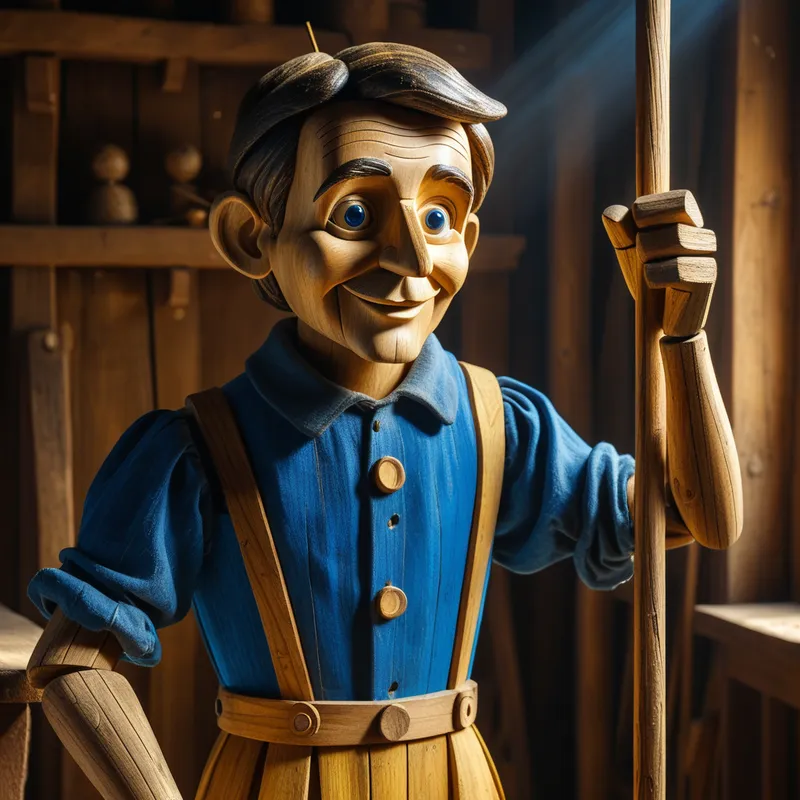
Listen, and I will tell you a story of longing. It begins not with a birth, but with a carving. In a small, sun-washed room smelling of resin and sawdust, an old man named Geppetto lived alone with his loneliness. His hands, gnarled as olive roots, took a piece of common pine—but this wood was not common. It was a Talking Log, a splinter of the wild forest that laughed and cried when touched by the plane. From this enchanted timber, Geppetto shaped a puppet: Pinocchio.
With the last stroke, the puppet blinked. He sprang to life, a clattering jangle of jointed limbs, his painted eyes wide with a raw, unformed curiosity. He was a creature of impulse, his world a series of immediate wants and reckless flights. Geppetto sold his coat to buy the boy a schoolbook, but Pinocchio, lured by the beat of a drum, sold the book for a ticket to the Great Puppet Theater. There, he was celebrated, but also nearly burned as firewood by the terrifying puppet-master.
Rescued by a coin, he set off for home, only to be waylaid by the sly Fox and Cat. They promised a field where coins grew like wheat. Gullible, Pinocchio buried his gold in the Field of Miracles and waited through a rain-drenched night, emerging robbed and humiliated. A Fairy with Turquoise Hair found him, a shivering, lying wretch. With each falsehood he told to excuse his folly, his nose—that proud proboscis of pine—sprouted longer, becoming a heavy, shameful branch.
She took him in, a mother to this motherless thing, and promised he could become a real boy if he proved himself brave, truthful, and obedient. But the siren song of Playland called. He fled to that country of endless games, where after months of revelry, he awoke to a braying sound. He had grown donkey ears, then a tail, then was fully transformed into a beast of burden, sold, worked to exhaustion, and thrown into the sea to drown.
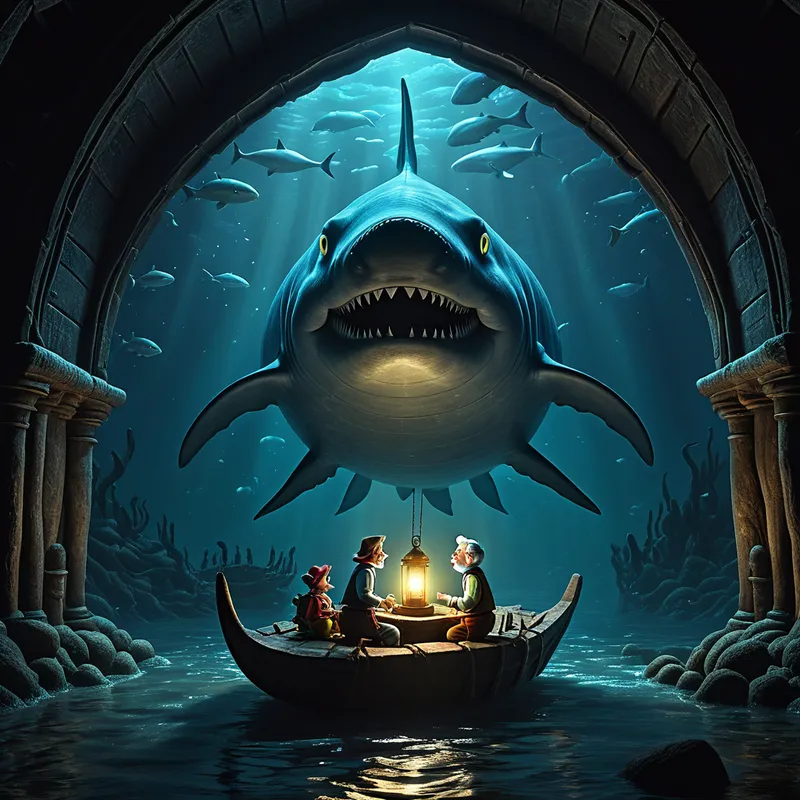
In the salty deep, fish nibbled away his donkey flesh, revealing the faithful pine beneath. Free again as a puppet, he was swallowed whole by the Terrible Dogfish. In the pitch-black, oil-slick belly of the beast, he found a faint light. It was Geppetto, who had sailed out to find him and had been swallowed years before, living on ship’s rations in a tiny raft. Their reunion in that gastric gloom was a quiet apocalypse of love and regret.
With his father weak upon his back, Pinocchio swam through the monster’s throat, tickled its tonsils with a fire, and escaped as the beast sneezed them into the crashing surf. He hauled Geppetto to shore and, in the days that followed, became the provider: he worked the fields, tended the old man, studied by candlelight. He ceased to be a burden and became a son. One morning, he awoke not to the creak of wood, but to the warm pulse of blood in his veins. The puppet was gone. In his bed lay a real boy, and on the table sat a lifeless puppet, collapsed in a pile of sticks, its journey complete.
Cultural Origins & Context
The story we know as Pinocchio is not an ancient myth, but a 19th-century literary fairy tale born from the specific soil of post-unification Italy. Its author, Carlo Collodi (a pseudonym for Carlo Lorenzini), was a journalist and satirist writing for children’s magazines. Serialized between 1881 and 1883 as The Story of a Puppet, the tale was deeply embedded in the Tuscan folk tradition—a world of talking animals, capricious fairies, and moral lessons delivered not with gentle whispers but with the thwack of a carpenter’s mallet.
Collodi’s Italy was a new nation struggling with poverty, education, and the formation of a civic identity. The story functioned as a kind of secular catechism for the poor children of the era, a harsh but loving guide to the perils of disobedience, laziness, and credulity. It was passed down not around a campfire, but through periodicals and later books, becoming a foundational pillar of modern European folklore. Its societal function was dual: to entertain with its wild picaresque adventures, and to inculcate the bourgeois virtues of hard work, honesty, and filial piety necessary for survival and success in a rapidly changing world. It is a folk tale that speaks directly to the transition from chaotic, rural childhood to disciplined, urban adulthood.
Symbolic Architecture
At its heart, Pinocchio is the story of the entelechy of the soul. The puppet is not just a wooden boy; he is the nascent, unintegrated psyche itself—all id and impulse, carved from the raw, living material of nature (the Talking Log) but lacking a core of authentic being.
The journey from puppet to person is the alchemy of experience transforming potential into essence.
His wooden body symbolizes the fabricated persona, the mask one wears before achieving self-awareness. The growing nose is a perfect somatic symbol: the lie that extends and solidifies, making the liar’s false reality impossible to ignore. The transformations into a donkey in Playland depict the brutal consequence of refusing growth—we become beasts of burden, enslaved by our own hedonism.
The Fairy with Turquoise Hair is the anima, the soul-guide who offers not just punishment but the possibility of redemption through love and truth. Geppetto is the loving but limited father-principle, who sets the form in motion. The ultimate triumph is not granted; it is earned through sacrifice, labor, and the courageous act of carrying one’s burdens (literally, saving Geppetto).

The Dreamer’s Resonance
When the Pinocchio pattern stirs in the modern dreamer, it signals a profound somatic and psychological crossroads: the struggle between the constructed self and the authentic self. To dream of having a wooden limb, a stiff jaw, or a face that feels like a mask is to feel the weight of the persona—the social role that has become a cage. The dream body is communicating a deep sense of artifice, of “faking it.”
Dreams of one’s nose elongating, or of being caught in a lie that becomes physically unmanageable, point to a specific psychological process: the integration of the Shadow. The lie is often the story we tell ourselves to avoid a shadow truth. The growing nose is the psyche’s insistent, grotesque way of making the denied truth visible and unavoidable. It is the somatic cost of self-deception. Dreams of being swallowed by a large creature (whale, building, earth) and finding a lost parental figure or a light within echo the night sea journey—a necessary descent into the darkness of the unconscious to rescue the vital, neglected parts of the self (the inner Geppetto) before rebirth is possible.

Alchemical Translation
The myth of Pinocchio is a precise map of individuation, the process of psychic transmutation where leaden potential becomes golden being. It begins with the prima materia: the chaotic, talking spirit of the forest log—our innate, raw nature. Geppetto’s workshop is the stage of formation, where cultural and parental forces shape that raw material into a recognizable form, a puppet of society.
The real boy is not born, but forged in the belly of the whale and on the anvil of daily sacrifice.
The long, picaresque middle—the theater, the Field of Miracles, Playland—represents the necessary nigredo, the blackening. This is the stage of error, suffering, and confrontation with the shadow (the Fox and Cat, one’s own donkey-ness). It is a painful but essential dissolution of the naive ego. The descent into the Terrible Dogfish is the ultimate mortificatio, the death of the old puppet-self in the dark womb of the unconscious. Here, in the stillness, the fragmented father (the inner principle of structure and authority) is reunited with the wandering son (the conscious ego).
The escape and subsequent life of service—caring for Geppetto, working, studying—is the albedo, the whitening, and the rubedo, the reddening. It is the application of conscious, disciplined effort to integrate the lessons of the journey. The puppet must actively live the virtues he once ignored. The final transformation is not a magical reward from the Fairy, but the inevitable result of this completed alchemical process. The wooden shell, its purpose served, falls away. What remains is the real boy: the integrated Self, no longer a marionette of impulse or society, but an autonomous, feeling, and responsible being, fully embodied and alive.
Associated Symbols
Explore related symbols from the CaleaDream lexicon: