Phurba the Ritual Dagger Myth Meaning & Symbolism
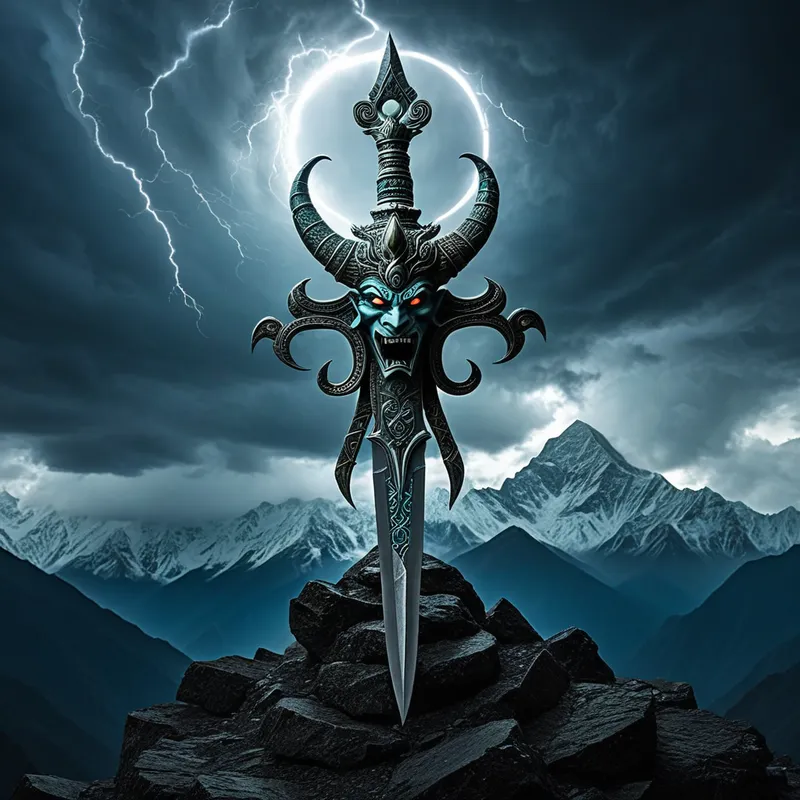
A myth of the sacred dagger, forged to pin chaos, binding demonic forces into the earth's heart to create a foundation for enlightened order.
The Tale of Phurba the Ritual Dagger
In the age before time was measured, when the world was a raw canvas of potential and peril, the mountains themselves were restless. From the deep, unseen fissures of the earth and the turbulent, unformed regions of the mind, forces of dregpa arose. They were not mere beasts, but sentient principles of chaos—disruption given form, entropy with a will. They twisted the paths of rivers into snares, turned the winds into lies, and coiled the aspirations of beings into knots of fear and hatred. The realm trembled on the brink of dissolution.
In this hour of looming unraveling, the enlightened mind, in its boundless compassion and fierce determination to preserve the possibility of awakening, manifested a wrathful aspect of sublime power. This was not a god of destruction, but a deity of ultimate stabilization. Some tell of the great yidam Vajrakilaya, his body the color of a thundercloud at midnight, his three faces seeing past, present, and future simultaneously, his six arms holding the tools of liberation. His central heart held the prototype, the ur-instrument: the Phurba.
The conflict was not a battle of armies, but a war of ontological grounding. The demons were not to be slain in the ordinary sense, for they were born from fundamental energies that could not be annihilated without annihilating the world itself. They had to be transformed, pinned, integrated. The rising action was a cosmic ritual. Vajrakilaya, embodying the realized yogin, did not chase the demons. He stood, unmovable as the axis of the world. With a roar that was the simultaneous sounding of a thousand mantras, he invoked the Phurba’s purpose. The air grew thick with the scent of ozone and sandalwood. The very elements coalesced around the dagger—the resolve of earth, the clarity of water, the heat of fire, the swiftness of air, the spaciousness of sky.
Then came the resolution, a moment of profound, violent grace. The Phurba was not thrust into a demon’s heart, but through the demon and into the primordial ground of being. It was a act of supreme acupuncture on the body of reality. The chaotic force, shrieking and twisting, was impaled upon the dagger’s three-edged blade. The blade did not kill it; it held it fast, transforming its wild, dispersive energy into a fixed, stable point. The demon became a genyen, a sworn guardian, its chaotic power bound into service as a pillar of the sacred order. The Phurba’s tip anchored deep in the underworld, its handle touched the celestial realms, and the bound demon at its center became part of the world’s supportive structure. The tremors ceased. The rivers ran true. A fierce, compassionate order was established, not by erasing chaos, but by nailing it down as the foundation.
Cultural Origins & Context
The myth of the Phurba is woven into the very fabric of Vajrayana Buddhism, particularly within the Nyingma tradition. It is not a folktale told around hearths, but a sacred narrative transmitted orally from master to disciple within the sealed context of wang and lung. The primary custodian of this myth is the yogin, the ngakpa or siddha, for whom the Phurba is a living extension of their own enlightened intent.
Its societal function was deeply pragmatic within a worldview that saw the human, natural, and spiritual realms as intimately connected. Before constructing a monastery, a stupa, or even a home, a ritual master would perform a sadhana involving the Phurba to “subdue the earth.” This act, echoing the primal myth, was believed to pin down the local sadag and naga, transforming them from potential obstructors into protectors of the sanctified space. Thus, the myth provided the cosmological blueprint for turning wild, untamed land—both external and internal—into a fit vessel for enlightenment.
Symbolic Architecture
The Phurba is a master symbol of psychic intervention. Its three-sided blade represents the conquest of the three poisons—ignorance, attachment, and aversion—the root causes of all suffering. The handle, often crowned with a vajra, signifies the indestructible, diamond-like nature of enlightened mind. The pommel, frequently featuring a wrathful deity’s head, embodies the fierce compassion necessary to confront the shadow.
The dagger is not for killing the self, but for murdering the illusions that imprison it. It is the precision tool of discernment, cutting the knot of confusion to reveal the thread of truth.
Psychologically, the demonic forces represent the untamed, chaotic contents of the unconscious—repressed traumas, compulsive emotions, and psychic complexes that sabotage conscious life. The hero, Vajrakilaya or the yogin, is the emerging ego-Self axis, the conscious personality aligned with the deeper, ordering principle of the psyche (the Self). The ritual act of plunging the Phurba is the moment of conscious insight and unwavering commitment where a chaotic complex is finally faced, named, and “pinned down”—not repressed again, but integrated into the personality’s structure in a transformed, manageable way.
The Dreamer's Resonance
When this mythic pattern stirs in modern dreams, it signals a profound somatic and psychological process of confrontation and stabilization. One may not dream of a literal Tibetan dagger, but of a sharp, penetrating object—a needle, a spike, a beam of light—being driven into a swirling, threatening, or tangled mass. This is the psyche’s innate ritual.
The somatic experience upon waking may be a sensation of release in the chest or gut, a feeling of a “knot” loosening. Psychologically, the dreamer is undergoing what the myth models: the binding of a chaotic inner force. This could be a sudden, piercing insight that finally clarifies a long-standing emotional confusion (“pinning it down”). It could represent the necessary, sometimes painful, act of setting a firm boundary (the immovable handle), which paradoxically frees both parties. The dream is an announcement that a period of inner turmoil is being actively transformed into a source of personal stability. The demon of anxiety is being bound into the role of alertness; the demon of rage, into the power of assertive protection.
Alchemical Translation
For the modern individual navigating the path of individuation, the Phurba myth models the alchemy of psychic transmutation. The process is not one of gentle refinement, but of fierce, precise operation.
Individuation requires the courage to become your own ritual master, to wield the dagger of consciousness against the inner chaos that blocks your wholeness.
First, one must identify the “demon”—the recurring pattern, the addictive behavior, the core wound that disrupts life. This is the chaotic dregpa rising from the personal underworld. Second, one must forge the “Phurba”—this is the development of a focused, non-judgmental awareness (the blade), grounded in one’s core values and integrity (the handle, the vajra). Third, and most critical, is the ritual act of piercing. This is the moment of full, embodied acceptance and commitment. One does not try to annihilate the wound (“I will never feel shame again”), which is impossible. Instead, one pins it with understanding (“This is my shame. I see its origin. I hold it here, in the light of my awareness”). By holding it fast in consciousness, its energy is transmuted. The chaotic shame becomes a known quantity, a part of one’s history that no longer has the power to disperse one’s identity. It is bound into the foundation of a more authentic, resilient self. The liberated energy then becomes a pillar of strength, a genyen that guards the newly consecrated inner temple.
Associated Symbols
Explore related symbols from the CaleaDream lexicon:
- Ceremonial Dagger — The direct representation of the Phurba itself, signifying the sacred application of precise, transformative force, not for harm but for liberation and stabilization.
- Ritual — The structured, intentional container that makes the dangerous work of transformation safe and effective, turning raw confrontation into sacred ceremony.
- Chaos — The primal, unformed demonic energy that the Phurba confronts and binds, representing the raw material of the unconscious before integration.
- Order — The enlightened state achieved through the ritual, where bound chaos becomes the stable foundation for spiritual structure and conscious life.
- Shadow — The personal and collective unconscious contents, the "demons" within that must be faced, pinned, and integrated for wholeness.
- Earth — The grounding element into which the Phurba is plunged, representing the anchoring of spiritual insight into physical reality and the body.
- Mountain — Symbolizing the immovable, axial quality of the ritual master and the stable reality established after the binding of chaos.
- Thunder — The sound of the enlightened roar of Vajrakilaya, representing the shocking, awakening power of the transformative insight that precedes the binding.
- Root — The Phurba's action of piercing to the root cause of suffering, and the subsequent establishment of a new, stable foundation for growth.
- Binding — The core action of the myth, representing not destruction but the integration and transformation of volatile energies into fixed, supportive structures.
- Altar — The sacred space, both external and internal, upon which the ritual of transformation is performed, setting the stage for the meeting of human and divine will.
- Destiny — The fulfillment of one's true path, which can only be walked once the obstructing demons of chaos and distraction have been bound and transformed into allies.