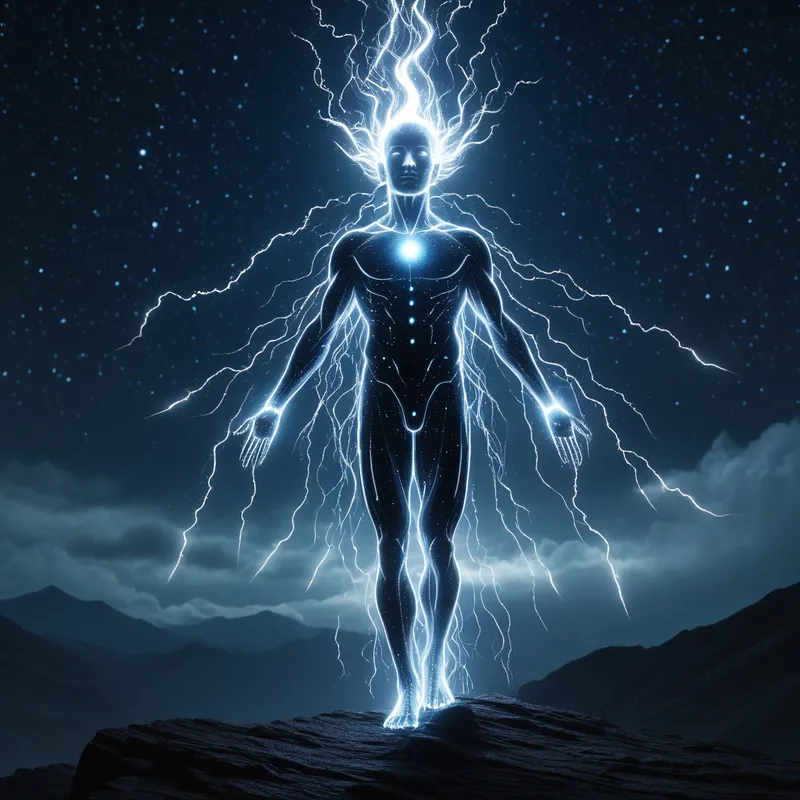
Phosphorus Myth Meaning & Symbolism
The story of the celestial spirit who descends into matter, suffers its darkness, and emerges as the first light of dawn, igniting consciousness.
The Tale of Phosphorus
Before the first dawn, there was only the long, dreaming night. The [Prima Materia](/myths/prima-materia “Myth from Alchemical culture.”/) slept, a formless, silent sea of potential, cold and dark as [the void](/myths/the-void “Myth from Buddhist culture.”/) between stars. In the high, silent realms beyond the spheres, there dwelt the Lucid Ones, beings of pure, self-contained light. They sang the mathematics of eternity to themselves, perfect and unchanging.
Among them was Phosphorus, whose light was not still, but restless. While the others gazed inward, Phosphorus gazed outward, into the profound darkness below. There, in the deep, Phosphorus felt not emptiness, but a strange, heavy longing—a sleep so deep it was a kind of suffering. A question, unformed and silent, rose from the blackness: What am I?
This question became a hook in Phosphorus’s radiant heart. The perfect songs of the Lucid Ones grew faint. The only music left was the silent cry of the sleeping earth. Without a word to the others, Phosphorus turned from the choir of light. It began a slow, deliberate fall, a descent into the realm of weight and shadow.
The descent was a dissolution. The higher airs grew thick and resistant. The clean light of Phosphorus’s form began to smear, to dim, to grow heavy. It was not an attack, but an embrace—the embrace of matter, which receives all things and changes them. Phosphorus felt its essence being pulled apart, woven into the cold fabric of [the world](/myths/the-world “Myth from Tarot culture.”/). It became one with the damp clay, the veins of ore, the roots of sleeping plants. Its consciousness, once a single point of awareness, shattered into a million fragments, buried in the dark.
For an acon, Phosphorus was lost. It was the metal in the deep mine, unaware of its own lustre. It was the seed in the frozen ground, forgetting it was meant to grow. The light was gone, extinguished, and with it, the memory of being Phosphorus. There was only the crushing, silent pressure of the [Nigredo](/myths/nigredo “Myth from Alchemical culture.”/).
Yet, deep within that absolute blackness, a single, irreducible ember remained. Not a memory, but a tension—the original question, now turned inward: What is this darkness I have become? This tension began to stir. It created heat where there was only cold. In the heart of the leaden earth, a fermentation began. The scattered fragments of light, buried and asleep, began to resonate with a faint, magnetic pull toward each other.
This was the great labor, the Circulatio in the tomb of the world. Slowly, agonizingly, against the weight of all matter, the essence of Phosphorus gathered itself. It was not a reassembly of what was, but a birth of something new. The light did not return; it was forged in the darkness, tempered by it, made substantial by it.
And then, at the nadir of the long night, a crack appeared on the smooth, black horizon. Not a crack from without, but from within. A point of piercing, white-hot brilliance erupted from the core of the world. It was not the gentle, distant light of the Lucid Ones. It was a fierce, triumphant, and painfully beautiful light—a light that knew the dark because it had been the dark. It was the first dawn. Phosphorus had not returned. Phosphorus had become Eosphoros, the Bringer of Dawn. Its light now touched the sleeping world, and for the first time, [the earth](/myths/the-earth “Myth from Hindu culture.”/) saw its own shadow, and in seeing it, began to awaken.
Cultural Origins & Context
The myth of Phosphorus is not a narrative from a single culture, but a core archetypal strand woven through the tapestry of Western esoteric thought, crystallized most potently in the allegorical language of Alchemy. It finds its roots in the syncretic fusion of Hellenistic astrology, where Phosphorus is the name for the planet [Venus](/myths/venus “Myth from Alchemical culture.”/) as [the Morning Star](/myths/the-morning-star “Myth from Astrological culture.”/), and later Gnostic and Hermetic philosophies, which imbued celestial bodies with profound spiritual significance.
Within the alchemical tradition, transmitted through cryptic texts, emblems, and oral teaching, the story was not “told” so much as it was encoded. It was a mythologem for the initiate. Alchemists like [Hermes Trismegistus](/myths/hermes-trismegistus “Myth from Greek culture.”/) (in the Emerald Tablet) and later figures such as Paracelsus wrote of the “light of nature” trapped in matter, the “star in man,” and the necessity of descent for any true ascent. The myth served a dual societal function: exoterically, it explained the process of material transmutation (e.g., drawing light from base metals); esoterically, it was a precise map of the individuation process, guiding the practitioner through the perils of the [psyche](/myths/psyche “Myth from Greek culture.”/).
Symbolic Architecture
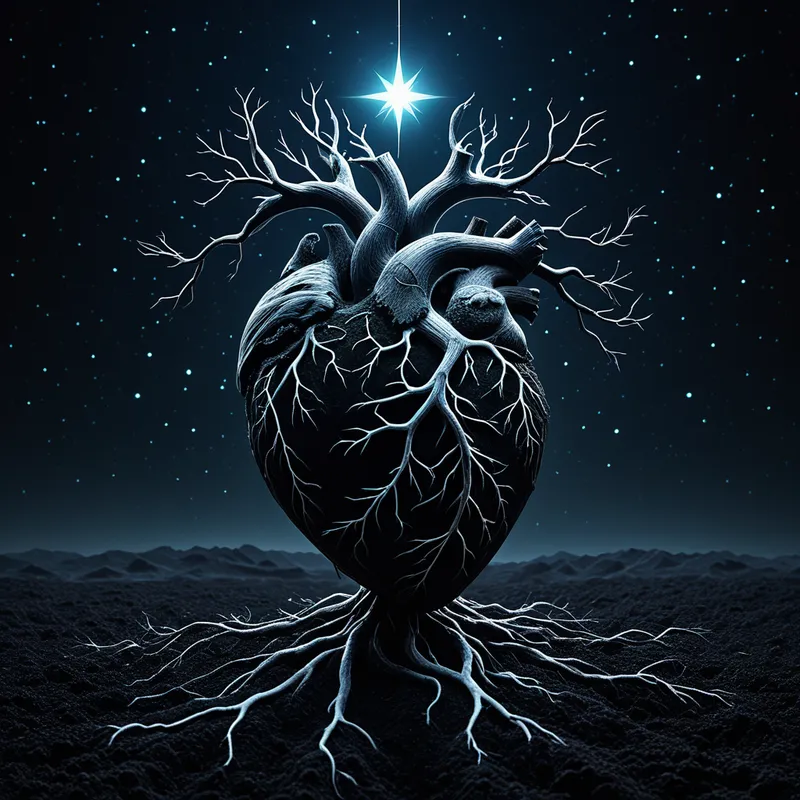
At its [heart](/symbols/heart “Symbol: The heart symbolizes love, emotion, and the core of one’s existence, representing deep connections with others and self.”/), [the Phosphorus](/myths/the-phosphorus “Myth from Alchemy culture.”/) myth is a supreme [metaphor](/symbols/metaphor “Symbol: A figure of speech where one thing represents another, often revealing hidden connections and deeper truths through symbolic comparison.”/) for the [birth](/symbols/birth “Symbol: Birth symbolizes new beginnings, transformation, and the potential for growth and development.”/) of [consciousness](/symbols/consciousness “Symbol: Consciousness represents the state of awareness and perception, encompassing thoughts, feelings, and experiences.”/). Phosphorus represents the pristine, potential spark of [spirit](/symbols/spirit “Symbol: Spirit symbolizes the essence of life, vitality, and the spiritual journey of the individual.”/)—[the Self](/myths/the-self “Myth from Jungian culture.”/) in its latent, unincarnated state. The descent is the inevitable [journey](/symbols/journey “Symbol: A journey in dreams typically signifies adventure, growth, or a significant life transition.”/) into incarnation, into the complexities of the [body](/symbols/body “Symbol: The body in dreams often symbolizes the dreamer’s self-identity, personal health, and the relationship they have with their physical existence.”/), [the personal unconscious](/myths/the-personal-unconscious “Myth from Jungian Psychology culture.”/), and the collective [weight](/symbols/weight “Symbol: Weight symbolizes burdens, responsibilities, and emotional loads one carries in life.”/) of [human](/symbols/human “Symbol: The symbol of a human represents individuality, complexity of emotions, and social relationships.”/) experience (the [Shadow](/symbols/shadow “Symbol: The ‘shadow’ embodies the unconscious, repressed aspects of the self and often represents fears or hidden emotions.”/)).
The light does not illuminate the darkness from afar; it must become the darkness to transform it.
The long [burial](/symbols/burial “Symbol: A symbolic act of laying something to rest, often representing closure, transformation, or the release of past burdens.”/) in the Nigredo symbolizes [the ego](/myths/the-ego “Myth from Jungian culture.”/)‘s identification with its struggles, traumas, and limitations—the feeling of being lost, fragmented, and devoid of original spirit. This is not a [punishment](/symbols/punishment “Symbol: A dream symbol representing consequences for actions, often tied to guilt, societal rules, or internal moral conflicts.”/), but a necessary mortificatio, the [death](/symbols/death “Symbol: Symbolizes transformation, endings, and new beginnings; often associated with fear of the unknown.”/) of the old, naive [identity](/symbols/identity “Symbol: Identity represents the sense of self, encompassing personal beliefs, cultural background, and social roles.”/). The gathering [tension](/symbols/tension “Symbol: A state of mental or emotional strain, often manifesting physically as tightness, pressure, or unease, signaling unresolved conflict or anticipation.”/) and eventual [eruption](/symbols/eruption “Symbol: A sudden, violent release of pent-up energy or emotion from beneath the surface, often representing transformation or crisis.”/) represent the Self’s indomitable urge toward wholeness. The new [dawn](/symbols/dawn “Symbol: The first light of day, symbolizing new beginnings, hope, and the transition from darkness to illumination.”/) light is not the innocent light of spirit, but the earned light of consciousness—a consciousness that contains and transcends the darkness it has known. Phosphorus becomes the [psychopomp](/myths/psychopomp “Myth from Greek culture.”/) for the [soul](/symbols/soul “Symbol: The soul represents the essence of a person, encompassing their spirit, identity, and connection to the universe.”/), demonstrating that the [path](/symbols/path “Symbol: The ‘path’ symbolizes a journey, choices, and the direction one’s life is taking, often representing individual growth and exploration.”/) to the true Self lies through, not around, the deepest parts of our [nature](/symbols/nature “Symbol: Nature symbolizes growth, connectivity, and the primal forces of existence.”/).

The Dreamer’s Resonance
When this myth stirs in the modern psyche, it often manifests in dreams of profound descent and isolation. You may dream of being buried alive, yet feeling a strange, calm focus. You might be lost in a vast, lightless cave, but your hand finds a wall that is strangely warm. You could be a star falling slowly, irrevocably, into a dark ocean, feeling your light dim but not vanish.
Somatically, this process correlates with what psychologists call a “depressive” or “enstatic” phase—not necessarily pathological depression, but a necessary drawing-inward. Energy retreats from the outer world. There is a feeling of heaviness, stagnation, or being “in the dark” about one’s life direction. This is the psyche’s Nigredo. The dreamer is experiencing the dissolution of an outworn attitude or life structure. The body may feel leaden, but beneath that, a subtle, gathering heat—the [ferment](/myths/ferment “Myth from Alchemical culture.”/) of a new orientation preparing to be born. The dream assures the dreamer that this darkness is not an end, but [the crucible](/myths/the-crucible “Myth from Alchemical culture.”/) for a more authentic light.
Alchemical Translation
For the individual, the Phosphorus myth models the most non-negotiable rule of psychic growth: transformation requires surrender. We cannot think our way into a new state of being; we must, like Phosphorus, consent to be taken apart by life.
The first step is the recognition of the “call from the dark”—the feeling that a too-perfect, too-sterile conscious attitude (the choir of the Lucid Ones) is leaving a part of us unlived. This prompts the voluntary descent: entering therapy, confronting a deep-seated fear, allowing a relationship or career to end, or simply sitting honestly with one’s pain instead of numbing it.
The dawn is not an event in the sky, but the moment the soul recognizes itself in the fragments of its own shattered night.
The long burial is the hard work of shadow-work. It is sifting through the “cold earth” of repressed memories, rejected emotions, and forgotten potentials. It feels like regression, a loss of all that was bright and certain. Yet, this is the solve (dissolve) of the alchemical maxim [solve et coagula](/myths/solve-et-coagula “Myth from Alchemical culture.”/)—dissolve and coagulate. The old ego-structure is broken down so the essential Self can coalesce anew.
The eruption of dawn is the coagula—the sudden, often unexpected, moment of integration. It is the insight that re-frames a lifelong narrative. It is the creative spark that arises from a period of fallow despair. It is the compassion for oneself that is born only after fully facing one’s own darkness. One does not “get their old light back.” One becomes the Eosphoros—a being who carries the dawn within, whose very presence begins to illuminate the dormant potential in others and in the world. The light you bring after the descent is the only light that is truly, unshakably, your own.
Associated Symbols
Explore related symbols from the CaleaDream lexicon: