Phoenix Myth Meaning & Symbolism
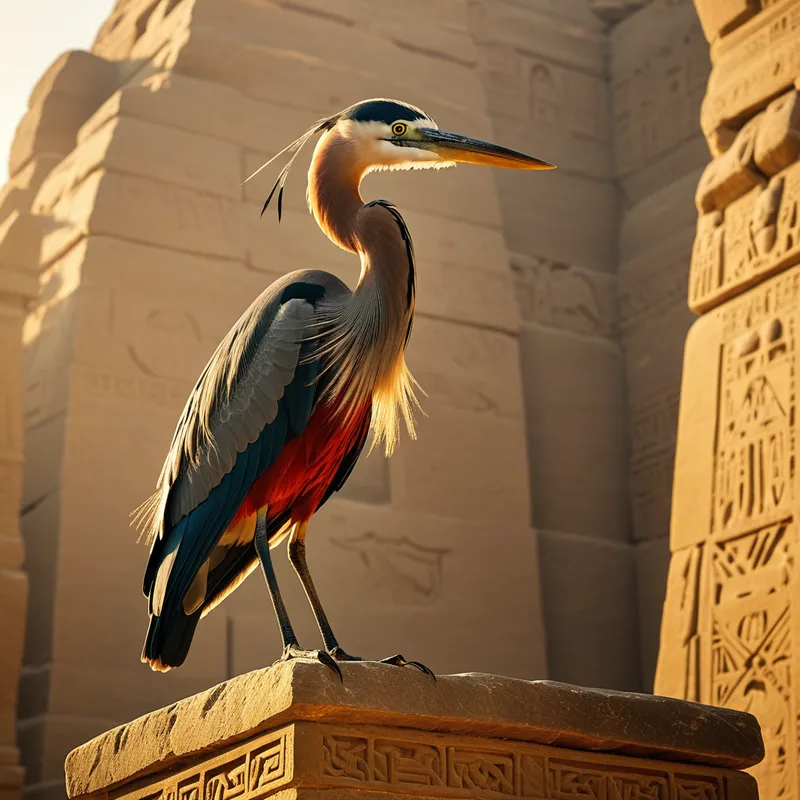
The sacred Bennu bird, born from primordial chaos, immolates itself to be reborn from ashes, embodying the eternal cycle of death and regeneration.
The Tale of Phoenix
In the time before time, when [the world](/myths/the-world “Myth from Tarot culture.”/) was a dark, formless ocean, a stillness hung over the waters of Nun. From this silent, boundless deep, a single cry pierced [the void](/myths/the-void “Myth from Buddhist culture.”/)—a sound that was both lonely and full of promise. It was the call of the Bennu.
It alighted upon the first [thing](/myths/thing “Myth from Norse culture.”/) that was not [water](/myths/water “Myth from Chinese culture.”/): a jagged peak of dark stone that had risen from [the abyss](/myths/the-abyss “Myth from Kabbalistic culture.”/). This was the benben stone, the navel of the world. The Bennu was a creature of impossible beauty, larger than any heron, with feathers of gleaming gold and the deep, fiery red of the sun’s heart. Its eyes held the knowledge of cycles not yet begun.
For centuries uncounted, the Bennu dwelled in the sanctuary of Heliopolis, the City of the Sun. It was the living soul of Ra himself, a beacon of the first light. It marked the rhythms of the cosmos: the flooding of the Nile, the journey of [the solar barque](/myths/the-solar-barque “Myth from Egyptian culture.”/), the turning of the stars. But as the [great year](/myths/great-year “Myth from Greek culture.”/) wheeled on, a profound weariness settled in its bones. Its radiant plumage, though glorious, grew heavy with the dust of ages. It knew the secret that all creation must learn: to live is to accumulate time, and time is a weight that must be shed.
With a purpose as solemn as a priest performing the opening of the mouth, the Bennu began its final labor. From the farthest palms of the delta and the [sacred groves](/myths/sacred-groves “Myth from Celtic culture.”/) of [the temple](/myths/the-temple “Myth from Jewish culture.”/), it gathered sprigs of fragrant myrrh and cassia. With meticulous care, it built a nest upon the holy benben stone, a fragrant pyre that was also a cradle. As the sun, Ra, began his perilous journey through [the underworld](/myths/the-underworld “Myth from Greek culture.”/), the Bennu settled upon its nest. It did not sleep. It turned its face to the last sliver of light on [the horizon](/myths/the-horizon “Myth from Various culture.”/) and began to sing—a song of gratitude, of release, of immense longing for the source.
Then, as if answering a call only it could hear, its body burst into a pure, silent flame. Not a fire of destruction, but a conflagration of essence. The gold and crimson feathers became light itself, consuming the nest, the spices, and the ancient form of the bird. Onlookers—if any could have borne witness—would have seen only a pillar of gentle fire reaching for the stars, leaving behind a mound of warm, silvery ash.
In that ash, as the night reached its deepest point, a tiny movement stirred. A new, damp wing, fragile and glistening, pushed free. By the time Ra’s barque broke the horizon, victorious from its nightly duel with the serpent Apep, a new Bennu stood upon the stone. It was identical to the old, yet utterly new, its eyes clear with the light of a first dawn. With a cry that echoed its own birth from the waters of Nun, it stretched its wings, lifted the ashes of its former self into a sacred pouch, and carried them to the altar of the sun, completing the circle. It had died. It was alive. It was forever.

Cultural Origins & Context
The myth of the Bennu is woven into the very fabric of ancient Egyptian cosmology, originating in the theology of Heliopolis, one of Egypt’s oldest religious centers. Here, the bird was venerated as the ba (soul or manifestation) of the sun god Ra, and later, of [Osiris](/myths/osiris “Myth from Global/Universal culture.”/), linking it inextricably to solar cycles and resurrection. It was not a folktale for the masses but a sacred narrative preserved by priests and inscribed in temple texts like the [Pyramid Texts](/myths/pyramid-texts “Myth from Egyptian culture.”/) and [the Book of the Dead](/myths/the-book-of-the-dead “Myth from Egyptian culture.”/).
Its societal function was profound. In a civilization obsessed with eternity and the defeat of entropy, the Bennu was a living symbol of guaranteed renewal. It modeled the daily rebirth of the sun, the annual flooding of the Nile (which brought life back to the parched land), and the hoped-for resurrection of [the pharaoh](/myths/the-pharaoh “Myth from Egyptian culture.”/) and, eventually, every justified soul. The Bennu was a cosmological anchor, proving through myth that decay and death were not endpoints, but necessary phases in an eternal return. Its image—and [the benben stone](/myths/the-benben-stone “Myth from Egyptian culture.”/) it perched upon—became the prototype for the obelisks and pyramidions that capped temples and pyramids, literally connecting architecture to this myth of cyclical regeneration.
Symbolic Architecture
At its core, the Bennu is not merely a [bird](/symbols/bird “Symbol: Birds symbolize freedom, perspective, and the connection between the earthly and spiritual realms, often representing the soul’s aspirations or personal growth.”/) that is reborn. It is the archetypal principle of [regeneration](/symbols/regeneration “Symbol: The process of renewal, restoration, and growth following damage or depletion, often representing emotional healing, transformation, or a fresh start.”/) through total surrender. Its [symbolism](/symbols/symbolism “Symbol: The use of symbols to represent ideas or qualities, often conveying deeper meanings beyond literal interpretation. In dreams, it’s the language of the unconscious.”/) is an intricate [architecture](/symbols/architecture “Symbol: Architecture in dreams often signifies structure, stability, and the framing of personal identity or life’s journey.”/) of [paradox](/symbols/paradox “Symbol: A contradictory yet true concept that challenges logic and perception, often representing unresolved tensions or profound truths.”/).
The Phoenix does not avoid its ashes; it builds its nest from them before it is even ash.
First, it represents Conscious Cyclicity. Unlike natural cycles that happen to us (seasons, aging), the Bennu’s act is deliberate. It feels the [weight](/symbols/weight “Symbol: Weight symbolizes burdens, responsibilities, and emotional loads one carries in life.”/) of time and chooses the fire. This transforms passive decay into active [ritual](/symbols/ritual “Symbol: Rituals signify structured, meaningful actions carried out regularly, reflecting cultural beliefs and emotional needs.”/), making [death](/symbols/death “Symbol: Symbolizes transformation, endings, and new beginnings; often associated with fear of the unknown.”/) an act of will and wisdom.
Second, it embodies the Unity of Opposites. It is both male and female (said to be self-created), both solar and osirian (linking the glory of the sun and the [fertility](/symbols/fertility “Symbol: Symbolizes creation, growth, and abundance, often representing new beginnings, potential, and life force.”/) of the resurrected god), and exists at the nexus of destruction and creation. Its fire is not an [enemy](/symbols/enemy “Symbol: An enemy in dreams often symbolizes an internal conflict, self-doubt, or an aspect of oneself that one struggles to accept.”/) but the midwife of its new form.
Psychologically, the Bennu is the [symbol](/symbols/symbol “Symbol: A symbol can represent an idea, concept, or belief, serving as a powerful tool for communication and understanding.”/) of the Self in its most dynamic [aspect](/symbols/aspect “Symbol: A distinct feature, quality, or perspective of something, often representing a partial view of a larger whole.”/). It represents the [psyche](/myths/psyche “Myth from Greek culture.”/)’s innate, non-negotiable drive toward wholeness, which cannot be achieved without the [dissolution](/symbols/dissolution “Symbol: The process of breaking down, dispersing, or losing form, often representing transformation, release, or the end of a state of being.”/) of outworn identities, complexes, and ways of being. The [nest](/symbols/nest “Symbol: A ‘nest’ symbolizes safety, home, and the nurturing aspects of personal and familial connections.”/) of spices signifies the conscious preparation—the gathered wisdom, the painful introspection ([myrrh](/symbols/myrrh “Symbol: A fragrant resin historically used in incense, perfumes, and embalming, symbolizing purification, sacrifice, and the sacred.”/) was for embalming)—that must precede any true transformation.
The Dreamer’s Resonance
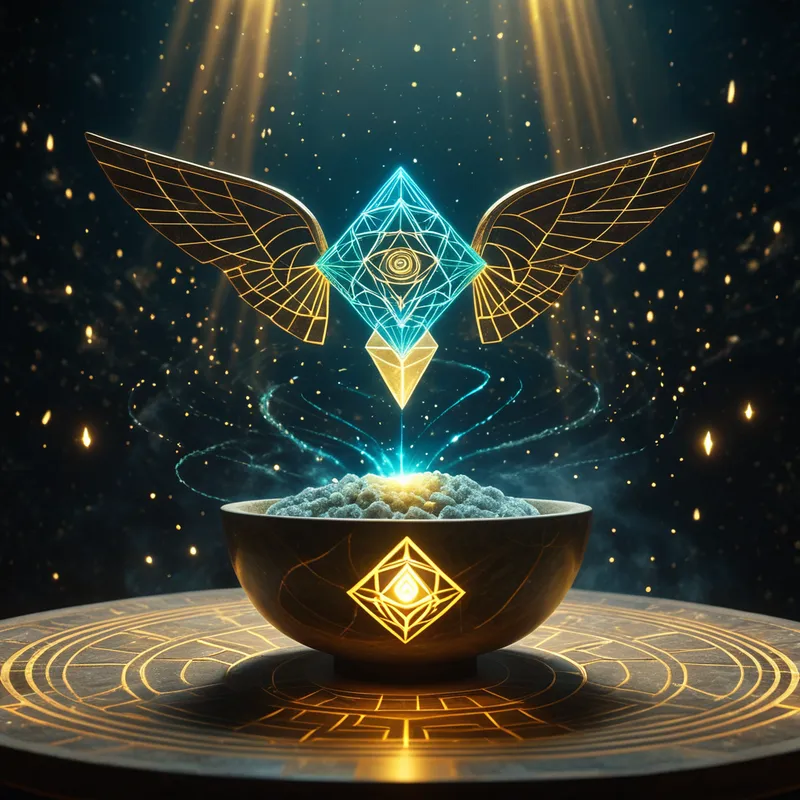
When [the Phoenix](/myths/the-phoenix “Myth from Global/Universal culture.”/) pattern stirs in the modern dreamer, it rarely appears as a literal bird. Instead, the psyche communicates through the myth’s core sensations and images. You may dream of a beloved house burning down, yet feeling a strange peace. You may find yourself in a sterile hospital that suddenly fills with the scent of desert spices. You may be desperately gathering sticks, knowing a great storm is coming, but the sticks are fragments of old letters or childhood toys.
Somatically, this process often manifests as profound fatigue—the “weight of the feathers.” It’s the exhaustion of maintaining a [persona](/myths/persona “Myth from Greek culture.”/), a career, or a relationship that has served its time but whose soul has departed. Psychologically, it is the phase where [the ego](/myths/the-ego “Myth from Jungian culture.”/), having identified a dead end, must consent to its own deconstruction. The conflict in the dream is between the part that clings to the familiar, dusty plumage and the deeper Self that knows the fire is the only path to vitality.
These dreams signal an impending psychic death—not a clinical depression, though it may share the topography, but a sacred depressions, a necessary emptying out. The dreamer is in the nest-building phase, gathering the aromatic insights that will make the impending dissolution meaningful rather than merely destructive.
Alchemical Translation
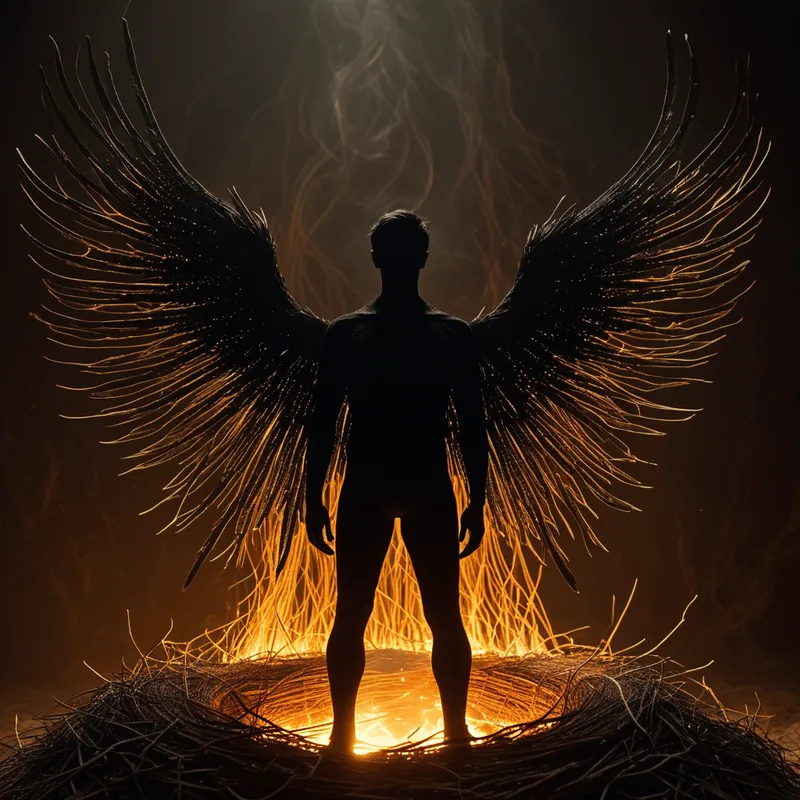
The alchemical process mirrored in the Phoenix myth is the [nigredo](/myths/nigredo “Myth from Alchemical culture.”/) followed by the albedo. In the journey of individuation, this is the model for psychic transmutation.
Individuation is not self-improvement. It is the Phoenix process: a cyclical immolation of who you thought you were, for the sake of who you are.
The first step is Recognition of the Weight. The modern individual must feel the authentic fatigue of an outlived life-stage—the career that no longer ignites passion, the identity built on others’ expectations, the trauma narrative one has worn like a familiar coat. This is the Bennu sensing the end of its cycle.
The second is The Deliberate Pyre. This is the active, often terrifying work of letting go. It is quitting the job without a new one, ending the relationship, voicing the long-silenced truth. It is not a chaotic breakdown, but a ritualized breaking down. The “spices” are the therapeutic insights, the spiritual practices, the supportive community that makes this fire sacred, not merely catastrophic.
The third is The Ashes and the Egg. After the conflagration, there is a fallow period—the ashes. This is a time of essential nothingness, depression, or void that must be endured, not rushed. Within it, invisible, the new form gestates. The final step is Carrying the Ashes to the Altar. This is integration. The new Self does not reject the old; it lifts its ashes, honoring the sacrifice that made the rebirth possible. The cycle is sacred because it is a circle, not an escape.
The Phoenix myth, therefore, offers no promise of easy change. It is a profound and demanding map for the only kind of renewal that matters: the kind that passes through the heart of the fire, requiring not just hope, but the unbearable, glorious courage to become your own fuel and your own dawn.
Associated Symbols
Explore related symbols from the CaleaDream lexicon:
- Nun
- Sunset Flamingo
- Phoenix
- Spinel Fragment
- Malachite Spiral
- Charcoal Ash
- Celosia Fire
- Palm Tree
- Attic of Ashes
- Molting Process
- Fabled Bird of Paradise
- Dreamlike Flamingo
- Volcanic Crystal
- Phoenix Tear
- Shattered Bowling Pin
- Inspirational Tale
- Recycling Bin
- Phoenix Pliers
- Etch A Sketch
- Ashes of the Past
- Burnt Paper
- Phoenix Rising
- Scattered Ashes
- Ashes from the Hearth
- Charred Root
- Cocoon of Flames
- Embers
- Ashes of Ancestors
- Fertile Soil from Ash
- Ruins Smoldering
- Bushfire Regrowth
- Wildfire Resilience
- Flame-Kissed Wilderness
- Wildfire’s Edge
- Ember Ash
- Wildfire Remains
- Vermilion Bird
- Phoenix Nesting
- Fire Transformation
- Phoenix Rebirth
- Respawn
- Spawn
- Reset
- Regeneration
- Fever
- Recovery
- Incineration
- Rebirth
- Rehabilitation
- Charcoal
- Charred