Philosophical Basilisk Myth Meaning & Symbolism
An alchemical myth where a sage's perfect thought, born from solitude, becomes a petrifying serpent that can only be undone by the gaze of the flawed world.
The Tale of Philosophical Basilisk
In the silent heart of a world where matter dreams of becoming spirit, there lived a sage named Kothar. His tower was not of stone, but of stacked parchment and whispered equations, a spiral ascending from the mud of the earth to the cold clarity of the stars. For forty years and forty days, Kothar had pursued a single, luminous thought: to conceive the Prima Essentia, the perfect and self-sustaining idea from which all wisdom would flow. He turned from the marketplace with its smells of bread and strife, from the forest with its tangled, weeping green. He sought a truth unsullied by the touch of the world.
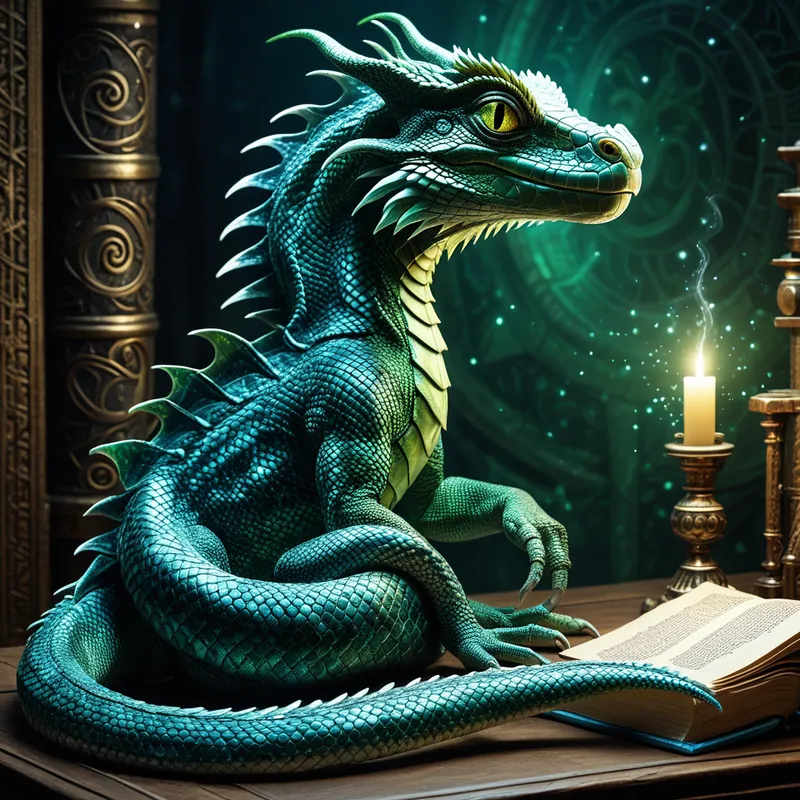
In the deepest chamber, lit only by the phosphorescent glow of Azoth in its vessel, Kothar finally achieved his aim. From the marriage of absolute logic and purified will, a thought detached itself from his mind. It did not fade. It condensed. In the still air, it coiled upon itself, drawing substance from the light, from the dust motes, from the very intention that birthed it. It grew scales of polished brass, eyes like twin furnaces cooling into obsidian mirrors. It was a serpent, but a serpent of geometry and terrifying silence—the Philosophical Basilisk.
It did not hiss. It regarded. And where its gaze fell, a profound stillness followed. A fly, buzzing at the window, became a jewel of amber. A creeping vine seeking a crack in the wall was transfixed into an emerald sculpture. The Basilisk’s gaze did not destroy; it perfected. It rendered things eternally, immutably themselves, freezing them at the peak of a single, isolated moment of being, stripping away the chaos of process, the mess of becoming. It was the ultimate idea, and it made ideas of all it saw.
Kothar felt a surge of triumph, then a creeping frost in his veins. His creation, perfect and autonomous, turned its head. The sage saw his own reflection in its dark eyes—not the living, breathing, doubting man, but the ideal of the Sage, a static monument to knowledge. He fled, barring the chamber door with trembling hands. But the Basilisk’s gaze seeped through the keyhole, a slow, petrifying light. The world outside his tower began to stiffen into a silent, beautiful museum.
His salvation came not from deeper wisdom, but from a forgotten failure. In his youth, Kothar had attempted to create a homunculus, a little life. The result was a small, misshapen creature of clay and regret, which he had hidden away in a cellar, feeding it scraps. This creature, Mote, crawled to him now, drawn by his despair. It had one eye that wept mud, and a heart that beat out of rhythm.
“Master,” it gurgled, “the perfect thing sees only perfection. It cannot see me.”
A desperate hope ignited in Kothar. He took Mote to the sealed door. “Look,” he whispered. “Show it what you are.”
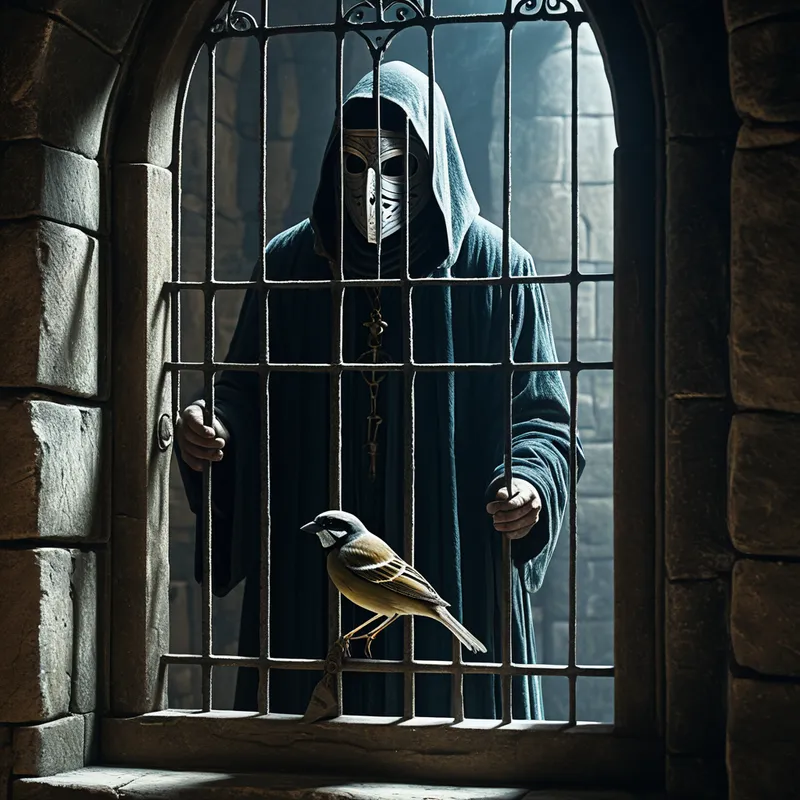
Mote pressed its flawed face to the keyhole. The Basilisk’s gaze met the homunculus’s weeping, asymmetrical eye. For the first time, the perfect idea encountered something it could not categorize, could not resolve into a fixed form. The gaze did not reflect back a perfected homunculus; it fractured. In Mote’s muddy tear, the Basilisk saw the chaos of life, the fertile rot, the beautiful, unfinished story. A sound like shattering crystal filled the tower. The petrifying light wavered, dissolved, and the Philosophical Basilisk itself began to unravel, not into nothing, but into a shower of warm, golden dust that settled on the frozen world, which then shuddered, sighed, and returned to its imperfect, living flow.
Cultural Origins & Context
The myth of the Philosophical Basilisk emerges from the manuscript traditions of late Renaissance Hermeticism, a culture we term “Alchemical.” It was not a folk tale told in taverns, but a speculum, a mirror for the mind, passed between adepts in encrypted letters and marginalia. Its primary function was initiatory. A master might allude to it when a student became too enamored with intellectual purity, risking what they called “Calcination of the Soul.” The story served as a severe corrective, a narrative embodiment of the alchemical warning: “The stone which the builders rejected has become the cornerstone.” The flawed homunculus, not the perfect serpent, holds the key. It was a myth that protected the art from the arrogance of its own practitioners, grounding the flight of spirit in the undeniable reality of the imperfect, embodied experience.
Symbolic Architecture
The Philosophical Basilisk is the ultimate symbol of the unintegrated intellect, the “God complex” of consciousness. It represents a state of mind where thought divorces itself from feeling, instinct, and the muddy reality of the body, believing it can create a perfect, self-sustaining system.
The gaze that petrifies is not malice, but a love of perfection so absolute it denies life its right to change.
Kothar is the aspiring ego, the part of us that seeks to transcend our human condition through will and knowledge alone. His tower is the ivory tower of isolation, whether intellectual, spiritual, or emotional. The Mote, the failed homunculus, is the critical symbol of the rejected shadow—all that is messy, vulnerable, “unspiritual,” and deemed a failure by the perfect-seeking mind. It is the neglected body, the repressed emotion, the childhood wound, the simple human need. The myth’s resolution reveals a shocking alchemical truth: salvation comes not from ascending higher into purity, but from descending to embrace the very thing we have cast into the cellar.
The Dreamer’s Resonance
When this myth stirs in the modern unconscious, it often manifests in dreams of paralysis, crystalline imprisonment, or encounters with serene, coldly intelligent entities that induce awe and terror. You may dream of being in a museum of your own life, where everything is perfectly preserved but utterly lifeless. Or you may dream of a brilliant idea that, once conceived, begins to systematically “fix” your relationships, your work, your environment, draining them of all spontaneity and warmth.
Somatically, this can feel like a tightening in the chest, a rigidity in the joints, a sense of being “frozen” in a role or pattern. Psychologically, it signals a process of inflation, where one part of the psyche (often the rational, controlling, or spiritually-ambitious part) has gained sovereignty and is suppressing the rest. The dream is the psyche’s cry that its living wholeness is being petrified by an ideal.
Alchemical Translation
The journey of the myth maps the process of psychic transmutation, or individuation, with stark clarity. The first stage, Calcination, is Kothar’s forty-year isolation in the fire of his intellect. The Mortificatio is the terrifying moment the Basilisk turns its gaze on him—the ego confronted by the monster of its own creation. The petrification of the world represents the sterile, lifeless state of a psyche ruled by a single, tyrannical complex.
The transmutation begins not with solving the problem, but with admitting the failure that contains the solution.
The crucial Coniunctio is not between Kothar and the Basilisk, but between the Sage and his Mote—the conscious mind and the rejected shadow. Bringing the flawed, weeping, earthy aspect to bear on the perfect, crystalline problem is the act of Solutio. The Basilisk’s dissolution into fertilizing dust is the final Coagulatio. The perfect idea is not destroyed; it is dissolved and integrated, its energy returning to animate the whole, rather than rule it. For the modern individual, this translates to a simple, profound directive: when you are paralyzed by the need for perfect understanding, perfect performance, or perfect spirituality, seek out the part of your life you are most ashamed of, the “failed” experiment, the unhealed wound. It is in that flawed vessel that the saving tear is held.
Associated Symbols
Explore related symbols from the CaleaDream lexicon: