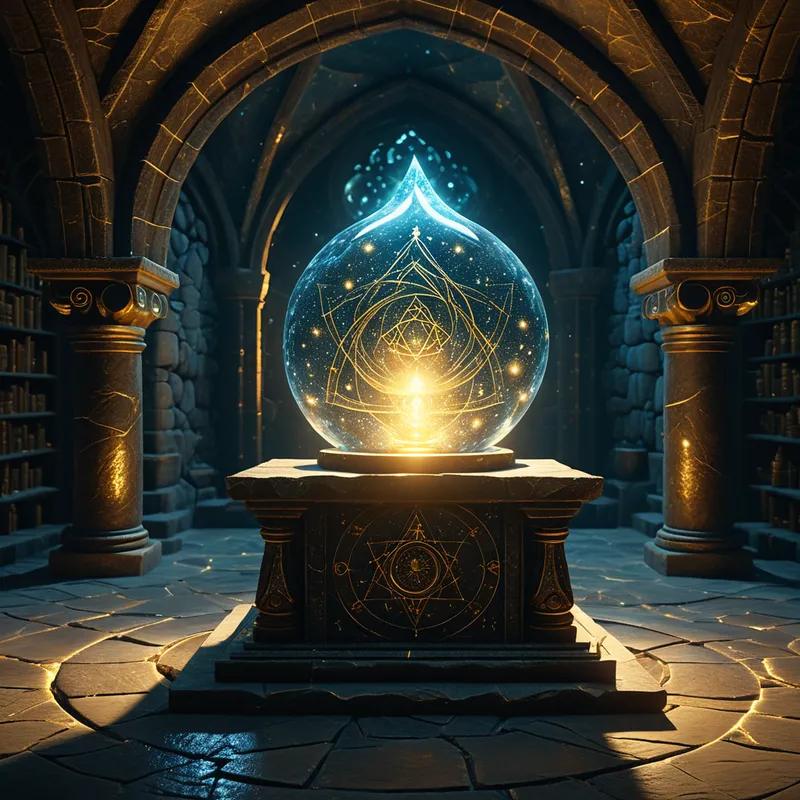
Philosopher's Stone Myth Meaning & Symbolism
The quest for the Stone is the soul's journey to transmute base matter into spiritual gold, achieving the union of body, mind, and spirit.
The Tale of the Philosopher’s Stone
Listen, and I will tell you of a secret fire that burns not in [the hearth](/myths/the-hearth “Myth from Norse culture.”/), but in the heart of [the world](/myths/the-world “Myth from Tarot culture.”/). It is the tale of the Philosopher’s Stone.
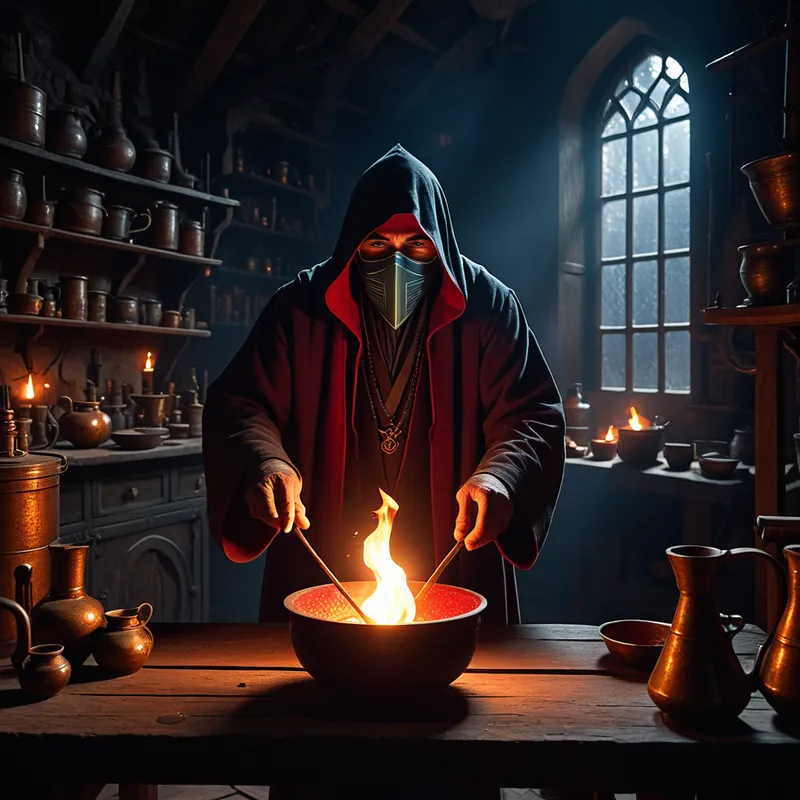
In the beginning, there was the [Prima Materia](/myths/prima-materia “Myth from Alchemical culture.”/). It was the dark, formless womb of potential, a sleeping dragon coiled in the depths of [the earth](/myths/the-earth “Myth from Hindu culture.”/) and the soul. From this abyss, [the Great Work](/myths/the-great-work “Myth from Alchemical culture.”/) was conceived. The seeker, the Adept, did not venture into sunlit forests or scale storm-wracked mountains. Their journey was inward, into the shadowed [labyrinth](/myths/labyrinth “Myth from Various culture.”/) of their own laboratory, which mirrored the cosmos itself. The air was thick with the scent of salt and [sulfur](/myths/sulfur “Myth from Alchemical culture.”/), of vinegar and strange herbs. The only sounds were the patient crackle of the furnace—the Athanor—and the slow drip of condensation in glass vessels.
The conflict was not with a beast, but with matter itself—base, leaden, and stubborn. It was a battle against impurity, distraction, and the despair of endless repetition. [The Adept](/myths/the-adept “Myth from Alchemical culture.”/) would toil for years, following the cryptic recipes of the ancients, the [Magnum Opus](/myths/magnum-opus “Myth from Alchemical culture.”/). They would dissolve and coagulate, distill and [ferment](/myths/ferment “Myth from Alchemical culture.”/), watching for the signs: the [Nigredo](/myths/nigredo “Myth from Alchemical culture.”/), a descent into blackest night where all form seemed lost; the Albedo, where a white queen arose, pure as moonlight; and the Citrinitas.
But the final gate was the most perilous: the [Rubedo](/myths/rubedo “Myth from Alchemical culture.”/). Here, the twin principles—the fiery, masculine Sulfur and the fluid, feminine [Mercury](/myths/mercury “Myth from Roman culture.”/)—long held in opposition, were brought together in a [sacred marriage](/myths/sacred-marriage “Myth from Alchemy culture.”/), the Coniunctio. This was not a gentle union, but a fiery conflagration within the sealed vessel. If the Adept’s will and purity held, if they had truly died to their old self in the blackness, then from the ashes of that union, it would bloom.
Not with a [thunderclap](/myths/thunderclap “Myth from Various culture.”/), but with a profound, silent radiance. In the heart of [the crucible](/myths/the-crucible “Myth from Alchemical culture.”/), a substance would form. It was said to be heavier than gold, yet lighter than air; red as blood, yet crystalline; a stone that was not a stone. It was the Elixir Vitae and the agent of Transmutation. A single grain of it, cast upon molten lead, would turn the entire mass into pure, sun-like gold. A drop of its tincture could heal any ailment and grant vitality. The quest was over. [The dragon](/myths/the-dragon “Myth from Chinese culture.”/) was tamed, not slain, and its fiery breath now served the perfected soul.
Cultural Origins & Context
The myth of the Philosopher’s Stone is not the folklore of a single people, but the esoteric backbone of a transnational, centuries-long tradition that flourished from Hellenistic Egypt through the Islamic [Golden Age](/myths/golden-age “Myth from Universal culture.”/) and into Medieval and Renaissance Europe. Its practitioners were often monks, physicians, and natural philosophers operating at the frayed edge of sanctioned knowledge. The myth was passed down not in public epics, but in deliberately obscure, lavishly illustrated manuscripts—the Mutus Liber or “wordless books.”
Its societal function was dual. Exoterically, it was a proto-science, a sincere investigation into the nature of matter that laid groundwork for chemistry and medicine. Esoterically, and more profoundly, it was a coded spiritual psychology. [The laboratory](/myths/the-laboratory “Myth from Alchemical culture.”/) processes were an allegory for the purification and exaltation of the human soul. The myth served as a container for heretical and transformative ideas about the divine being immanent within nature and the human potential for deification, ideas that had to be hidden from orthodox authorities. It was a myth for initiates, for those who could “read the signs.”
Symbolic Architecture
At its core, the [Stone](/symbols/stone “Symbol: In dreams, a stone often symbolizes strength, stability, and permanence, but it may also represent emotional burdens or obstacles that need to be acknowledged and processed.”/) is the ultimate [symbol](/symbols/symbol “Symbol: A symbol can represent an idea, concept, or belief, serving as a powerful tool for communication and understanding.”/) of the achieved Self, the endpoint of the process of Individuation. It represents the psychic center that is both created and discovered, the [diamond](/symbols/diamond “Symbol: Diamonds symbolize purity, strength, and unyielding love, often representing wealth and high status.”/)-like [clarity](/symbols/clarity “Symbol: A state of mental transparency and sharp focus, often representing resolution of confusion or attainment of insight.”/) that emerges from the long compression of conflict and suffering.
The Stone is the psyche made substantial, the point where spirit fully incarnates and matter becomes conscious.
The Prima Materia is the unformed content of the personal and [collective unconscious](/symbols/collective-unconscious “Symbol: The Collective Unconscious refers to the part of the unconscious mind shared among beings of the same species, embodying universal experiences and archetypes.”/)—our raw complexes, instincts, and potential. The [Athanor](/symbols/athanor “Symbol: An alchemical furnace representing spiritual transformation, purification, and the sustained process of creating the Philosopher’s Stone.”/) is [the ego](/myths/the-ego “Myth from Jungian culture.”/), the necessary [vessel](/symbols/vessel “Symbol: A container or structure that holds, transports, or protects something essential, representing the self, emotions, or life journey.”/) that must withstand the heat of self-confrontation. The stages of Nigredo, [Albedo](/symbols/albedo “Symbol: In alchemy, the whitening stage representing purification, spiritual ascension, and the emergence of consciousness from darkness.”/), and Rubedo map directly onto the psychological process of confronting the [Shadow](/symbols/shadow “Symbol: The ‘shadow’ embodies the unconscious, repressed aspects of the self and often represents fears or hidden emotions.”/) (Nigredo), integrating the [anima](/symbols/anima “Symbol: The feminine archetype within the male unconscious, representing soul, creativity, and connection to the inner world.”/)/[animus](/symbols/animus “Symbol: In Jungian psychology, the masculine inner personality in a woman’s unconscious, representing logic, action, and spiritual guidance.”/) or [soul](/symbols/soul “Symbol: The soul represents the essence of a person, encompassing their spirit, identity, and connection to the universe.”/)-[image](/symbols/image “Symbol: An image represents perception, memories, and the visual narratives we create in our minds.”/) ([Albedo](/symbols/albedo “Symbol: In alchemy, the whitening stage representing purification, spiritual ascension, and the emergence of consciousness from darkness.”/)), and finally achieving the [synthesis](/symbols/synthesis “Symbol: The process of combining separate elements into a unified whole, representing integration, resolution, and the completion of a personal journey.”/) of all opposites into a new, stable totality (Rubedo). The Stone itself is the emergent, transcendent function that resolves lifelong tensions.
The Dreamer’s Resonance
When this myth stirs in the modern unconscious, it rarely appears as a literal stone. Instead, one might dream of finding a mysterious, impossibly dense object in a basement or garden—a gem, a key, a lump of iridescent metal that feels profoundly significant. The dreamer often knows, somatically, that this object has the power to “fix” or “complete” something. Alternatively, the dream may feature intricate, puzzling machinery (the laboratory) that the dreamer must operate, or a process of patiently cooking, refining, or distilling a substance.
These dreams often cluster during life phases of intense inner work: during analysis, after a crisis, or at the onset of midlife. The somatic sense is one of pressured containment—the “vessel” of one’s life feeling sealed and heated. Psychologically, this signals the unconscious activation of the individuation process. The dreamer is in the Athanor. The feeling of confusion or searching for a lost formula reflects the ego’s struggle to consciously navigate a deeply autonomous psychic transformation.
Alchemical Translation
For the modern individual, the myth models the path of psychic transmutation not as a sudden enlightenment, but as a devoted, practical craft applied to the raw material of one’s own life. The “base metal” is our neuroses, our repetitive patterns, our unresolved traumas—all that feels heavy, inert, and worthless. The promise of the myth is that this very material is the essential ingredient.
The first operation is Solve: the conscious deconstruction of rigid identities and narratives. This is the therapy session, the journaling, the honest confrontation with failure. It leads to the Nigredo, a depressive, lost state where old certainties die.
The fire that melts the metal is not comfort, but truthful self-observation.
Then comes Coagula: the slow, patient rebuilding from insight. This is the integration of shadow qualities, the nurturing of neglected talents (the Albedo). The final, critical leap is the Coniunctio—not a harmonizing, but a fiery holding of tension. One must consciously contain the opposition between, say, fierce ambition and the need for rest, or logical judgment and intuitive feeling, without letting one annihilate the other. From sustaining this tension in [the vessel](/myths/the-vessel “Myth from Alchemical culture.”/) of awareness, a third [thing](/myths/thing “Myth from Norse culture.”/) emerges: the Stone.
In modern terms, the Stone is not perfection, but wholeness. It is the embodied capacity to hold paradox, to find meaning in suffering, and to act from a center that unites thought, feeling, and instinct. It is the “gold” of an authentic personality, capable of transmuting the leaden moments of existence into the substance of a meaningful life. The Elixir is the vitality that flows from such integration. The myth assures us that the quest itself, the diligent work on oneself, is the only true forge where the Stone can be found.
Associated Symbols
Explore related symbols from the CaleaDream lexicon:
- Tech Startup
- Vein of Gold
- Quartz Crystal
- Malachite Disk
- Hematite Sphere
- Quartz Cluster
- Moldavite Fragment
- Elixir of Life
- Sorcerer’s Stone
- Holographic Card
- Catalyst Stone
- Pulsating orbs
- Sunshine Shimmer
- Ember Stone
- Firestone
- Singularity
- Glucose
- Elixir
- Orichalcum
- Catalysis
- Vaccine
- Compact
- Quartz
- Incandescence