
Philomela's Tongue Myth Meaning & Symbolism
A princess, silenced by violence, weaves her story into a tapestry, transforming trauma into a testament of truth and ultimate metamorphosis.
The Tale of Philomela’s Tongue
Hear now a tale not of glorious heroes, but of a silence that screamed, and a loom that spoke. In the ancient land of Attica, there lived a king, Pandion, who had two daughters as radiant as the dawn: Procne and Philomela. Procne was given in marriage to Tereus, a lord of distant, wild Thrace, a man whose valor in war was as famed as the shadow in his heart.
Years passed in Thrace. Procne, longing for her sister, begged her husband to bring Philomela for a visit. Tereus sailed to Athens and beheld Philomela. In that moment, a fire not of the hearth but of the abyss was kindled in him. He swore oaths to Pandion, promises of protection as solid as the earth, and sailed away with the maiden.
But the ship did not sail for Thrace’s court. It veered to a lonely, wooded headland. There, in a secluded shepherd’s hut, Tereus revealed his true nature. He dragged Philomela inside, and with a violence that choked the very air, he violated her. As she lay broken, her voice rose—a torrent of curses, vows to shout his crime from the highest peak, to tear the veil from his monstrous face.
Her words were arrows aimed at his false kingship. And so, to silence the truth, he did the unthinkable. He drew his sword. But he did not take her life. He took her voice. He seized her tongue and cut it from its root, casting the bloody flesh to the earth where it twitched, a final, silent witness. He left her in that stone prison, believing her story was now buried in mute flesh.
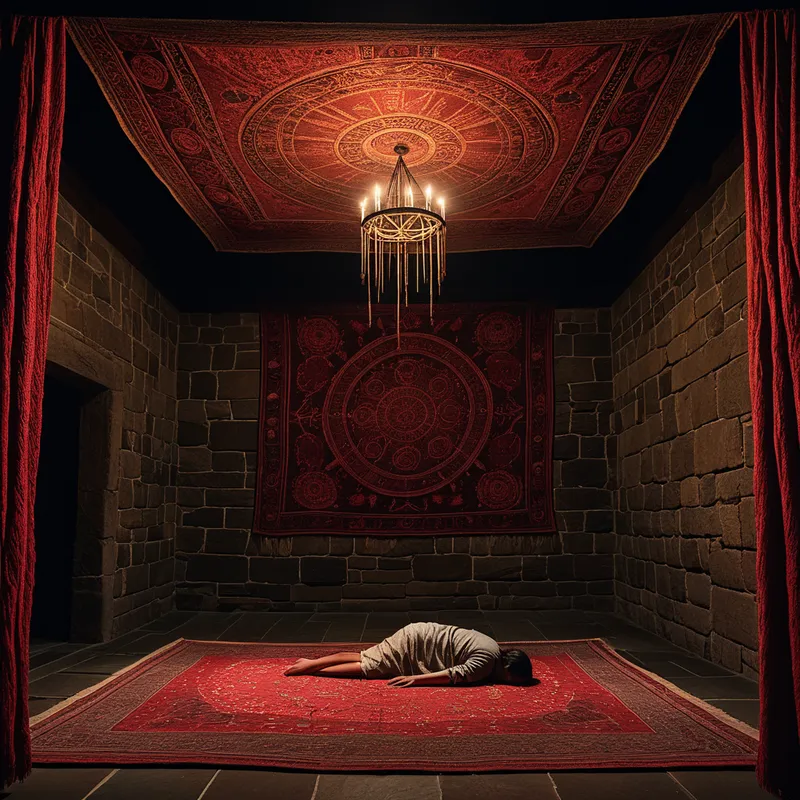
Yet, he did not know the creativity of a soul in torment. Locked away, with only the seasons as her calendar and her agony as her ink, Philomela conceived a plan. She asked her guards for a loom. Day upon day, month upon month, she wove. Not patterns of flowers or hunting scenes, but a narrative in thread. With crimson and somber hues, she wove the story of the voyage, the hut, the violence, the silencing—the entire truth of Tereus’s crime into a tapestry. When it was complete, a masterpiece of indictment, she gestured pleadingly to an old serving woman, conveying through desperate eyes that this cloth must reach her sister, Queen Procne.
The servant, understanding the weight of the silent plea, carried the woven story to the palace. Procne received it. Her fingers traced the horrific images. The loom had spoken where the tongue could not. The silence of the tapestry was louder than any scream. In that moment, sisterhood became a furies’ bond. Procne, during the rites for Dionysus, when women roam the wilds unchallenged, found Philomela’s prison and freed her. Their reunion was wordless, a communion of shared rage and shattered love.
And from this rage, a terrible justice was born. Procne remembered her son by Tereus, the boy Itys. In a act of retribution that mirrors the brutality it answers, the sisters killed the child, prepared his flesh, and served it to Tereus at a feast. As the king gorged himself on his own lineage, Philomela emerged, her face a mask of vengeful triumph, and hurled the child’s head onto the table.
The revelation was cataclysmic. Tereus, in a fury of grief and horror, seized his axe and chased the sisters through the woods. But the gods, who had watched this tragedy unfold, intervened. As he raised his axe for the final blow, all three were transformed. Tereus became a crested hoopoe, his weapon becoming a sharp beak. Procne, forever mourning, became a swallow, her breast stained with eternal sorrow. And Philomela, the silenced weaver, became a nightingale, her throat now capable of the most beautiful, haunting, and sorrowful song in all the world.
Cultural Origins & Context
This harrowing myth comes to us primarily from the Roman poet Ovid in his Metamorphoses, though its roots are undeniably Greek. It belongs to a cycle of Athenian foundation myths, explaining the origins of certain birds and serving as a dark counterpart to tales of civic order. In a culture where public speech (parrhesia) was the cornerstone of male citizenship, the brutal silencing of a woman’s voice was a profound transgression. The myth was not a simple folktale but a cultural nightmare, exploring the extremes of patriarchal violation and the terrifying, transformative power of female rage when cornered.
Its societal function was complex. On one level, it was a cautionary tale about the chaos that erupts when hospitality, marriage, and oath-keeping—the sacred bonds of xenia—are shattered. On another, it gave a voice, however mythic, to the unspeakable. It acknowledged the reality of violence against women and the terrifying, creative lengths to which the silenced might go to be heard. The loom, a quintessential symbol of proper, domestic female labor, becomes in this story the ultimate instrument of subversion and truth-telling.
Symbolic Architecture
The myth’s power lies in its stark, brutal symbols. Philomela’s severed tongue is not merely an act of mutilation; it is the theft of narrative control, the attempt to erase her from the story of her own life. It represents the ultimate psychic trauma: the forcible internalization of experience, making it unsayable.
The loom, then, becomes the psyche’s answer to violence. When the direct path of speech is destroyed, consciousness finds a lateral, symbolic route.
The tapestry is the embodied psyche. It is memory made manifest, trauma externalized and given form. It bypasses the shattered verbal faculty and communicates directly through image and symbol—the native language of dreams and deep trauma. It is proof that what is silenced does not disappear; it seeks another, often more potent, mode of expression.
The final metamorphosis into birds is the ultimate alchemical symbol. They do not die, nor are they simply punished. They are translated. Their overwhelming, human passions—Philomela’s need to sing her truth, Procne’s consuming grief and rage, Tereus’s violent pursuit—are distilled into their eternal natures. The nightingale’s song, beautiful and melancholy, is the soul’s truth finally voiced, but forever tinged with the pain of its origin.
The Dreamer’s Resonance
When this myth stirs in the modern dreamer, it signals a profound psychological process. To dream of being mute, of having one’s mouth filled with cloth or earth, speaks to a core experience of being silenced—not necessarily by another’s violence, but by internalized shame, societal expectation, or a trauma that has stolen one’s words. The somatic feeling is often of a scream trapped in the chest, a pressure with no outlet.
Dreams of intricate weaving, of creating a cryptic map or a coded message, mirror Philomela’s tapestry. The psyche is attempting to show what it cannot yet say. It is assembling the fragments of experience into a coherent, if painful, picture. This is the stage of processing, where the dreamer is the weaver in the prison of their own unconscious, patiently crafting the story of their wound.
A dream of metamorphosis into a bird, especially one associated with song or flight, often follows this period of silent crafting. It heralds the possibility of translation—not an erasure of the pain, but a transformation of its energy. The trauma may become the source of a new “song”: a creative pursuit, a deepened empathy, or the hard-won ability to speak one’s truth.

Alchemical Translation
The myth of Philomela models the individuation journey through its stark stages: violation, imprisonment, creative embodiment, and ultimate transmutation. The initial trauma (Tereus’s act) represents a shattering of the ego’s naive world. The conscious self is overpowered by a brutal aspect of the shadow and rendered “speechless”—unable to integrate the experience.
The imprisonment is the necessary, if agonizing, stage of containment. Here, in the solitude of suffering, the work begins. Philomela does not go mad; she weaves. This is the alchemical nigredo, the blackening, where in the darkness of despair, the first matter of the soul is worked upon.
The act of weaving the tapestry is the opus itself: the conscious, patient work of giving symbolic form to the formless pain. It is the ego aligning with the creative, meaning-making power of the Self.
Presenting the tapestry to Procne (the sister, the other, the ally within the psyche) represents bringing this unconscious material into a form that can be witnessed and understood by another part of the self. This recognition sparks the fierce, transformative rage that leads to the overthrow of the old, destructive order (symbolized by the fate of Itys).
Finally, the metamorphosis is the rubedo, the reddening, the final stage of alchemical gold. The raw, human agony is not eliminated but sublimated. Philomela’s truth becomes a song. The pain is not gone; it has become the timbre of her voice, the source of its haunting beauty and depth. For the modern individual, this translates to the hard-earned state where one’s wound is no longer a secret prison, but has become, through the arduous work of symbolic creation, an integral part of one’s unique voice and contribution to the world. The silenced one becomes the singer. The weaver in the dark becomes the author of her own, transformed, story.
Associated Symbols
Explore related symbols from the CaleaDream lexicon: