
Philoktetes Myth Meaning & Symbolism
A hero, cursed with a festering wound, is abandoned on a desolate island for ten years, only to be retrieved when his suffering becomes the key to victory.
The Tale of Philoktetes
Hear now the tale of the man who held the fire of the gods and was burned by it. The story begins not with glory, but with a stench. On the sacred isle of Artemis, the air was thick with the smell of sacrifice. The Greek fleet, bound for Troy, had paused to honor the divine huntress. Philoktetes, son of Poeas, stood among them, a man of renowned skill. It was he, and he alone, who had been worthy to light the funeral pyre of the great Heracles, receiving the hero’s unerring, invincible bow and poisoned arrows as his sacred reward.
But the favor of the gods is a double-edged sword. As Philoktetes approached the altar, a serpent—some say sent by Hestia, angered by the disturbance of her wild places—struck. Its fang pierced his foot. The wound did not heal. It festered, weeping a foul pus, and echoed with agonized cries that shattered the peace of the camp. The pain was unendurable, a constant, screaming companion. Worse than the pain was the smell; a putrid, rotting odor that spoke of death walking among the living.
The commanders, Odysseus and the sons of Atreus, made a hard, pragmatic choice. The unity of the army, the silence needed for prayer and strategy, was paramount. On the voyage to Troy, they steered their ships to the desolate, rocky shores of Lemnos. With whispers of pity and shudders of disgust, they carried the screaming Philoktetes ashore, left him with his bow, a few supplies, and the echoing vastness of the sea. Then they sailed away. The last sound he heard was the fading splash of oars, leaving him alone with his torment.
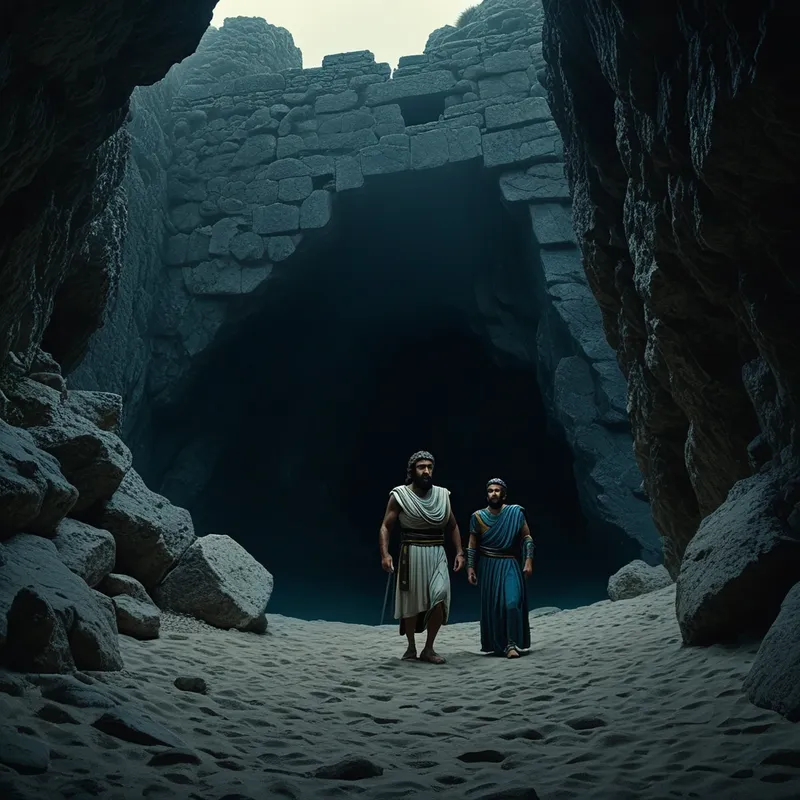
For ten long years, Philoktetes lived a life of raw, animal survival. His world shrank to the circumference of his pain. The cave was his palace, the cries of gulls his chorus. He dressed his wound with rags, hunted seabirds with the god-bow, and howled his rage at the uncaring sky. The hero was gone, replaced by a wraith of suffering, forgotten by the world that had used him and cast him aside.
Yet, the Fates had not finished their weaving. A prophecy, whispered by a captured seer, reached the Greeks, now bogged down in the tenth year of the war at Troy’s walls: “Ilion cannot fall without the bow of Heracles and the man who wields it.” The very source of their disgust was now the key to their victory. Odysseus, the master of tricks, returned to Lemnos, bringing with him the young, honorable Neoptolemus. Their plan was deceit: to steal the bow through guile. But Neoptolemus, gazing upon the broken, noble man in his cave, felt his heart fracture. He confessed the ruse.
In that moment of raw, painful truth, something shifted. The gods, perhaps Asclepius himself, intervened. The great hero Heracles, now immortal, appeared from the heavens. He spoke not of pity, but of destiny. He commanded Philoktetes to go to Troy, where his wound would be healed by the sons of Asclepius, and where his suffering would finally be transformed into purpose. With the weight of divine command and the support of the remorseful Neoptolemus, Philoktetes chose. He left his island of agony. At Troy, he was healed. Then, standing before the Scaean Gates, he drew back the great bow, and with an arrow guided by a decade of pent-up fury and divine will, he struck down the Trojan prince Paris, the spark of the war. The man who had been discarded as useless became the architect of victory.
Cultural Origins & Context
The myth of Philoktetes is a cornerstone of the Epic Cycle, the body of poems that surrounded the saga of Troy. It was most famously dramatized in the tragedy Philoktetes by Sophocles, performed in 409 BCE. In the competitive, public arena of the Athenian Dionysia, this story was not mere entertainment; it was a profound civic and psychological examination.
Sophocles presented the myth at a time when Athens was deeply scarred by the long, brutal Peloponnesian War. The audience knew intimately the costs of conflict: the wounded veterans, the hard pragmatism of leaders, the erosion of old virtues. The play forced them to confront uncomfortable questions about the treatment of the suffering, the morality of expediency (embodied by Odysseus), and the possibility of integrating a polluted, pained element back into the social body for its own salvation. The myth functioned as a cultural container for discussing trauma, utility, and the complex relationship between individual agony and collective destiny. It was passed down not just as a hero’s tale, but as a moral and political dilemma staged before the gods.
Symbolic Architecture
At its heart, Philoktetes is the archetype of the Shadow cast out. His festering wound is not merely physical; it is the visible manifestation of a sacred curse, a divine affliction. It represents that part of the self or the community which is too painful, too shameful, too disruptive to be kept in the light of consciousness.
The wound that will not heal is the truth that will not be silenced.
The bow of Heracles is his paradoxical power. It is the gift born of a sacred duty (lighting Heracles’ pyre), linking him to the divine, yet it is utterly useless to him in his exile for any purpose beyond bare survival. It symbolizes a latent potential, a destined skill or truth, that is completely disconnected from its rightful context. The island of Lemnos is the psychic hinterland, the place of exile where the unwanted aspects of the self are dumped—a landscape of isolation where the ego’s rejected contents scream in perpetuity.
Odysseus represents the pragmatic, strategic consciousness that seeks to achieve goals (the fall of Troy) through manipulation, often at the cost of integrity. Neoptolemus is the nascent moral conscience, the part of the psyche that recognizes the betrayal and struggles to reconcile expediency with honor. The final intervention of the deified Heracles is crucial: it represents the transcendent function, the arrival of a symbolic, archetypal authority from a level beyond the personal conflict. This authority does not erase the pain but re-contextualizes it, revealing its necessary role in a larger pattern of meaning.
The Dreamer’s Resonance
When this myth stirs in modern dreams, it often signals a profound encounter with a long-exiled part of the psyche. To dream of a festering, neglected wound—especially on the foot, the part of us that makes contact with the world and moves us forward—suggests a foundational pain that inhibits progress. The dreamer may be isolating themselves (the island), feeling betrayed by their own ambitions or by others (the abandoning fleet), or nursing a bitterness that has become a core identity.
Somatically, this can manifest as chronic tension, a sense of being “stuck,” or illnesses that resist clear diagnosis—the body speaking the language of the exiled wound. Psychologically, it is the process of confronting what philosopher Nietzsche called “the spirit of gravity,” that heavy, painful burden that one must eventually learn to carry, not discard. The dream is an invitation to stop howling in isolation and to begin the terrifying, necessary process of retrieving that wounded, potent, and utterly essential part of the self.

Alchemical Translation
The journey of Philoktetes is a perfect map for the alchemical process of individuation, specifically the stage of mortificatio and solutio—the rotting and the dissolving—followed by a guided coagulatio—a re-solidification with new purpose.
The initial state is one of separation. The conscious ego, focused on its collective mission (the war), cannot tolerate the stench and noise of the wound (the complex) and exiles it. This is a necessary, if brutal, stage of self-preservation. The decade on Lemnos is the nigredo, the blackening, where the exiled content suffers in darkness, a putrefaction that seems like utter ruin.
The island of exile is also the crucible of transformation; nothing can be reborn that has not first been broken down.
The retrieval is the most delicate alchemical operation. It cannot be accomplished by brute force (the army) nor by complete deceit (Odysseus’s initial plan). It requires the conjunctio, the coming together, of the cunning mind (Odysseus) and the feeling heart (Neoptolemus), mediated by truth-telling. This confrontation with reality is the solvent that begins to loosen the calcified pain.
Finally, the appearance of Heracles is the archetypal lapis philosophorum, the Philosopher’s Stone. It represents the emergence of a transpersonal meaning. The wound is not simply healed; it is redeemed by being placed within a cosmic narrative. The personal suffering is revealed to have been a necessary ingredient for a collective destiny. The alchemical gold produced is not just victory at Troy, but the integration of the outcast. The once-useless sufferer becomes the essential agent, his poisoned arrows—now symbols of his transformed pain—finding their destined mark. For the modern individual, this translates to the hard-won realization that our deepest wounds, our most shameful secrets, often hold the key to our unique potency and purpose. We are not asked to celebrate the pain, but to consent to carry it forward, where it can be transmuted from a source of isolation into the very instrument of our completion.
Associated Symbols
Explore related symbols from the CaleaDream lexicon: