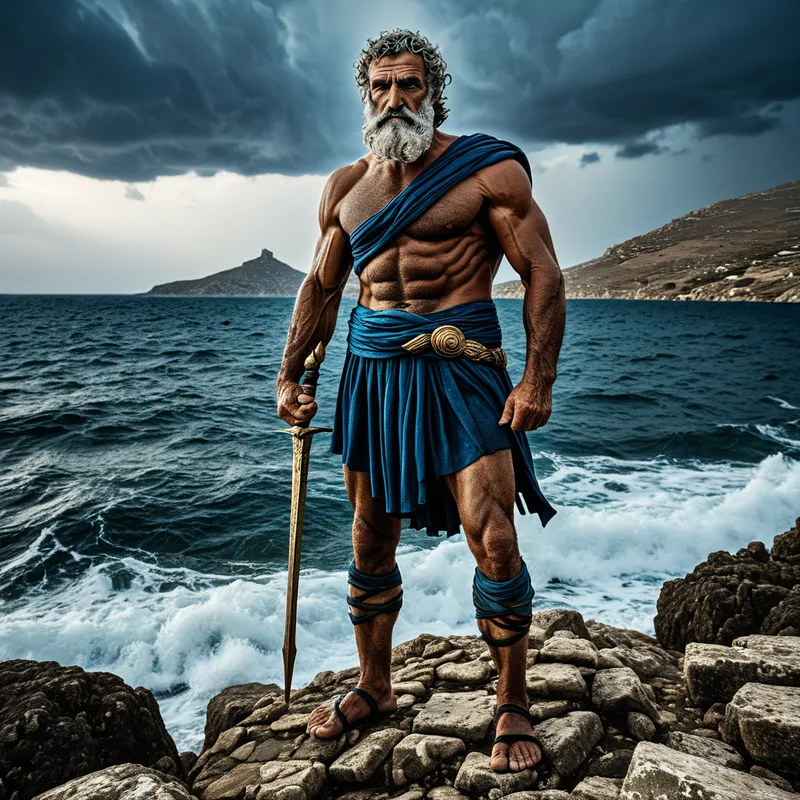
Philocetes Myth Meaning & Symbolism
A Greek hero, wounded and abandoned for ten years, whose unbearable suffering and sacred bow become essential to the final victory at Troy.
The Tale of Philocetes
Hear now the tale of the man the gods forgot, the hero whose agony became his altar. It begins not with glory, but with a stench.
The great fleet of the Achaeans was a forest of masts upon the wine-dark sea, bound for Troy. Among them sailed Philocetes, son of Poeas, a prince of unmatched skill with the bow—a bow gifted to him by the dying Heracles himself, a weapon strung with destiny. But the voyage was cursed from the first oar-stroke. As the ships paused at the isle of Chryse, Philocetes, drawn by piety or fate, approached a hidden altar. There, guarding the shrine of the nymph, a serpent lay coiled. It struck not to kill, but to poison. Its fang pierced his foot.
The wound did not heal. It festered. It wept a pus so foul, a pain so shrieking, that it seemed to carry the venom of the underworld itself. Philocetes’s cries were not of a man, but of a wounded beast. They tore through the camp, a discordant hymn that shattered sleep and turned men’s bowels to water. The stench of his rotting flesh clung to the sails, a miasma that promised ill-fortune.
And so, the commanders—the shrewd Odysseus, the noble Achilles—made a choice. Not of mercy, but of expediency. On the barren, wind-scoured shores of Lemnos, they carried the screaming, fevered hero. They laid him in a shallow cave, left him with his bow, his arrows, and a skin of water. Then they turned their backs on his curses, raised their sails, and fled from the sound of his suffering. For ten years, Philocetes lived as a ghost of war. He learned the language of gulls and the patience of stone. His wound was his only companion, a weeping mouth that spoke of endless betrayal. His bow, the divine gift, hung unused—a symbol of a power he could no longer wield for the comrades who had cast him out.
Meanwhile, at Troy, walls would not fall. Prophets whispered that an oracle had spoken: the city could not be taken without the arrows of Heracles. The very bow that lay with the abandoned man. A cold dread settled on Odysseus. He, the master of tricks, must now return to the agony he had deserted. With the young, virtuous Neoptolemus in tow, he sailed back to Lemnos. Their mission: deception. Steal the bow.
But the rock of Lemnos had honed more than Philocetes’s body; it had honed his spirit. Neoptolemus, faced with the raw, untamed truth of the hero’s suffering, found his own nobility revolting against the lie. The theft was attempted, but the soul of the young warrior rebelled. In a clash of wills—the cunning of Odysseus against the reclaimed integrity of Philocetes—a different truth emerged. It was not theft that was required, but invitation.
Only the intervention of the deified Heracles himself, appearing from the heavens, could resolve the bitter stalemate. The god-hero commanded his old friend: go to Troy. Your suffering has not been in vain. There, your wound will be healed, and with your arrows, you will win immortal glory.
And so it was. At Troy, the healers tended him. The festering wound, borne for a decade, finally closed. Philocetes, whole once more, stood before the Scaean Gates. He drew the bow of Heracles, its string humming with a forgotten song. A single arrow, guided by fate and fury, found its mark in the heel of Paris, the cause of the war. The archer, once the army’s shame, became its salvation.

Cultural Origins & Context
The myth of Philocetes is a thread woven late into the grand tapestry of the Trojan War cycle. It finds its most famous treatment in the Athenian tragedy Philoctetes by Sophocles, performed in 409 BCE. However, the story was known long before, part of the oral tradition crystallized in epic poems like the Cypria, which detailed the war’s beginnings.
In the competitive, communal world of the Greek city-state, the myth served a profound societal function. It asked uncomfortable questions of the collective. What does the polis do with the unbearable? With the member whose suffering disrupts the harmony and mission of the whole? Philocetes represents the ultimate social exile, the individual sacrificed for the perceived good of the group. Sophocles’s play, staged during the protracted and morally draining Peloponnesian War, would have resonated deeply with an Athenian audience weary of conflict, familiar with hard choices, and suspicious of the Odyssean cunning that often guided their own politics. The myth became a lens to examine the tensions between expediency and integrity, collective goal and individual agony.
Symbolic Architecture
Philocetes is the archetype of the Shadow made flesh. He is what the heroic ego must repress to function: the festering wound, the unbearable cry, the stench of vulnerability. His exile on Lemnos is not merely a plot point; it is the psyche’s act of banishing its own unresolved pain to a remote island of consciousness.
The wound that will not heal is a memory that demands to be felt.
The serpent at Chryse’s altar is no random beast. It strikes the foot, the point of contact with the earth, our foundation and our movement. This is a wound to one’s stance in the world, one’s ability to “stand on one’s own two feet” in society. The divine origin of the bow juxtaposed with the bestial origin of the wound creates the central paradox: his greatest power (the bow) is inextricably linked to his greatest shame (the wound). One cannot be had without the other.
Lemnos itself is the liminal space, the psychological desert where the ego is stripped bare. Here, the heroic identity—“warrior,” “comrade,” “prince”—rots away, leaving only the raw, howling core of being. The bow, unused for a decade, represents potential in stasis, a destiny waiting for the necessary consciousness to wield it.
The Dreamer’s Resonance
When the pattern of Philocetes stirs in the modern dreamer, it speaks of a profound psychological process: the return of the repressed. One may dream of being abandoned in a familiar yet empty place (a deserted office, a childhood home with no people), of a foul odor emanating from one’s own body, or of a cherished skill or tool that is suddenly useless or stolen.
Somatically, this can manifest as a persistent, inexplicable pain or illness that doctors cannot diagnose—a literal “wound that will not heal.” Psychologically, it is the eruption of old grief, a betrayal never processed, a humiliation buried alive. The dream-ego, like the Greek army, wants to flee the discomfort. The Philocetes process insists we stay. It forces us to inhabit the Lemnos of our own psyche, to sit with the stench and the cry until we recognize it not as a foreign invader, but as a disowned part of the self.

Alchemical Translation
The myth of Philocetes is a precise map of individuation, the alchemical transmutation of leaden suffering into golden consciousness. The initial nigredo, the blackening, is the festering wound and the betrayal—the descent into utter despair and isolation on Lemnos. This is not a mistake, but a necessary dissolution of the old, socialized identity.
The bow cannot be drawn until the archer has known the full tension of his own solitude.
The return of Odysseus and Neoptolemus represents the ego’s reluctant, often deceptive, attempt to re-engage with the exiled content—to “steal” the power (the bow) without integrating the pain (the man). This always fails. True integration requires the coniunctio, the sacred marriage symbolized by Neoptolemus’s change of heart. The youthful, principled part of the psyche (Neoptolemus) must ally with the wounded one (Philocetes) against the merely cunning, strategic ego (Odysseus).
The final, transcendent stage is guided by the Senex figure of Heracles. He represents the higher Self, the transpersonal authority that reveals the meaning in the suffering. His command is the insight that heals: your agony was not meaningless; it was the crucible that prepared you to fulfill your destiny. The healing at Troy is the albedo, the whitening—not the erasure of the scar, but the integration of its story into the fabric of the whole self.
For the modern individual, the myth instructs: you cannot simply retrieve your abandoned talents or power. You must first return, in full consciousness, to the Lemnos where you left your pain. You must listen to its cries, bear its stench, and finally, invite it to accompany you. Only then does the sacred bow answer your hand, and the arrow fly true.
Associated Symbols
Explore related symbols from the CaleaDream lexicon: