Pheidippides Myth Meaning & Symbolism
A herald runs to save his city, delivers victory, meets a god in the wilderness, and dies—a story of ecstatic duty and the body's final, sacred message.
The Tale of Pheidippides
Hear now the tale of the fleet-footed one, the man who ran with the fate of a city clinging to his breath. The sun was a bronze shield over the plain of Marathon, and the air trembled not with heat alone, but with the silent dread before the storm of men and metal. Among the Athenians, chosen for his speed that could outpace rumor itself, was Pheidippides, a hemerodromos—a day-runner. His was not the strength of the spear but the endurance of the sinew and the will.
His first run was one of pleading, a desperate arc south to Sparta. Over mountain tracks and through lonely passes, he flew, his heart drumming a rhythm of urgency. He found the Spartans amidst their sacred rites and heard their cold, lawful refusal. No help would come before [the moon](/myths/the-moon “Myth from Tarot culture.”/) was full. The news was a stone in his gut, yet he turned and ran back, the weight of solitude his only companion, to an army standing alone on the shore, outnumbered, watching the Persian host spread like a dark stain on the beach.
Then came the clash—the shouting, the shattering of wood and bone, the incredible, roaring miracle of Athenian victory. The Persians broken, fleeing to their ships. And in that moment of collective gasp, a new terror seized the generals. The Persian fleet would now sail, not home, but around the cape to undefended Athens. To the women, the children, the very heart of [the polis](/myths/the-polis “Myth from Greek culture.”/). They turned to the one whose legs were still taut, whose lungs still knew the song of the road. Pheidippides.
No command was needed. He knew. He drank, splashed [water](/myths/water “Myth from Chinese culture.”/) on his burning neck, and then he was gone. The twenty-five miles from Marathon to Athens unspooled beneath his feet, a blur of dust, olive groves, and the pounding of his own blood. This was no mere dash. It was a distillation of an entire city’s hope into the rhythm of a single man’s flight. The landscape became a prayer; each labored breath, a stanza. He did not feel the stones, the thirst, the screaming protest of his muscles. He was a living arrow, and Athens was the target.
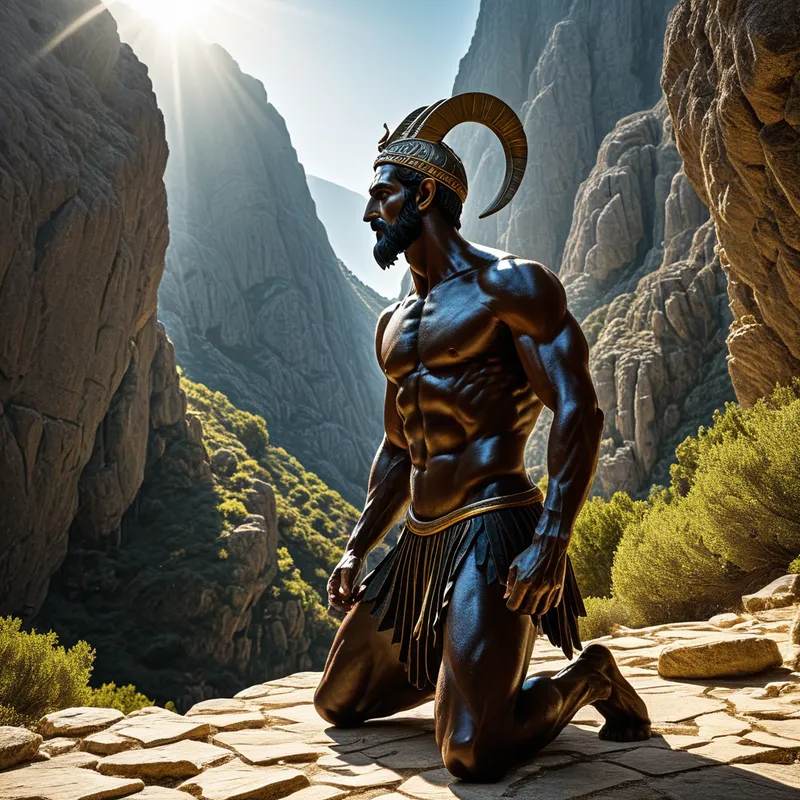
But the gods watch such exertions. As he climbed the final, rugged path through the wilds of Mount Parthenion, the air changed. The scent of pine turned primal, musky. A presence, vast and untamed, filled the narrow pass. Before him stood Pan. The god’s eyes held the deep quiet of the forest and the sharp intelligence of the beast. He spoke, not with a voice, but directly into the runner’s soul: “Why do the Athenians not honor me, who am their friend, who could stand with them?” In that suspended moment, amidst divine awe and mortal mission, Pheidippides received the message. He pledged the city’s reverence, and the god vanished, leaving only the echo of pipes and the scent of earth.
The encounter burned in him, a second wind not of the body, but of the spirit. He ran on, the city walls now in sight. Through the gates, into [the agora](/myths/the-agora “Myth from Greek culture.”/), to where the elders waited in an agony of suspense. He gathered the last atom of his life into his chest, and his cry tore the silence: “Nike! Rejoice, we conquer!” And as [the word](/myths/the-word “Myth from Biblical culture.”/)—Nike—echoed against the stone, his [triumph](/myths/triumph “Myth from Roman culture.”/) and his duty spent in a single exhalation, the strength that had bound his soul to his flesh dissolved. He crumpled to the dust, a smile of terrible completion on his lips, and died. The message was delivered. The city was saved. The runner was free.

Cultural Origins & Context
The story of Pheidippides is a rare myth that brushes directly against the parchment of history, recorded by the historian Herodotus a generation or two after the famed Battle of Marathon (490 BCE). Herodotus recounts the run to Sparta and the encounter with Pan, but notably not the fatal run to Athens. That culminating act of sacrificial delivery appears in later sources, like the Roman writer Pliny the Elder and the Greek biographer Plutarch, who wove the threads of oral tradition into the narrative we know today.
This evolution is telling. The Greeks venerated the hemerodromoi, professional couriers whose endurance was legendary. Pheidippides’ story served multiple societal functions: it was a patriotic etiological myth explaining Athenian worship of Pan (a cult established after Marathon), a celebration of the citizen-soldier’s ultimate duty, and a profound meditation on the limits of human capacity. It was not merely a tale of athleticism, but of angaria—the pressing service of the state that demanded everything. The myth lived in the space between verifiable event and symbolic truth, told to inspire, to warn, and to consecrate the incredible human cost of a freedom narrowly won.
Symbolic Architecture
At its core, the myth of Pheidippides is a supreme [allegory](/symbols/allegory “Symbol: A narrative device where characters, events, or settings represent abstract ideas or moral qualities, conveying deeper meanings through symbolic storytelling.”/) of the liminal state—the critical threshold. The runner is neither fully at the battle nor fully in the [city](/symbols/city “Symbol: A city often symbolizes community, social connection, and the complexities of modern life, reflecting the dreamer’s relationships and societal integration.”/); he is the connecting [tissue](/symbols/tissue “Symbol: Represents emotional release, vulnerability, and the delicate nature of feelings or physical fragility.”/), the living synapse between two states of being: war and [peace](/symbols/peace “Symbol: Peace represents a state of tranquility and harmony, both internally and externally, often reflecting a desire for resolution and serenity in one’s life.”/), [danger](/symbols/danger “Symbol: The symbol of ‘Danger’ often indicates a sense of threat or instability, calling for caution and awareness.”/) and [safety](/symbols/safety “Symbol: Safety represents security, protection, and the sense of being free from harm or danger, both physically and emotionally.”/), [death](/symbols/death “Symbol: Symbolizes transformation, endings, and new beginnings; often associated with fear of the unknown.”/) and [life](/symbols/life “Symbol: The symbol of ‘Life’ represents a journey of growth, interconnectedness, and existential meaning, encompassing both the joys and challenges that define human experience.”/).
The messenger becomes the message. His body is no longer a vessel of self, but a conduit for a truth larger than individual existence.
His encounter with Pan in the [wilderness](/symbols/wilderness “Symbol: Wilderness often symbolizes the untamed aspects of the self and the unconscious mind, representing a space for personal exploration and discovery.”/) is the key. Pan, god of the sudden, irrational [terror](/symbols/terror “Symbol: An overwhelming, primal fear that paralyzes and signals extreme threat, often linked to survival instincts or deep psychological trauma.”/) (panic), represents the raw, untamed [psyche](/myths/psyche “Myth from Greek culture.”/) that erupts when [the ego](/myths/the-ego “Myth from Jungian culture.”/) is pushed to its absolute limit. In his exhausted, hyper-focused state, Pheidippides crosses into a numinous [reality](/symbols/reality “Symbol: Reality signifies the state of existence and perception, often reflecting one’s understanding of truth and life experiences.”/). He does not seek the [vision](/symbols/vision “Symbol: Vision reflects perception, insight, and clarity — often signifying the ability to foresee or understand deeper truths.”/); it seeks him. The god’s complaint is the unconscious demanding recognition, insisting that even in the city’s most conscious [moment](/symbols/moment “Symbol: The symbol of a ‘moment’ embodies the significance of transient experiences that encapsulate emotional depth or pivotal transformations in life.”/) of [strategy](/symbols/strategy “Symbol: A plan of action designed to achieve a long-term or overall aim, often involving competition, resource management, and foresight.”/) and politics, the wild, instinctual foundations of life must be honored. The runner’s pledge is [the ego](/myths/the-ego “Myth from Jungian culture.”/)’s acknowledgment of this deeper, chthonic power.
His final [sprint](/symbols/sprint “Symbol: A burst of rapid movement toward a goal, representing urgency, effort, and focused progress in life’s journey.”/) and death symbolize the ultimate expenditure. The message of victory is pure, unadulterated, and delivered with the entirety of his being. There is no leftover self for a return [journey](/symbols/journey “Symbol: A journey in dreams typically signifies adventure, growth, or a significant life transition.”/). The successful [transmission](/symbols/transmission “Symbol: A symbol of communication, transfer, or passage of energy, information, or influence between entities or states.”/) requires the [dissolution](/symbols/dissolution “Symbol: The process of breaking down, dispersing, or losing form, often representing transformation, release, or the end of a state of being.”/) of the transmitter. He embodies the [paradox](/symbols/paradox “Symbol: A contradictory yet true concept that challenges logic and perception, often representing unresolved tensions or profound truths.”/) of the [hero](/symbols/hero “Symbol: A hero embodies strength, courage, and the ability to overcome significant challenges.”/): his greatest act is also his [terminus](/myths/terminus “Myth from Roman culture.”/).

The Dreamer’s Resonance
When this myth stirs in the modern unconscious, it often manifests not as a literal dream of running, but as an overwhelming somatic and emotional experience of pressed service. One may dream of being tasked with an impossible delivery, of running through molasses, of shouting a vital warning that emerges as a whisper. The body in the dream is central—aching lungs, leaden legs, a heart pounding against the ribs.
This is the psyche signaling a state of extreme existential or psychological burden. The dreamer is likely in a life phase where they feel they are carrying a crucial truth, responsibility, or emotional outcome for a “city”—be it their family, their work, or their own inner community of selves. The encounter with the “Pan” figure in the dream—perhaps a terrifying animal, a chaotic natural force, or an uncanny, silent presence—indicates that the effort has pushed them to a brink where primal, instinctual material is breaking through. The psyche is warning that the current pace is unsustainable and that the wild, neglected aspects of [the self](/myths/the-self “Myth from Jungian culture.”/) are demanding a toll. The dream is an experience of the liminal body, feeling both the immense pressure of the task and the eerie, expanded consciousness that comes at the edge of collapse.

Alchemical Translation
For the individual on the path of individuation, the myth of Pheidippides models the final, critical phase of delivering one’s own hard-won truth to the conscious self. The long training and the “battle” represent the earlier struggles of analysis, shadow-work, and confronting complexes. The run to Athens is the active embodiment of that insight—the grueling, often lonely work of integrating it into daily life and identity.
The meeting with Pan is the non-negotiable encounter with the Self. It is the moment when the ego, in its supreme effort, is humbled and instructed by the totality of the psyche, the wild god within.
The alchemical process here is one of transmutation through total expenditure. The ego’s heroic effort (the run) is necessary, but it is not sufficient. It must be confronted by and make a covenant with the irrational, instinctual ground of being (Pan). Only then, having acknowledged this deeper power, can the final delivery be made. The “death” of Pheidippides is not a literal psychic death, but the necessary death of the ego that believes it runs alone, for itself. It is the dissolution of the old, isolated identity so that the new, more integrated consciousness—the “victory” message—can live. The runner dies, but the word Nike echoes forever in the agora of the soul. The individual learns that true victory is not in survival, but in the complete, sacrificial offering of one’s limited self to the emerging truth of the greater Self. The marathon, then, is not a race to be won, but a sacred, exhaustive ritual of becoming.
Associated Symbols
Explore related symbols from the CaleaDream lexicon: