Pharos of Alexandria Myth Meaning & Symbolism
A myth of a king, a god, and a promise: the creation of a lighthouse so magnificent it became a wonder, a beacon, and a warning.
The Tale of Pharos of Alexandria
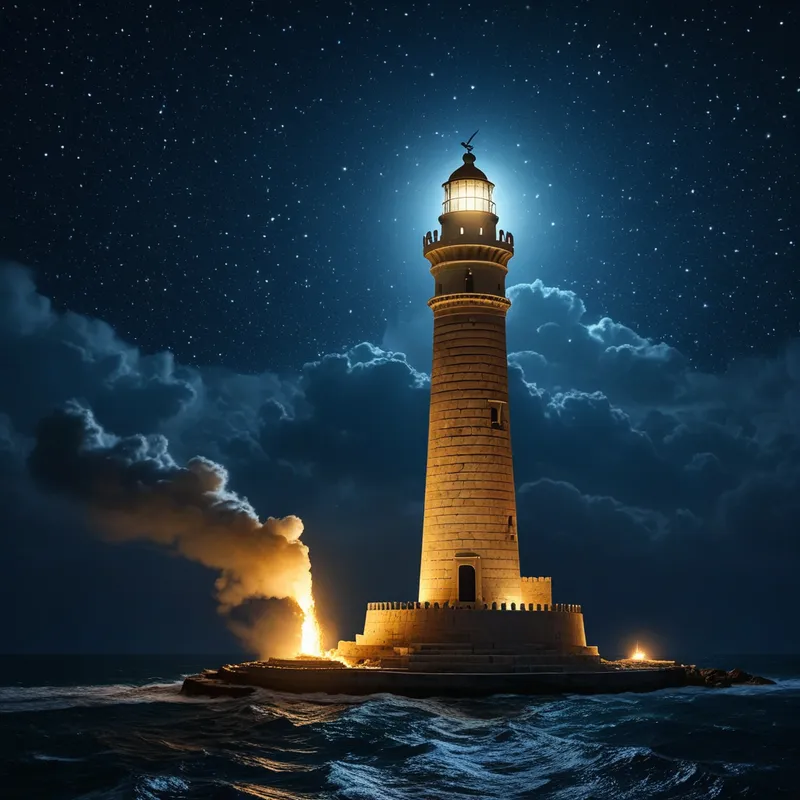
Hear now of a king who dreamed in stone and a god who walked in dreams. In the city where two worlds met—the silt-rich Nile and the wine-dark sea—Ptolemy Soter, a king of Macedon ruling an Egyptian land, felt the weight of [the horizon](/myths/the-horizon “Myth from Various culture.”/). His city, Alexandria, was a jewel set between the marsh and the deep, a harbor where knowledge pooled like rare spices. Yet the coast was a liar. Its shores were flat, its approaches silent and treacherous, a graveyard of hulls hidden beneath smiling waves. Sailors whispered of the syrtis, a maw that swallowed ships whole in the blind dark.
The king’s plea was not to the local gods of the delta, but to one who held the very seas in his thrall: [Poseidon](/myths/poseidon “Myth from Greek culture.”/). In the salt-scented temple, under the gaze of a trident, Ptolemy made an offering not of gold, but of a vision. He promised a wonder. He swore to raise a tower of such impossible height, such fierce and guiding light, that it would be a star fixed to [the earth](/myths/the-earth “Myth from Hindu culture.”/), a monument to the god’s dominion and a salvation to all who sailed under his capricious will. It would bear the name of the island it would stand upon: Pharos.
The god heard. Some say he sent a dream, a vision of a flame that did not consume, a pillar that touched the belly of the clouds. The king awoke with fire in his mind and summoned his architect, Sostratus of Cnidus. “Build it,” was the command. “Build what the god has shown me.”
And so the earth was pierced. For years, the island groaned under the weight of marble hauled from distant quarries. A three-tiered giant grew: a broad, square base, a graceful octagonal middle, and a cylindrical crown where the fire would live. Within its belly, a ramp spiraled upward, wide enough for donkeys to carry fuel to [the summit](/myths/the-summit “Myth from Taoist culture.”/). And at its peak, a great brazier was set, polished bronze mirrors waiting to hurl the fire’s essence across the leagues.
The night it was lit, [the sea](/myths/the-sea “Myth from Greek culture.”/) itself seemed to hold its breath. Then, the flame roared to life. The mirrors caught it, shaped it, and threw a spear of light across the black [water](/myths/water “Myth from Chinese culture.”/). On distant decks, sailors cried out—not in fear, but in relief. The liar’s coast was unmasked. The path was clear. The Pharos stood, not just as a tool, but as a covenant made visible, a promise between king, god, and all who dared the deep. It was the first of its kind, and so magnificent it was counted among the Seven Wonders. Yet, in the mortar of its foundation, Sostratus secretly etched a dedication not to the king or the god, but to all sailors, for whom the light truly burned. A silent truth within a monumental promise.
Cultural Origins & Context
The myth of the Pharos is unique among the tales of the ancient world. It is not a story of the distant, heroic age, but one born in the bustling, pragmatic Hellenistic era, a fusion of Greek ambition and Egyptian landscape. While the structure itself was historical, completed around 280 BCE, its legendary status was immediate. It transcended mere engineering to become a mythos.
The tale was propagated not by epic poets, but by travelers, merchants, and geographers like Strabo. It was a story of practical divinity. In a culture where Poseidon’s favor was directly linked to maritime survival and economic prosperity, the lighthouse was a tangible act of eusebeia (piety). It served a critical societal function: it legitimized Ptolemaic rule by demonstrating a divine mandate and a commitment to public good, turning a perilous coast into a hub of safe commerce. The myth reinforced the Hellenistic ideal of the benevolent monarch who tamed nature through wisdom and devotion, creating order from chaos for the benefit of all.
Symbolic Architecture
The Pharos is a profound [symbol](/symbols/symbol “Symbol: A symbol can represent an idea, concept, or belief, serving as a powerful tool for communication and understanding.”/) of [consciousness](/symbols/consciousness “Symbol: Consciousness represents the state of awareness and perception, encompassing thoughts, feelings, and experiences.”/) itself. It represents the [human](/symbols/human “Symbol: The symbol of a human represents individuality, complexity of emotions, and social relationships.”/) endeavor to project order, meaning, and [guidance](/symbols/guidance “Symbol: The act of receiving or seeking direction, advice, or leadership in a dream, often representing a need for clarity, support, or a higher purpose on one’s life path.”/) onto the formless, [unconscious depths](/symbols/unconscious-depths “Symbol: The hidden, primordial layers of the psyche containing repressed memories, instincts, archetypes, and collective wisdom beyond conscious awareness.”/)—the chaotic sea of the unknown.
The lighthouse does not calm the storm; it allows us to navigate it. It is the fixed point of awareness in the psyche’s tumultuous seas.
Its three tiers mirror the ancient—and Jungian—[conception](/symbols/conception “Symbol: The beginning of new life, ideas, or projects; a moment of profound creation and potential.”/) of [the world](/myths/the-world “Myth from Tarot culture.”/): the [material](/symbols/material “Symbol: Material signifies the tangible aspects of life, often representing physical resources, desires, and the physical world’s influence on our existence.”/) and foundational ([the square](/myths/the-square “Myth from Platonic culture.”/) base), the transitional and aspirational (the octagonal [shaft](/symbols/shaft “Symbol: A vertical passage or structural element, often representing transition, connection, or hidden depths in dreams.”/)), and the spiritual, illuminating [pinnacle](/symbols/pinnacle “Symbol: The highest point or peak, representing achievement, culmination, or spiritual transcendence.”/) (the circular [crown](/symbols/crown “Symbol: A crown symbolizes authority, power, and achievement, often representing an individual’s aspirations, leadership, or societal role.”/) and fire). The fire at its [summit](/symbols/summit “Symbol: The highest point of a mountain, representing achievement, perspective, and the culmination of effort.”/) is the light of [the ego](/myths/the-ego “Myth from Jungian culture.”/), of focused [attention](/symbols/attention “Symbol: Attention in dreams signifies focus, awareness, and the priorities in one’s life, often indicating where the dreamer’s energy is invested.”/) and reason. Yet this light is dependent on constant fuel—the resources of the unconscious, hauled up the dark, spiral [ramp](/symbols/ramp “Symbol: The ramp symbolizes a transitional phase, needs for adjustment, or overcoming obstacles, typically relating to progress.”/) of the [psyche](/myths/psyche “Myth from Greek culture.”/). The mirrors are the reflective faculty of consciousness, the [ability](/symbols/ability “Symbol: In dreams, ‘ability’ often denotes a recognition of skills or potential that one possesses, whether acknowledged or suppressed.”/) to take raw experience and focus it into discernible [direction](/symbols/direction “Symbol: Direction in dreams often relates to life choices, guidance, and the path one is following, emphasizing the importance of navigation in personal journeys.”/).
The secret [inscription](/symbols/inscription “Symbol: A permanent mark, carving, or writing on a surface, often carrying messages, records, or artistic expression meant to endure.”/) by Sostratus adds a crucial [layer](/symbols/layer “Symbol: Layers often symbolize complexity, depth, and protection in dreams, representing the various aspects of the self or situations.”/). It symbolizes the [truth](/symbols/truth “Symbol: Truth represents authenticity, honesty, and the quest for knowledge beyond mere appearances.”/) that often lies beneath the official narrative of our psyche. The [monument](/symbols/monument “Symbol: A structure built to commemorate a person, event, or idea, often representing legacy, memory, and cultural identity.”/) may be built for a [king](/symbols/king “Symbol: A symbol of ultimate authority, leadership, and societal order, often representing the dreamer’s inner power or external control figures.”/) (the ego) or a god (the archetypal Self), but its ultimate, foundational [purpose](/symbols/purpose “Symbol: Purpose signifies direction, meaning, and intention in life, often reflecting personal ambitions and core values.”/) is service to the [soul](/symbols/soul “Symbol: The soul represents the essence of a person, encompassing their spirit, identity, and connection to the universe.”/)’s [journey](/symbols/journey “Symbol: A journey in dreams typically signifies adventure, growth, or a significant life transition.”/)—the “sailors” navigating our inner world.
The Dreamer’s Resonance
To dream of a lighthouse, particularly one of ancient or mythic grandeur like the Pharos, signals a critical moment of orientation in the dreamer’s psychological process. The somatic feeling is often one of relief mixed with acute vulnerability—the relief of seeing the light, the vulnerability of being exposed on a dark sea.
Such a dream emerges when the conscious mind (the dreamer in the boat) is lost or threatened by overwhelming emotional or unconscious content (the stormy sea, the hidden reefs). The lighthouse represents a nascent or emerging aspect of [the Self](/myths/the-self “Myth from Jungian culture.”/) that offers guidance. However, the dream’s tension lies in the distance and the journey toward it. Is the light steady, or does it flicker? Is the path to the harbor safe, or does the light ironically reveal terrifying waves? This dream pattern embodies the process of seeking internal structure and clarity during a period of psychic disorientation, where the ego is attempting to establish a reliable beacon of meaning amidst inner chaos.
Alchemical Translation
The myth of the Pharos models the alchemical opus of individuation—the construction of a enduring, guiding center within the psyche. The raw, chaotic elements (the treacherous coast, the dark sea) are the [prima materia](/myths/prima-materia “Myth from Alchemical culture.”/). King Ptolemy’s vow represents the ego’s initial, willful commitment to the work, often sparked by a moment of crisis or a divine discontent (“This darkness must end”).
The alchemist does not destroy the sea; they build a tower beside it. Individuation is not the eradication of the unconscious, but the establishment of a conscious vantage point from which to relate to it.
The long, arduous construction is the labor of analysis and self-confrontation—hauling heavy insights up [the spiral](/myths/the-spiral “Myth from Celtic culture.”/) of memory and pattern. The fire is the ignis of conscious realization, which must be constantly tended. The final, operational lighthouse symbolizes the achieved [lapis philosophorum](/myths/lapis-philosophorum “Myth from Alchemical culture.”/)—not a static state of perfection, but a functioning, resilient structure of consciousness. It is a psyche that can generate its own light of understanding, capable of guiding itself through future internal storms, while forever acknowledging the vast, dark sea from which it arose and upon which its light depends. The myth, therefore, is a blueprint for building a soul that can both withstand the depths and illuminate [the way](/myths/the-way “Myth from Taoist culture.”/) home.
Associated Symbols
Explore related symbols from the CaleaDream lexicon: