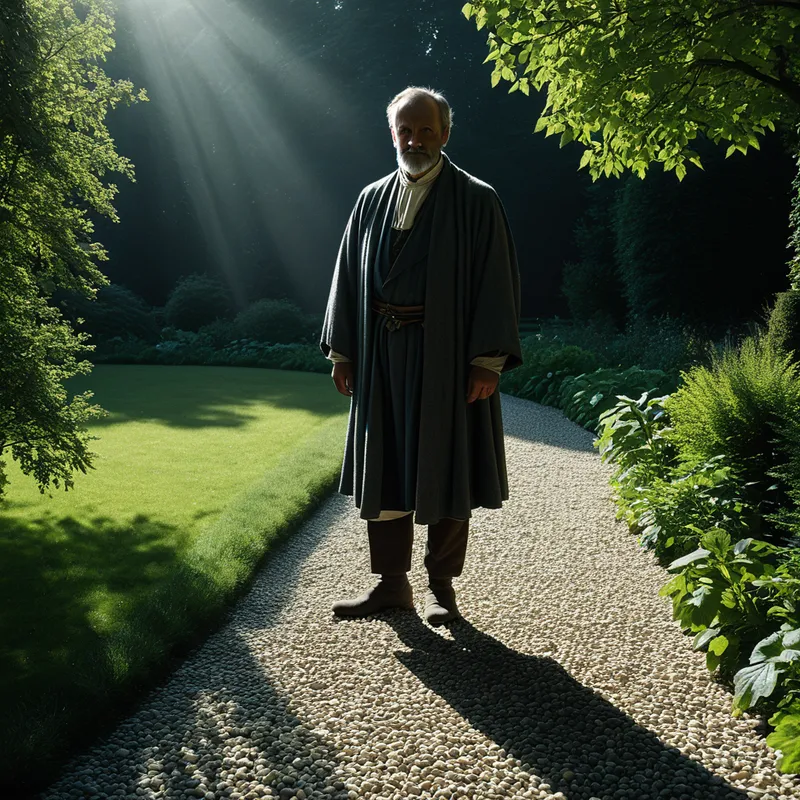
Peter Schlemihl Myth Meaning & Symbolism
A man sells his shadow for endless gold, gaining wealth but losing his place in the world, becoming a spectral wanderer in search of his soul.
The Tale of Peter Schlemihl
Listen, and I will tell you of a man who walked the world as a living riddle. His name was Peter Schlemihl. He arrived in a bustling port city, a stranger with empty pockets and a heart full of hope, seeking his fortune.
One glittering afternoon, at a garden party held by a wealthy merchant, Peter’s fate was sealed. Among the finely dressed guests moved a tall, gaunt, and unnervingly dry man, clad in simple grey. This man produced wonders from his pocket: a telescope, a Turkish carpet, even a splendid tent—all drawn from the same, seemingly bottomless depth. Peter, astonished, struck up a conversation. The grey man was courteous, his eyes like polished stones. He expressed a peculiar interest not in Peter’s talents or character, but in his most mundane possession: his shadow, which lay crisp and dark upon the sunlit lawn.
“Would you,” the grey man proposed, his voice a soft rustle, “consider parting with your shadow? I have here the purse of Fortunatus, which is never empty. An endless supply of gold. For your shadow.”
To Peter, it seemed a mad, miraculous joke. What use was a shadow compared to a life of ease? In a moment of blinding folly, he agreed. He felt a strange, cold shudder pass through him as the grey man deftly peeled his shadow from the grass, rolled it up like parchment, and tucked it away. In exchange, Peter received the heavy, clinking purse.
At first, his wealth brought joy. He bought fine clothes, a grand house. But as the sun rose the next day, the horror dawned. Wherever he walked, his feet left no imprint of darkness. In the brilliant light, he was a man cut out from reality, a walking blasphemy against nature. People gasped. Children pointed and cried. Dogs barked at the unnatural sight. He was rich beyond measure, yet poorer than the lowliest beggar, for he could not stand in the sun without provoking terror and revulsion. He became a creature of the night and overcast days, a spectral prisoner of his own bargain.
He sought out the grey man to undo the pact, but the fiend only offered a crueler trade: Peter’s soul, in exchange for the shadow’s return. This, even in his despair, Peter refused. Cast out from human society, he eventually found a pair of seven-league boots. Donning them, he fled from the world of men altogether, choosing a life of eternal, lonely wandering across the earth as a naturalist, studying the silent, shadowless world of plants and stones, a king of solitude who had traded his reflection in the eyes of others for all the gold in the world.

Cultural Origins & Context
The story of Peter Schlemihl is not an ancient folktale, but a profound literary fairy tale born in the Romantic era. It was penned in 1814 by the German poet and botanist Adelbert von Chamisso. While not “Germanic” in the ancient, mythological sense, it is deeply Germanic in its philosophical and cultural preoccupations. It emerged from a society grappling with the upheavals of the Napoleonic Wars, rapid industrialization, and the rise of a mercantile bourgeoisie. Chamisso himself was a French-born aristocrat who felt rootless in Germany, a man without a true homeland—a living Schlemihl.
The tale functions as a modern parable for a newly materialistic age. Passed down not by village bards but through books and salons, it served as a societal warning. It asked a question that was becoming urgent: In the pursuit of wealth and social standing, what essential, intangible part of ourselves are we prepared to sell? The story gave form to the growing anxiety about alienation—the fear of becoming a ghost in the machine of society, connected by currency but disconnected from community and nature.
Symbolic Architecture
The myth’s power lies in its stark, perfect symbols. The shadow is not merely an absence of light; it is the unconscious counterpart to the conscious ego. It is our natural grounding, our connection to the earth, our visible proof of being a solid, real creature in a real world. It represents everything we take for granted about belonging: our reputation, our social persona, our instinctual life.
To sell one’s shadow is to trade the soul’s substance for the world’s currency. It is the ultimate bargain of the ego, which believes it can live on light alone.
The purse of Fortunatus symbolizes limitless material potential, but it is cursed gold. It buys everything except the one thing needed: acceptance. The grey man is the cold, logical spirit of the bargain devoid of soul—the devil as a businessman, the Homo economicus incarnate. He does not deal in fiery passion but in dry, transactional predation. Peter’s final acquisition, the seven-league boots, represent a desperate, transcendent solution: a flight into the macrocosm to escape the microcosm of human relations. He exchanges social integration for a cosmic, but profoundly lonely, perspective.

The Dreamer’s Resonance
When this myth stirs in the modern psyche, it manifests in dreams of profound social alienation. One may dream of being at a party where everyone’s laughter is muffled, and one’s own voice makes no sound. Or of looking in a mirror and seeing no reflection, only the room behind. Somatic sensations often accompany this: a feeling of being weightless, insubstantial, or terrifyingly transparent.
This is the psyche signaling a state of severe dissociation. The dreamer is undergoing a process where a core part of their identity—their “shadow” in the sense of their authentic instincts, vulnerabilities, or social belonging—has been bartered away for a conditional reward: professional success at the cost of personal relationships, social media validation at the cost of true self-expression, security at the cost of vitality. The dream is a crisis alert: the ego is walking in the sun, but the soul has been left behind in the dark, rolled up and stored away.

Alchemical Translation
The path of Peter Schlemihl models a harrowing, yet ultimately individuating, journey. The initial stage is the Nigredo: the blackening. This is the catastrophic realization of the bargain’s true cost—the plunge into despair and social death. Peter’s refusal to sell his soul to the grey man is the critical turning point, the moment of separatio. He chooses his essential, indefinable self over even the promise of renewed conformity.
The triumph is not in getting the shadow back, but in refusing to compound the original sin of the ego with the final surrender of the Self.
His flight with the seven-league boots is the Albedo, the whitening, a purification through isolation. He turns his exile into a vocation, studying the natural world. This is the psyche retreating from a toxic collective value system to reconnect with the objective, non-human ground of being. He integrates not with society, but with the Earth itself. The final stage is not a return, but a transformation into the Senex-naturalist. His kingdom is no longer the drawing-room, but the globe. His wealth is not gold, but experience and knowledge. He becomes the eternal wanderer, the Wandering Jew of science, whose curse becomes his unique perspective. For the modern individual, the myth teaches that the price of wholeness is often the forfeiture of conventional belonging. One must sometimes lose the world to find one’s own ground, walking a lonely but sovereign path, having learned that the most precious things cast no shadow that can be bought or sold.
Associated Symbols
Explore related symbols from the CaleaDream lexicon: