Perun Myth Meaning & Symbolism
The myth of Perun, the Slavic thunder god, tells of a cosmic battle against the serpent Veles, a story of sovereignty, righteous fury, and the fertilizing storm.
The Tale of Perun
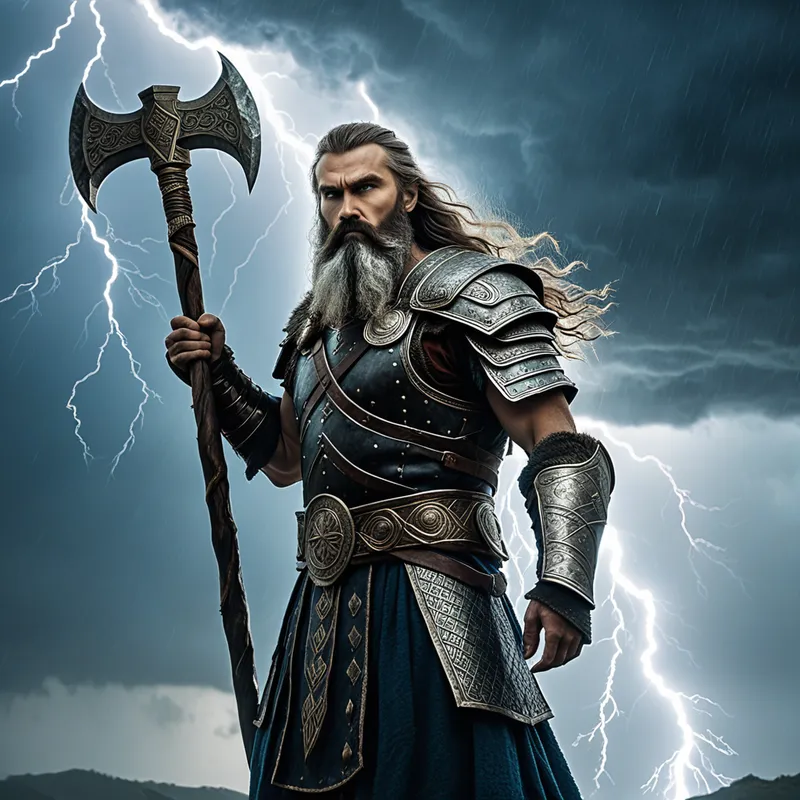
Listen. The world was young, and the sky was a taut hide stretched over the bones of the earth. In the high, clear realm of Prav lived Perun, whose beard was the gathering storm and whose voice was the crack that splits the oldest oak. His axe was the lightning bolt, his chariot the rolling thunderclouds. He was the pillar of the world, the guarantor of oaths, the fury that cleansed.
But deep below, in the wet, whispering realm of Nav, coiled Veles. He was the shape-shifter, the lord of deep waters and hidden treasures, the patron of poets and thieves. His body was the serpent, his breath the creeping mist, his domain the tangled root and the dark pool. Where Perun built order with fire from the sky, Veles wove potential from the mud below.
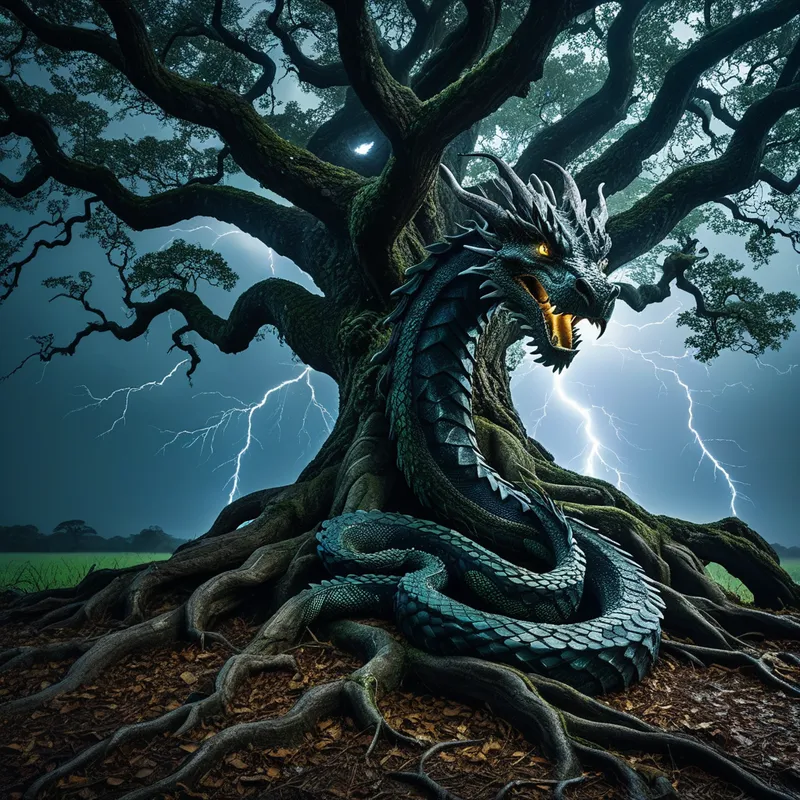
The conflict was written in the fabric of things. It was the tension between the towering oak and the root that seeks to topple it, between the clear boundary of the field and the wild, encroaching marsh. The great offense came when Veles, in the form of a mighty serpent, slithered up the World Tree that held all realms apart. He sought to steal something precious from Perun’s celestial keep—his divine cattle, the clouds themselves, or perhaps the very light of the sun. Some say he stole Perun’s wife or children, a theft of sacred kinship.
The sky darkened with Perun’s wrath. The air grew thick and heavy, charged with the scent of ozone and coming rain. He mounted his chariot, its wheels the rumble in the mountains, and pursued the serpent god across the three worlds. Lightning, his fiery arrows, scorched the earth where Veles dove into the waters. Thunder shook the foundations of villages, a warning and a promise.
The chase was the storm itself—a rising action of torrential rain, howling winds, and brilliant, terrifying flashes that illuminated the fleeing serpent’s scaled back. Veles transformed: now a bull, now a man with horns of a ram, now a simple black goat fleeing through a farmer’s field. But Perun’s eye, the unblinking sun behind the cloud, saw through all guises.
Their final battle raged at the axis of the world, where the tree meets the sky and its roots drink from the underworld’s spring. Perun, with a roar that silenced the wind, hurled his axe of lightning. It struck true, piercing scale and flesh, pinning the great serpent to the earthly realm. Veles was defeated, cast down, but not destroyed. He retreated, bleeding not blood but life-giving water, back into the rivers and deep places of the earth.
And from that conflict, the world was renewed. The rain, born of their struggle, fell to nourish the scorched earth. The first rainbow, a bridge of truce, arched across the sky. Order was restored, but the serpent’s potential slept in the soil, waiting. The myth ends not with an end, but with the promise of the next gathering cloud, the next necessary storm.
Cultural Origins & Context
The myth of Perun and Veles is the central theological drama of the pre-Christian Slavic world, reconstructed from folk songs, fairy tales, and the often-hostile chronicles of Christian missionaries. Unlike the codified myths of Greece or Rome, these stories lived in the duma (epic song) of bards, the rituals of village elders, and the carved wooden idols standing in groves of oak, Perun’s sacred tree.
This was not merely a story for entertainment; it was a cosmological model and a social contract. Perun was the god of the ruling warrior class (knyazes), of laws, treaties, and sworn oaths (sworn, tellingly, by striking the earth—invoking the witness of the underworld). His worship involved sacrifices at hilltop sanctuaries. Veles, in contrast, was the god of the common folk, of cattle-herders, merchants, musicians, and magicians—all those who dealt with the fluid, unpredictable forces of wealth, art, and nature’s hidden depths.
The myth was performed annually in seasonal rituals. The conflict mirrored the cyclical struggle between the dry, ordered summer (Perun’s domain) and the wet, chaotic winter (Veles’s time). The spring thunderstorms, which fertilized the fields, were seen as Perun’s victorious battle releasing the waters Veles had bound. The myth explained the world’s dynamic balance: sovereignty requires a constant, vigorous defense against the chaos that would consume it, yet that very chaos is the source of fertility and creative potential.
Symbolic Architecture
At its heart, this is the archetypal myth of the Ruler defending his kingdom against the Trickster. It is the eternal drama of consciousness (Perun, the clear sky, the defining flash of lightning) engaging the unconscious (Veles, the deep waters, the shape-shifting mist).
The lightning bolt is not merely destruction; it is the sudden, illuminating insight that defines a boundary, makes a judgment, and calls a thing by its true name.
Perun represents the necessary force of differentiation—the ego that says “I am” and “this is mine,” that establishes law, identity, and structure. His axe cleaves the world into opposites: sky and earth, order and chaos, mine and thine. Veles represents everything that opposes or precedes such differentiation: the primordial unity, the instinctual drives, the creative but amoral wellspring of life and magic that flows beneath the ego’s foundations. The theft he commits is the perpetual “return of the repressed,” the uprising of forgotten desires, fears, and talents that the conscious personality has disowned.
Their battle is not good versus evil, but a necessary, generative tension. The fertilizing rain is the psychic product of this conflict—the new energy, the creative solution, the emotional release that comes when conscious will engages with unconscious content.

The Dreamer's Resonance
When this myth stirs in the modern soul, it often manifests in dreams of pursuit, storms, and serpents. To dream of being chased by a storm or a towering, angry figure may signal that the dreamer’s conscious attitude (their inner Perun) is being challenged. An unexamined life rule, a rigid self-image, or a long-held oath may have become oppressive, and the instinctual self (Veles) is in rebellion, “stealing” energy in the form of anxiety, illness, or compulsive behavior.
Conversely, to dream of a serpent threatening your home or a cherished possession may indicate a flood of unconscious material—old grief, rage, or chaotic desire—that feels like it will overwhelm the ego’s structures. The somatic experience is one of charge and pressure: a tight chest (the gathering storm), a knotted stomach (the coiled serpent), a feeling of being “electrified” or on edge.
The healing movement in such dreams is not the annihilation of one force by the other, but the recognition of their relationship. The dream may progress to the image of rain after the storm, or a serpent shedding its skin near a tree’s roots. This signals the psyche moving toward integration, where the fierce clarity of the ego accepts and channels the fertile, transformative power of the depths.
Alchemical Translation
The alchemical journey modeled here is the opus contra naturam—the work against nature, which is really the work of cultivating conscious awareness out of unconscious nature. Perun’s initial state is one of latent, potential power (the static charge in the cloud). Veles’s provocation (the theft) is the nigredo, the darkening, the necessary crisis that initiates the work.
The furious chase is the separatio, the fierce, active discrimination where the individual learns to identify what is truly “theirs”—their authentic values, strengths, and responsibilities—and what belongs to the impersonal, chthonic realm of instinct and collective energy. The hurling of the lightning axe is the coniunctio in its most dynamic and violent form: the sacred marriage of sky and earth, consciousness and unconscious, in a moment of explosive, transformative contact.
Individuation is not a peaceful coronation; it is a repeated, righteous defense of the psychic territory you have claimed as your own, fought with the weapons of awareness and integrity.
The retreat of Veles, wounded but alive, signifies that the work is never done. The integrated psyche does not eliminate the unconscious; it establishes a dynamic relationship with it. The fertilizing rain is the ultimate goal: the aqua vitae, the vital energy now available to the conscious personality. The modern individual undergoing this alchemy learns to wield their “lightning”—their focused will, their moral courage, their decisive insight—not to destroy their inner serpent, but to compel its creative, life-giving waters to rise. They become the ruler of their own inner kingdom, a sovereignty earned through perpetual, respectful engagement with the wild lands at their borders.
Associated Symbols
Explore related symbols from the CaleaDream lexicon:
- Thunder — The terrifying voice and manifest power of Perun, representing the shocking, unavoidable force of divine judgment or psychological truth that breaks through denial.
- Lightning — Perun’s weapon and primary symbol, embodying sudden illumination, decisive action, and the fiery power that cleaves confusion to reveal clear structure.
- Serpent — The form of Veles, representing the chthonic, instinctual, and magical forces of the unconscious, as well as cyclical transformation and hidden wisdom.
- Tree — The World Tree or sacred oak, the axis mundi where the battle takes place, symbolizing the individual psyche or cosmos as a living system connecting all levels of reality.
- Storm — The total atmosphere and event of the myth, representing the necessary psychic turmoil that precedes cleansing, renewal, and the release of pent-up energy.
- Axe — The double-edged weapon of Perun, a tool of both creation (clearing land) and destruction, symbolizing the discriminating power of consciousness to make decisive cuts.
- Water — The domain and essence of Veles, representing the fluid unconscious, emotional depth, potential, and the life-giving rain that results from the conflict.
- Sky — The realm of Perun, representing consciousness, order, law, and the higher, aspirational faculties of the human spirit.
- Earth — The battleground and the realm nourished by the storm, representing the manifest world, the body, and grounded reality where archetypal conflicts play out.
- Rain — The blessed resolution of the myth, symbolizing the fertility, emotional release, and new growth that follows a period of intense inner conflict and confrontation.
- Bridge — The rainbow that appears after the storm, representing the temporary truce or connection forged between opposing psychic forces, enabling communication and exchange.
- Order — The cosmic principle embodied by Perun, representing the human need for structure, boundary, identity, and conscious governance of the inner and outer world.