
Persephone's Winter Myth Meaning & Symbolism
The goddess Persephone is abducted by Hades, eats pomegranate seeds, and must spend part of each year in the Underworld, creating the cycle of seasons.
The Tale of Persephone’s Winter
Hear now the story that explains the turning of the world, the reason the earth grows cold and silent. It begins in the eternal spring of Demeter, where life was a constant, lush promise. Her daughter, Kore—the Maiden—was the very soul of that blossoming world. She danced with her companions in the Nysian meadow, a place drenched in sunlight and humming with bees, her laughter the sound of petals unfurling.
But in the sun-drenched grass, a flower shone with an impossible light—a narcissus, planted by the will of the earth itself as a snare. Drawn by its unearthly beauty, Kore reached for it. In that moment, the solid ground roared and cracked asunder. From the black chasm, a chariot drawn by immortal, smoke-dark horses erupted, and the hand of Hades, Lord of the Many Guests, closed around her wrist. Her cry was swallowed by the abyss as the earth sealed itself above her, leaving only trampled flowers and a terrible silence.
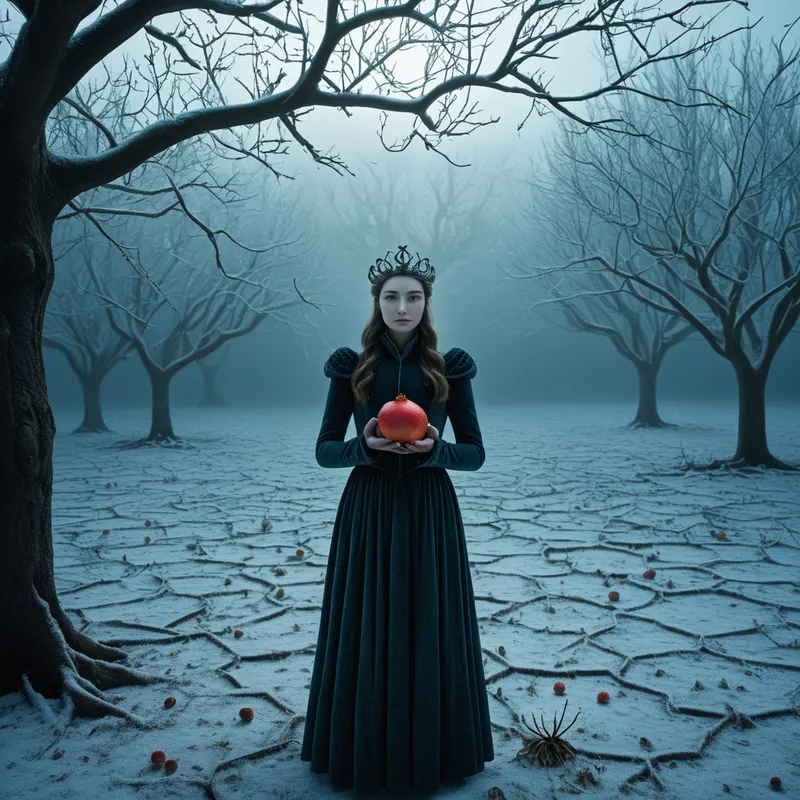
Demeter’s grief was a force of nature. She cast off her divinity, wrapped herself in the guise of an old woman, and wandered the mortal world, a drought walking in her footsteps. Fields withered. Rivers ran dry. The first famine stalked humanity, for the goddess of life had turned her face away, searching every corner of the earth for her lost light.
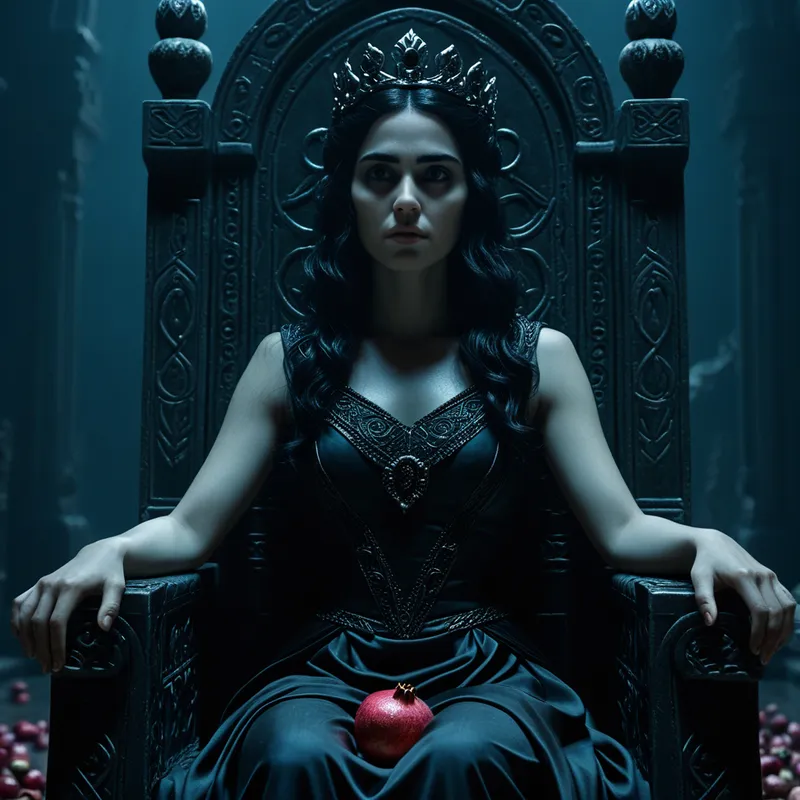
Meanwhile, in the sunless realms below, a transformation was taking place. Kore, the Maiden, was in the palace of Erebus. Hades offered her not a prison, but a throne. She was no longer a child of the meadow but the potential Queen of the Dead. Yet, she refused all food, for to consume the food of the underworld is to bind oneself to it forever. Her heart yearned for the upper world, a silent winter in her soul.
The suffering above grew so great that Zeus himself was forced to intervene. He commanded Hermes, the swift messenger, to descend and bring the maiden back. But as Hermes arrived, he found a pivotal scene. The gardener of the underworld, Ascalaphus, bore witness: tempted by hunger or perhaps a dawning acceptance, the queen-to-be had eaten. Not a feast, but a potent token—four, or six, blood-red seeds from the fruit of the dead, the pomegranate.
This small, fatal act changed everything. A compromise was forged in the cold halls of cosmic law. For each seed eaten, a month of the year must be spent below. Thus, Persephone—for she was now both the Maiden and the Queen—was born. She rises each spring, and Demeter’s joy paints the world in green and gold. But when the time of the seeds comes due, Persephone descends to her dark throne, and Demeter’s grief brings the fallow, waiting silence of winter. The wheel of the year turns on the axis of her journey.
Cultural Origins & Context
This central myth, known as the Homeric Hymn to Demeter, was more than a seasonal explanation for ancient Greeks. It was the sacred narrative at the heart of the Eleusinian Mysteries, the most famous and revered religious rites of the ancient world. For nearly two thousand years, initiates from all walks of life—from slaves to emperors—made the pilgrimage to Eleusis to be inducted into secrets that promised a blessed lot in the afterlife.
The myth was not merely recited; it was ritually enacted. The initiates (mystai) would re-experience the anguish of Demeter, the terror and awe of Persephone’s abduction, and the triumphant joy (hilaria) of her return. This participatory storytelling served a profound societal function: it provided a framework for understanding life’s most painful transitions—loss, death, and the hope of renewal. It democratized access to a hopeful vision of the afterlife, countering the bleak, shadowy existence depicted in mainstream Homeric Hades. The story of the Two Goddesses offered a powerful metaphor for the soul’s own cyclical journey through darkness and light.
Symbolic Architecture
The myth of Persephone’s Winter is a masterful map of the psyche’s necessary descent. Persephone herself symbolizes the nascent consciousness, the youthful ego (Kore) that must be severed from the protective, nurturing matrix of the mother (Demeter) to encounter its own depths.
The abduction is not a tragedy, but an initiation. The conscious self must be taken by a force greater than itself—the unconscious, or fate—into the realm of what it does not know.
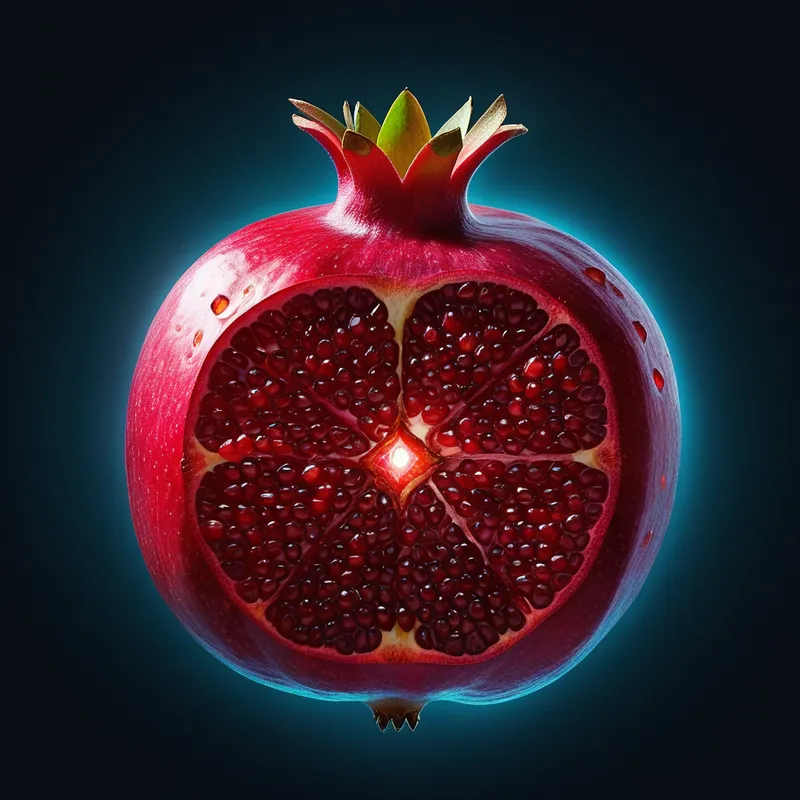
The Underworld represents the unconscious, the place of shadow, memory, and the ancestors of the psyche. Hades is not a villain, but the lord of this interior wealth, the archetypal principle of the deep, structuring masculine that claims the light-bringing feminine for a sacred union. The pomegranate is the ultimate symbol of conscious choice within the realm of fate. To eat its seeds is to willingly integrate a piece of the underworld’s reality into one’s own substance. It is the point of no return that is also the beginning of true sovereignty. Persephone does not escape the underworld; she becomes its queen, integrating her maidenhood with a profound, underworldly authority.
The Dreamer’s Resonance
When this myth stirs in modern dreams, it signals a profound initiation underway in the dreamer’s psyche. One may dream of sudden falls, of being pulled into caves or basements, of finding oneself in elegant but somber interior spaces. These are landscapes of the Underworld.
The somatic experience is often one of contraction: a feeling of being frozen, stuck, or in a period of enforced introspection and depression. This is Persephone’s winter in the soul. The psychological process is a necessary nekya—a descent into the underworld for knowledge. The dreamer is being compelled to confront aspects of life they have avoided: grief, repressed anger, ancestral patterns, or a deep sense of meaninglessness. The figure of Hades in a dream may appear as a compelling but intimidating stranger, a authoritative father-figure, or simply as the irresistible pull towards a difficult but necessary truth. The dream is not a warning, but an announcement: a part of you is being called to rule over a domain you have feared to visit.
Alchemical Translation
For the modern individual, Persephone’s journey models the alchemical process of psychic individuation. The first stage, the abduction, is the crisis that shatters the comfortable, sunlit identity. A loss, a failure, a depression—it feels like a violation by the unconscious.
The winter of the soul is not the death of the self, but the gestation of the Queen. In the dark, what was once a fleeting identity (Kore) is tempered into enduring substance (Persephone).
The descent and sojourn in the underworld is the nigredo, the blackening, where one must sit with the shadow without immediate hope of rescue. Here, the temptation is to remain in a state of passive victimhood. The alchemical key is the pomegranate seed: the small, conscious act of acceptance within the ordeal. It is the decision to learn from the depression, to find meaning in the loss, to take responsibility for one’s portion of the darkness.
The return is not to the old life, but as a transformed being. The individual who has made this descent no longer belongs solely to the world of naïve light (Demeter’s eternal spring). They carry the wisdom of the depths within them. They become cyclical, capable of creative output (spring/summer) and necessary introspection (fall/winter). The psyche achieves a sacred marriage (hieros gamos) between the conscious attitude and the riches of the unconscious. One becomes, like Persephone, a mediator between worlds, capable of bearing life because one has authentically faced death. The wheel turns within, and the inner seasons grant both compassion and unshakeable depth.
Associated Symbols
Explore related symbols from the CaleaDream lexicon: