Persephone's Veil Myth Meaning & Symbolism
A myth of the maiden goddess abducted into the underworld, whose veil symbolizes the threshold between life and death, innocence and sovereignty.
The Tale of Persephone's Veil
Listen, and let the scent of asphodel carry you back. The world was young, and the sun belonged to Demeter. Her laughter made the wheat grow tall; her tears were the morning dew. And she had a daughter, Kore, whom we call Persephone. She was the spring incarnate, a girl whose footsteps coaxed hyacinths from the soil and whose voice was the whisper of leaves.
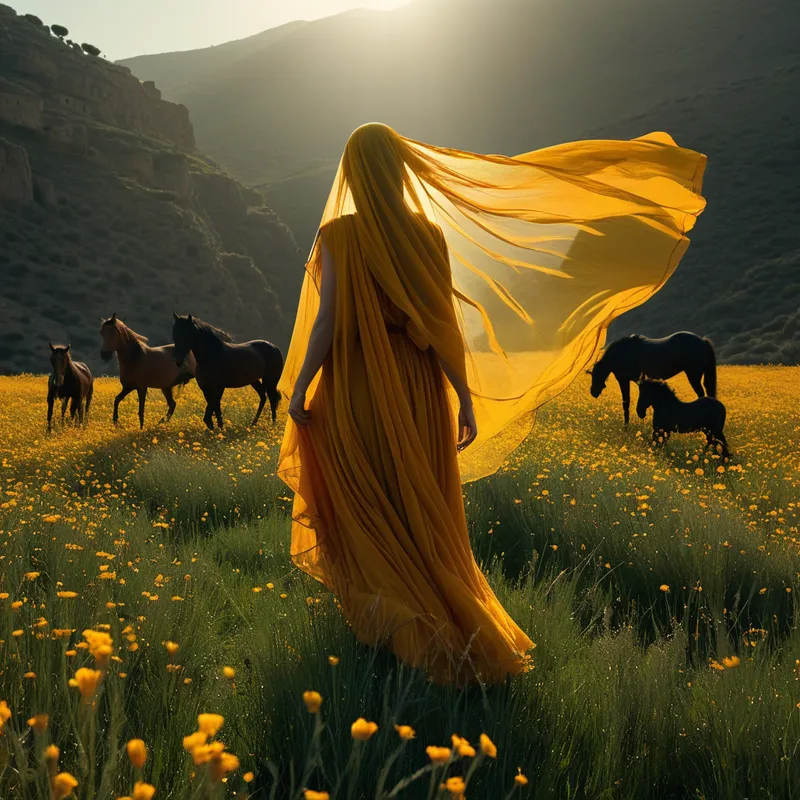
On that day, the day the world cracked open, she was in a meadow in Nysa. The air was thick with the perfume of roses, violets, and crocus. She danced with the Oceanids, her saffron-yellow veil—a gift from her mother, woven from sunlight and flax—fluttering behind her like a captured sunbeam. She bent to pluck a narcissus, a flower of stunning, hypnotic beauty that Hades himself had caused to grow. As her fingers closed around the stem, the earth did not yield. It roared.
The fertile soil split with a sound like a thousand trees snapping. From the abyss came a thunder of hooves on stone, and a chariot of polished jet, drawn by horses darker than a starless midnight. Hades, Lord of the Necropolis, reached out a hand of iron and shadow. Persephone’s cry was swallowed by the chasm. Her veil, torn from her hair, was the last thing to disappear into the gloom—a flash of gold against the void before the earth sealed itself, leaving only a scar in the meadow and a single, trampled flower.
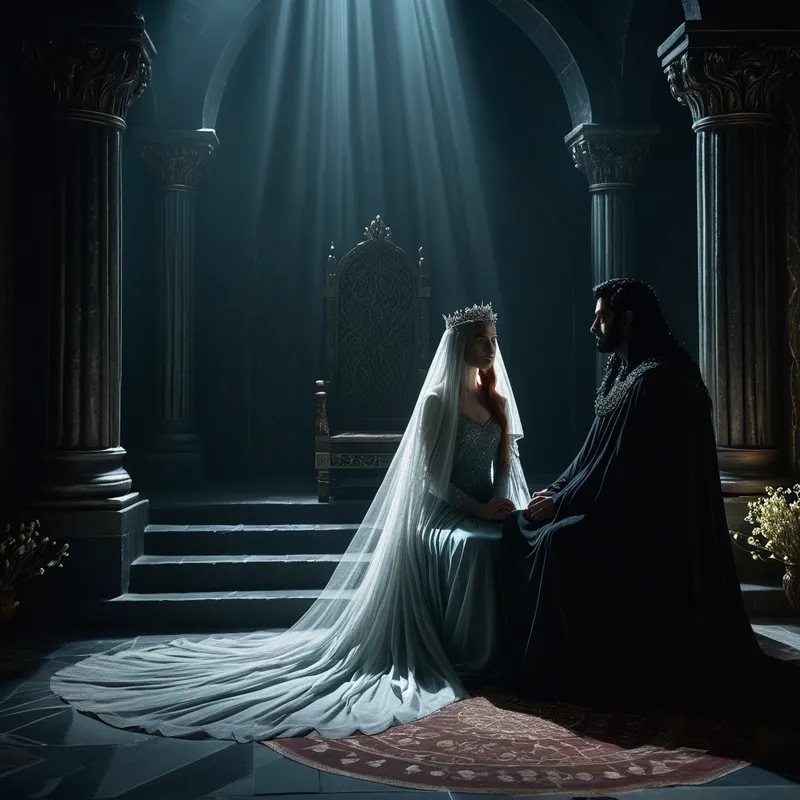
Above, Demeter’s grief was a winter that gripped the world. Below, in the silent halls of Erebus, Persephone sat in darkness. Her veil, now a ghost of its former self, lay beside her. Hades offered her a throne, not a cage. He offered her pomegranate seeds, the fruit of the dead. In her loneliness, she ate six. Each seed was a covenant, a taste of the underworld’s power that bound her to it.
Meanwhile, the world above died. No seed sprouted; no child was born. The cries of humanity reached the ears of Zeus. A bargain was struck. Because she had eaten the food of the dead, Persephone must return to the underworld for a portion of each year. When Hermes came to lead her back to the light, she rose from the obsidian throne. She was no longer just Kore, the Maiden. She was Persephone, the Queen. And as she ascended, she took her veil with her—no longer a simple sun-yellow cloth, but a garment that had known the depths, now shimmering with a dual nature, ready to be both the shroud of autumn and the banner of spring.
Cultural Origins & Context
This story, central to the Eleusinian Mysteries, was not merely a tale of seasons. It was the bedrock of a state-sponsored cult that promised initiates a blessed afterlife, a hope not commonly found in the bleak Greek view of Hades. The Homeric Hymn to Demeter, our primary source, functioned as a sacred text recited during rituals. It was performed, not just read, embedding its rhythms and images into the communal psyche.
The myth served profound societal functions. It explained the non-negotiable cycle of agriculture—the grain (Persephone) must be buried (descend) to be reborn. It modeled a critical female transition from daughter (kore) to queen (Persephone), a journey of terrifying autonomy outside the mother’s domain. For the polis, it reinforced the necessity of divine and natural order, where even Zeus’s decrees must bow to the primal law: to eat of a place is to belong to it.
Symbolic Architecture
The veil is the myth’s central, multifaceted symbol. It is the membrane between worlds—innocence and experience, life and death, the conscious ego and the unconscious realm.
The veil is not a barrier, but a threshold. To pass through it is to be unmade and remade.
Initially, it represents the sheltered, curated identity given by the mother (Demeter). Its tearing is the violent, necessary rupture of that identity. In the underworld, the veil absorbs the darkness; it becomes the witness to her transformation. When she returns, it is no longer a marker of naive girlhood but a symbol of integrated wisdom. She has seen what lies beneath, and that knowledge is woven into her very being.
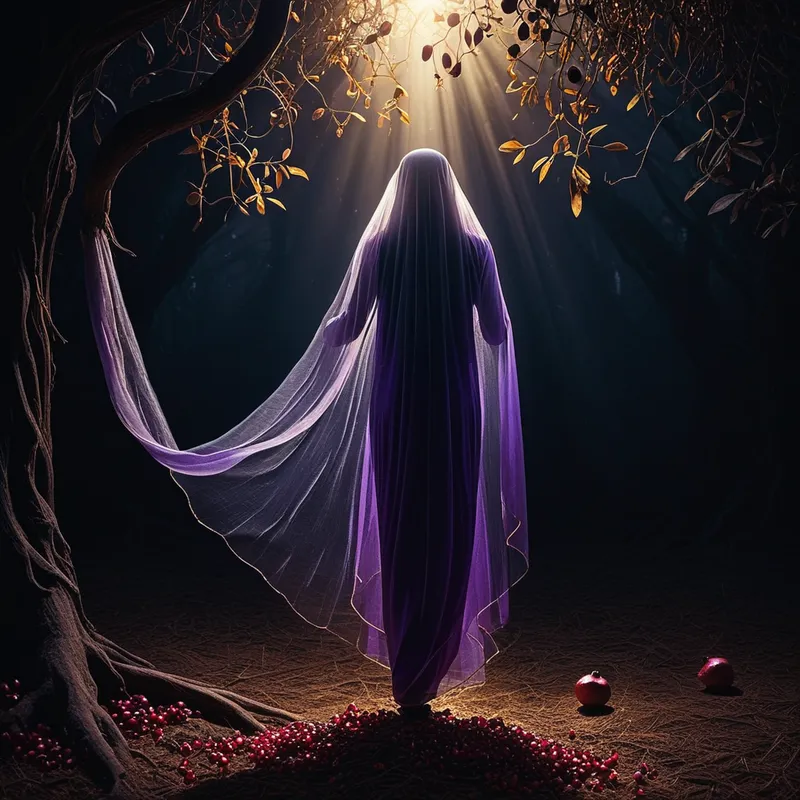
The pomegranate seeds are the point of no return. They represent the conscious ingestion of one’s shadow, the parts of life that are dark, potent, and generative. By eating them, Persephone actively participates in her fate. She accepts a portion of the underworld’s sovereignty, transforming her story from one of passive victimhood to one of complex rulership.
The Dreamer's Resonance
When this myth stirs in the modern dreamer, it often signals a profound initiation underway. To dream of a tearing veil, a sudden descent into a dark earth, or of eating strange, blood-red fruit is to dream of the psyche’s own imperative toward wholeness.
The somatic experience can feel like a crushing depression, a sudden loss of all that felt bright and secure—the “winter of the soul.” Psychologically, this is the ego’s forced encounter with the personal shadow or the collective anima/animus. The dreamer is being “abducted” by a power from within—a long-ignored passion, a buried trauma, or a call to a daunting new authority. The dream of Persephone is not a nightmare of helplessness, but a map of a necessary descent. The anxiety is the friction of transformation.
Alchemical Translation
The myth of Persephone’s Veil is a perfect allegory for the Jungian process of individuation. The alchemical work is the transmutation of the pure, undifferentiated maiden (the prima materia) into the conscious queen who holds dominion over both upper and lower worlds.
The first stage, nigredo (blackening), is the abduction itself—the plunge into the darkness of depression, confusion, or crisis. The ego’s light is extinguished. The second, albedo (whitening), occurs in the underworld: the slow, painful sorting and understanding of what one finds there. This is Persephone learning the topography of her new realm. The final stage, rubedo (reddening), is symbolized by the pomegranate seeds and the return. It is the integration of that underworld knowledge into a renewed conscious life. The Self that emerges is dual-natured.
The goal is not to escape the underworld, but to earn the right to travel between its depths and the heights, carrying the wisdom of each to the other.
For the modern individual, this means that our periods of “descent”—loss, failure, depression, radical change—are not meaningless sufferings to be avoided at all costs. They are the very crucible in which our simplistic, sunlit identity is torn so that a more complex, resilient, and sovereign Self can be woven. We are called not to remain forever in the meadow of innocence, but to take our seat on the throne of conscious adulthood, wearing a veil that has known both the sun and the rich, fertile dark.
Associated Symbols
Explore related symbols from the CaleaDream lexicon: