Persephone's Return Myth Meaning & Symbolism
The daughter of Demeter is taken to the underworld, causing eternal winter, and returns each spring, embodying the cycle of life, death, and rebirth.
The Tale of Persephone’s Return
Listen, and hear the story that explains why [the earth](/myths/the-earth “Myth from Hindu culture.”/) grows cold and silent, and why life always, always returns.
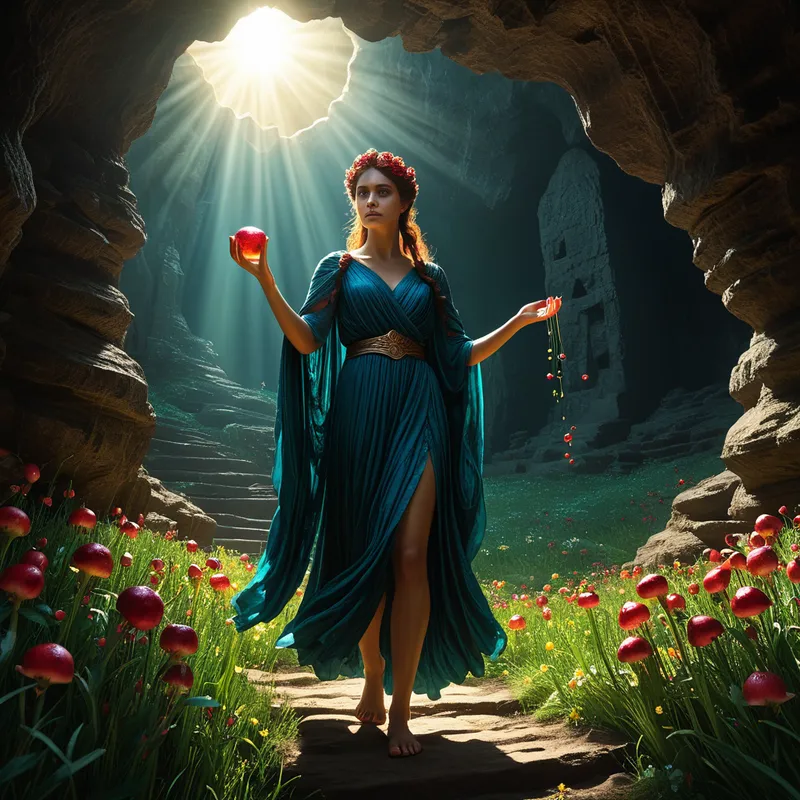
In the time when [the world](/myths/the-world “Myth from Tarot culture.”/) was younger and the gods walked closer, there was a meadow. Not just any meadow, but a place where every flower that ever was or would be bloomed in a riot of color and scent. Here, [Persephone](/myths/persephone “Myth from Greek culture.”/), radiant daughter of Demeter, gathered blossoms with her companions, her laughter the sound of spring itself. Her mother, whose power made the fields swell with grain, watched over all life with a fierce, nurturing love. All was abundance.
But beneath the roots of the world, in sunless halls of polished stone and whispering shades, a longing stirred. [Hades](/myths/hades “Myth from Greek culture.”/), lord of the unseen realm, had seen the maiden’s light. A chasm opened in the very center of that perfect meadow. The earth groaned. From the darkness erupted a chariot of blackest obsidian, drawn by steeds whose breath was frost. Before a cry could escape her lips, before her fingers could drop the lilies they held, [Hades](/myths/hades “Myth from Greek culture.”/) took Persephone. The chasm sealed, leaving only torn earth and a fading, chilling silence where laughter had been.
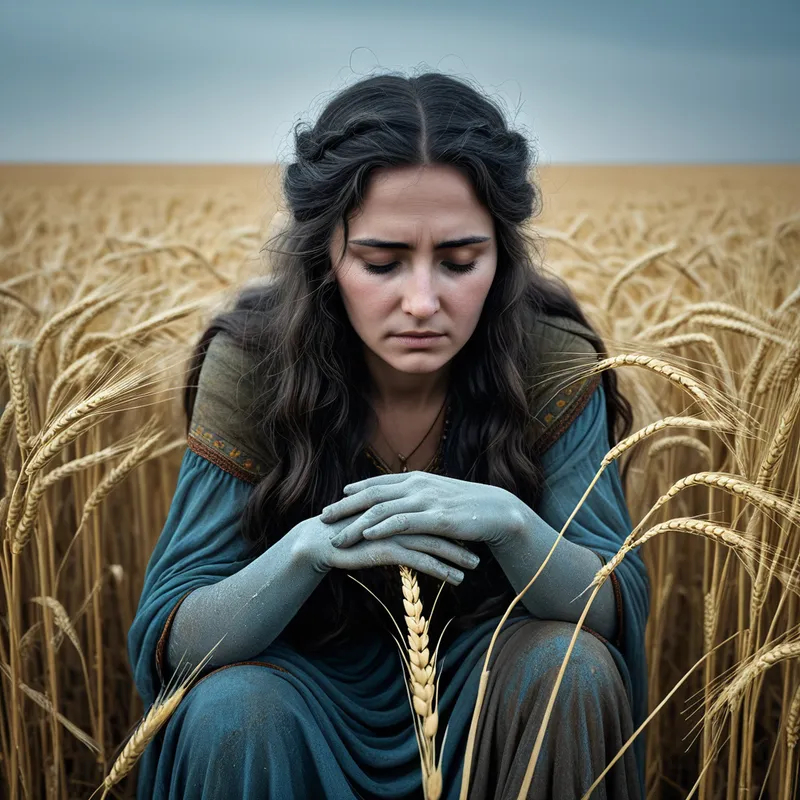
Demeter’s scream was [the wind](/myths/the-wind “Myth from Various culture.”/) that stripped the trees. Her grief was a frost that killed the seed in [the womb](/myths/the-womb “Myth from Various culture.”/) of the soil. For nine days and nine nights, she wandered the mortal world, a torch in each hand, her divine form cloaked in mortal sorrow, asking all she met—god, nymph, and human—for news of her stolen child. The world began to die. Rivers stalled. Leaves browned and fell. The soil hardened into iron, and famine, a guest unknown, settled upon humanity.
In her despair, the sun god [Helios](/myths/helios “Myth from Greek culture.”/), who sees all, revealed the truth: Zeus himself had consented to the match. Betrayal compounded her desolation. Demeter abandoned Olympus. In her wrath and sorrow, she decreed that not a single stalk would rise, not a single vine would climb, until her eyes beheld her daughter again. The great cycle of life ceased.
Faced with the extinction of all who offered them tribute, the gods relented. [Hermes](/myths/hermes “Myth from Global/Universal culture.”/), the swift messenger, was sent to [the underworld](/myths/the-underworld “Myth from Greek culture.”/) to parley. He found Persephone in the throne room beside Hades, no longer a gathering maiden but a queen, her innocence tempered by the gravity of the realm she now presided over. Yet, at the mention of her mother, a light flickered in her eyes. Hades, bound by the decree of Zeus, could not refuse her departure. But as she turned to go, he offered her a final gift: a few seeds of the pomegranate, the fruit of the dead. In her joy, or perhaps in a new understanding, she accepted and ate.
Her return to the upper world was the first thaw. Where her feet touched the dead ground, grass sprouted. Demeter, feeling the shift in the world’s bones, raced to meet her. Their embrace at Eleusis was the first warmth. But the reunion’s joy was shadowed. Because she had consumed food of the [underworld](/myths/underworld “Myth from Greek culture.”/), a sacred bond was forged. For each pomegranate seed eaten, she must return to Hades for one month of the year.
Thus, the great rhythm was born. When Persephone ascends to her mother, Demeter’s joy paints the world in green and gold—this is Spring and Summer. When she descends again to her throne in the dark, her mother’s grief draws a grey cloak over the land—this is Autumn and Winter. The maiden was taken, but the Queen returns. Life is lost, and life is found, in an endless, sacred turn.
Cultural Origins & Context
This myth, central to what scholars call the Homeric Hymn to Demeter, was far more than a simple etiological tale explaining the seasons for the ancient Greeks. It was [the sacred heart](/myths/the-sacred-heart “Myth from Christian culture.”/) of the Eleusinian Mysteries, the most famous and revered initiatory cult of the ancient world for nearly two millennia. The hymn itself, likely composed in the 7th century BCE, served as a liturgical text.
The myth was not merely told; it was experienced. Initiates (mystai) underwent secret rites at Eleusis, where the story of Demeter’s search and Persephone’s return was ritually re-enacted. The details remain secret, but classical sources suggest the rites involved a sacred drama, revelations in darkened halls, and the displaying of sacred objects. The promise of the Mysteries was profound: a blessed lot in the afterlife, freeing the initiate from the fear of death. Persephone’s journey modeled this hope—she who descended into the realm of death and returned, granting her devotees a similar promise of life beyond [the veil](/myths/the-veil “Myth from Various culture.”/). The myth thus functioned on multiple levels: as a foundation for agriculture, a template for societal rites of passage (particularly for women), and [the cornerstone](/myths/the-cornerstone “Myth from Biblical culture.”/) of a personal, salvific religion.
Symbolic Architecture
The myth’s power lies in its perfect symbolic [architecture](/symbols/architecture “Symbol: Architecture in dreams often signifies structure, stability, and the framing of personal identity or life’s journey.”/), mapping the [psyche](/myths/psyche “Myth from Greek culture.”/)’s deepest territories.
The abduction is not a crime, but an inevitable calling; the return is not an escape, but a reconciliation of realms.
Persephone represents the conscious ego or the nascent psyche—the “Kore” or maiden—in its original, undifferentiated state of innocent belonging (with Demeter). Her abduction by [Hades](/symbols/hades “Symbol: Greek god of the underworld, representing death, the unconscious, and hidden aspects of existence.”/) symbolizes the necessary, often traumatic, encounter with the unconscious—the [shadow](/symbols/shadow “Symbol: The ‘shadow’ embodies the unconscious, repressed aspects of the self and often represents fears or hidden emotions.”/) and the [depths](/symbols/depths “Symbol: Represents the subconscious, hidden emotions, or foundational aspects of the self, often linked to primal fears or profound truths.”/). This is not a literal evil, but the powerful, magnetic pull of what has been denied, hidden, or deemed taboo. The [underworld](/symbols/underworld “Symbol: A symbolic journey into the unconscious, representing exploration of hidden aspects of self, transformation, or confronting repressed material.”/) is the unconscious itself, a place of riches ([Hades](/symbols/hades “Symbol: Greek god of the underworld, representing death, the unconscious, and hidden aspects of existence.”/) is Plouton, “the rich one”) and profound transformation.
Demeter embodies the powerful, nurturing, and possessive [aspect](/symbols/aspect “Symbol: A distinct feature, quality, or perspective of something, often representing a partial view of a larger whole.”/) of the [mother](/symbols/mother “Symbol: The symbol of ‘Mother’ represents nurturing, protection, and the foundational aspect of one’s emotional being, often associated with comfort and unconditional love.”/) [archetype](/symbols/archetype “Symbol: A universal, primordial pattern or prototype in the collective unconscious that shapes human experience, behavior, and creative expression.”/). Her [grief](/symbols/grief “Symbol: A profound emotional response to loss, often manifesting as deep sorrow, yearning, and a sense of emptiness.”/) and the resulting [winter](/symbols/winter “Symbol: Winter symbolizes a time of reflection, introspection, and dormancy, often representing challenges or a period of transformation.”/) represent the catastrophic collapse of the old conscious [attitude](/symbols/attitude “Symbol: Attitude symbolizes one’s mental state, perception, and posture towards life, influencing emotions and actions significantly.”/) when its most cherished value (the [daughter](/symbols/daughter “Symbol: In dreams, a daughter symbolizes innocence, potential, and the nurturing aspects of oneself or one’s relationships.”/)/ego) is taken into the unknown. Her search is the psyche’s desperate attempt to reintegrate what has been lost.
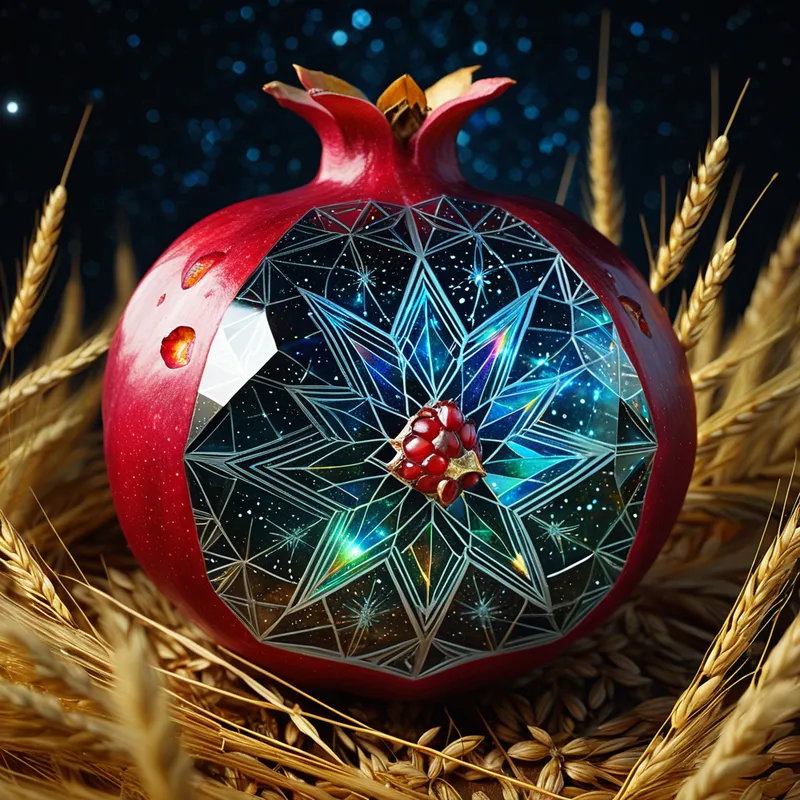
The [pomegranate seeds](/myths/pomegranate-seeds “Myth from Greek culture.”/) are the crux. To eat the [food](/symbols/food “Symbol: Food in dreams often symbolizes nourishment, both physical and emotional, representing the fulfillment of basic needs as well as deeper desires for connection or growth.”/) of a [realm](/symbols/realm “Symbol: The symbol of ‘Realm’ often signifies the boundaries of one’s consciousness, experiences, or emotional states, suggesting aspects of reality that are either explored or ignored.”/) is to belong to it. Persephone’s consumption signifies a point of no return—[the ego](/myths/the-ego “Myth from Jungian culture.”/) is irrevocably changed by its encounter with the depths. She assimilates a [piece](/symbols/piece “Symbol: A ‘piece’ in dreams often symbolizes a fragment of the self or a situation that requires integration, reflection, or understanding.”/) of the underworld’s [reality](/symbols/reality “Symbol: Reality signifies the state of existence and perception, often reflecting one’s understanding of truth and life experiences.”/). This creates her dual [citizenship](/symbols/citizenship “Symbol: Legal and social membership in a nation, representing belonging, rights, duties, and identity within a collective.”/): she is both the Spring Maiden and the [Queen](/symbols/queen “Symbol: A queen represents authority, power, nurturing, and femininity, often embodying leadership and responsibility.”/) of the Dead. The [resolution](/symbols/resolution “Symbol: In arts and music, resolution refers to the movement from dissonance to consonance, creating a sense of completion, release, or finality in a composition.”/) is not a [rescue](/symbols/rescue “Symbol: The symbol of rescue embodies themes of salvation, support, and liberation from distressing circumstances.”/), but a cyclical treaty. The psyche must learn to live in two worlds.
The Dreamer’s Resonance
When this myth stirs in modern dreams, it signals a profound initiation underway in the dreamer’s life. It is the psyche’s way of processing a “descent.”
Dreams of being suddenly taken or falling into the earth, of finding a hidden door or staircase leading down, of encountering a compelling, dark, or regal figure—these are echoes of the abduction. They often coincide with life events that feel like a forcible end to innocence: a deep loss, a depression, a diagnosis, a betrayal, or simply the unsettling onset of adulthood’s responsibilities. The somatic feeling is one of chilling inevitability, of a fate that cannot be outrun.
Dreams of being in a beautiful but silent garden, of searching frantically for a lost child or precious object, or of a world turning barren and cold mirror Demeter’s phase. This is the conscious self experiencing the devastating grief and stagnation that follows the descent. The psyche feels lifeless, creative energies are frozen.
The triumphant dream symbol is the return. Dreaming of emerging from a cave into sunlight, of a dead landscape suddenly bursting into impossible bloom, or of holding a pomegranate—whole, split, or as seeds—indicates the process of reintegration is beginning. The dreamer is not who they were; they now carry the knowledge of the depths (the seeds) within them, and their life will henceforth move in cycles of engagement (with the world) and withdrawal (into the inner realm) with a new, hard-won wisdom.

Alchemical Translation
The alchemical process mirrored in Persephone’s return is the [nigredo](/myths/nigredo “Myth from Alchemical culture.”/), followed by the albedo, in a never-ending [opus circulatorium](/myths/opus-circulatorium “Myth from Alchemical culture.”/). It models the core of Jungian individuation.
Individuation is not about becoming perfect, but about becoming whole; it requires accepting one’s citizenship in both the upper and lower worlds.
[The first stage](/myths/the-first-stage “Myth from Alchemical culture.”/), the abduction (Nigredo), is the necessary dissolution. The conscious personality (Kore) must be “plucked” from the safe, unified field of the maternal psyche (Demeter’s endless summer) and subjected to the dark, isolating fire of the unconscious. This is a kind of psychic death, where old identities and certainties are stripped away. In modern terms, it is the crisis that forces one to ask, “Who am I, beyond my roles, my family’s expectations, my surface life?”
The reign in the underworld is the stage of incubation and confrontation. Here, in the darkness, the psyche meets its shadow (Hades as lord of the rejected) and discovers its own latent sovereignty (Persephone as Queen). This is not a passive imprisonment, but an active, if painful, claiming of authority over one’s inner chaos and riches.
The return with the seeds (Albedo & Conscious Integration) is the true alchemical gold. The ego does not come back “cured” of the darkness, but informed by it. The pomegranate seeds—the accepted, digested pieces of [the shadow](/myths/the-shadow “Myth from Jungian culture.”/)—become the source of cyclical wisdom. The integrated individual learns that periods of creative output and social engagement (spring/summer) must be balanced by periods of introversion, rest, and inner work (autumn/winter). The myth teaches that wholeness is dynamic, not static. One is always both the grieving mother and the returning queen, the longing seeker and the fulfilled ruler of the deep. To live the myth is to embrace this eternal, fruitful return.
Associated Symbols
Explore related symbols from the CaleaDream lexicon: