
Persephone's Pomegranate Seeds Myth Meaning & Symbolism
A goddess is taken to the underworld, eats seeds of the dead, and becomes queen of two worlds, forging the cycle of seasons and the soul.
The Tale of Persephone’s Pomegranate Seeds
Hear now the story that holds the secret of the turning year, the tale of the maiden who walked in light and learned the wisdom of the dark.
In the first golden age of the world, when the earth was a gift that never ceased giving, there lived Demeter, whose love made the wheat grow tall and the fruit swell sweet. Her joy was her daughter, Kore, whom we call Persephone. The girl was the very spirit of spring—her laughter was the sound of budding leaves, her footsteps left violets in the grass. She spent her days in the sun-drenched meadows of Sicily, dancing with the Oceanids, her radiance a counterpoint to her mother’s grounded, nurturing power.
But deep beneath the fertile soil, in a kingdom of silence and memory, a loneliness grew. Hades, lord of the unseen realms, watched from the shadows. He saw not just a maiden, but a queen who could bring a different kind of life to his domain. He went to his brother, Zeus, and received a silent, fateful consent.
The day it happened was deceptively bright. Persephone was reaching for a narcissus of astonishing beauty—a flower placed by Hades himself, a lure whose blossom was a hundredfold, whose scent made the sky itself swoon. As her fingers closed around the stem, the earth beneath Sicily cracked open with a sound like a mountain sighing. From the chasm, a chariot of black adamant erupted, drawn by immortal, smoke-dark steeds. A hand, strong as fate and cold as a tombstone, seized her. Her cry was swallowed by the rushing wind as the earth sealed itself above her, leaving only a scatter of flowers and a terrible, echoing silence.
Demeter’s grief was a force of nature. She cast off her divinity, wrapped herself in the cloak of an old woman, and wandered the mortal world. In her sorrow, she withheld her grace. The green world withered. Leaves browned and fell, seeds lay dormant in the frozen ground, and humanity faced extinction. The gods received no sweet smoke from barren altars.
Meanwhile, in the Underworld, Persephone sat on a throne of polished ebony, a queen in a palace of ghosts. She refused all food, a prisoner in a gilded cage, her heart a frozen seed. Hades, in his own stern way, did not force her but waited. He offered her the fruit of the dead: a pomegranate, its leathery hide hiding a cavern of ruby jewels. Despairing, thinking her mother lost to her forever, or perhaps moved by a dawning understanding of the power now held in her hands, the young queen accepted. She ate six—or some say four—of the sweet-sharp seeds. The juice was like a contract signed in blood, a binding to the realm of shades.
Through the intervention of the sun-god Helios, who had witnessed the abduction, Demeter learned the truth. Her rage at Zeus’s betrayal shook Olympus. A compromise, brokered by the messenger Hermes, was struck. Because Persephone had eaten the food of the dead, she was bound to it. For each seed consumed, she would spend a corresponding month of the year in the dark with Hades. The rest, she could spend in the upper world.
Thus, when Hermes led her up the dark path back to the light, and she fell into her mother’s arms, the world erupted in blossom. But the knowledge was in her eyes now, and the pact was in her blood. She was no longer just Kore, the maiden. She was Persephone, the destroyer of flowers and the bringer of the spring, the Queen of Two Worlds.

Cultural Origins & Context
This myth, central to the Eleusinian Mysteries, was not merely a story but a foundational narrative for understanding life, death, and the cycles of nature. It was immortalized in the Homeric Hymn to Demeter, a text that served as a sacred script for one of the most important religious cults of the ancient world. The myth functioned on multiple levels: as an etiological tale explaining the seasons, as a sacred drama in the Mysteries that promised initiates a blessed afterlife, and as a social narrative about the transition of young women into marriage—a kind of abduction from the mother’s home to the husband’s domain. It was told and retold in rituals that involved fasting, sacred re-enactments, and the revelation of secret objects, binding the community to the earth’s rhythms and offering solace in the face of mortality.
Symbolic Architecture
At its heart, this is a myth of initiation and the integration of opposites. Persephone’s journey is the soul’s necessary descent into the unconscious.
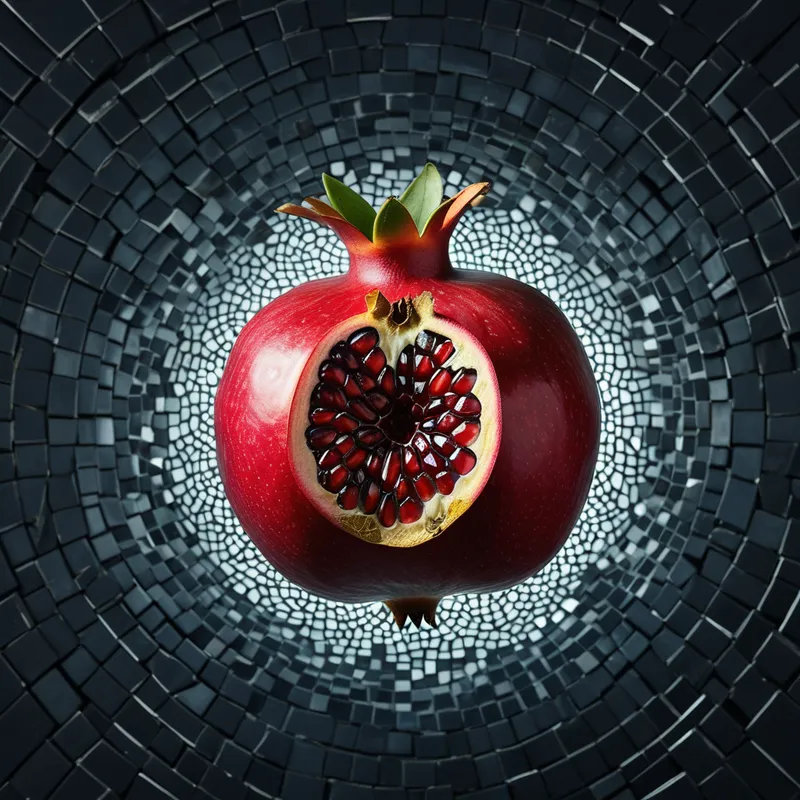
The pomegranate seed is the compact symbol of a fateful choice: to ingest the knowledge of darkness and be forever changed by it.
Kore represents the conscious ego, living in perpetual spring in the care of the Great Mother. Hades is not merely a kidnapper but the personification of the deep, unseen psyche—the shadow and the animus. The abduction is a traumatic but inevitable rupture, a call to depth that cannot be refused. The pomegranate seeds are the ultimate symbol of conscious commitment to this underworld journey. To eat them is to internalize the experience, to say “yes” to the transformation, even in despair. It is the moment the victim becomes the queen, the one who is acted upon becomes the sovereign of her new realm.
Demeter’s grief-stricken winter represents the creative paralysis of the conscious mind when it is severed from its connection to the soul’s depth. The resolution—the cyclical sharing of Persephone—models a psyche that has achieved wholeness: one capable of functioning in the bright world of persona and relationship, yet rooted in the fertile darkness of the inner self.
The Dreamer’s Resonance
When this myth stirs in modern dreams, it signals a profound initiation underway. Dreaming of being pulled underground, of finding a luminous fruit in a dark place, or of a radiant figure who is also sorrowful, points to a numinous descent. The dreamer may be experiencing a depression, a major life transition (loss, career change, the end of a relationship), or a sudden confrontation with their own hidden depths.
Somatically, this can feel like a heavy lethargy, a “wintering” of the spirit—a la Demeter’s barren world. Psychologically, it is the process of the conscious ego being dismantled to make room for a more complex self. The pomegranate in a dream is a powerful call to integration. It asks: What knowledge from your own “underworld”—be it grief, anger, or forgotten potential—are you being asked to consciously ingest and own? The dream Persephone is not a damsel in distress; she is the archetype of the psyche learning to hold its own sovereignty in the midst of profound change.
Alchemical Translation
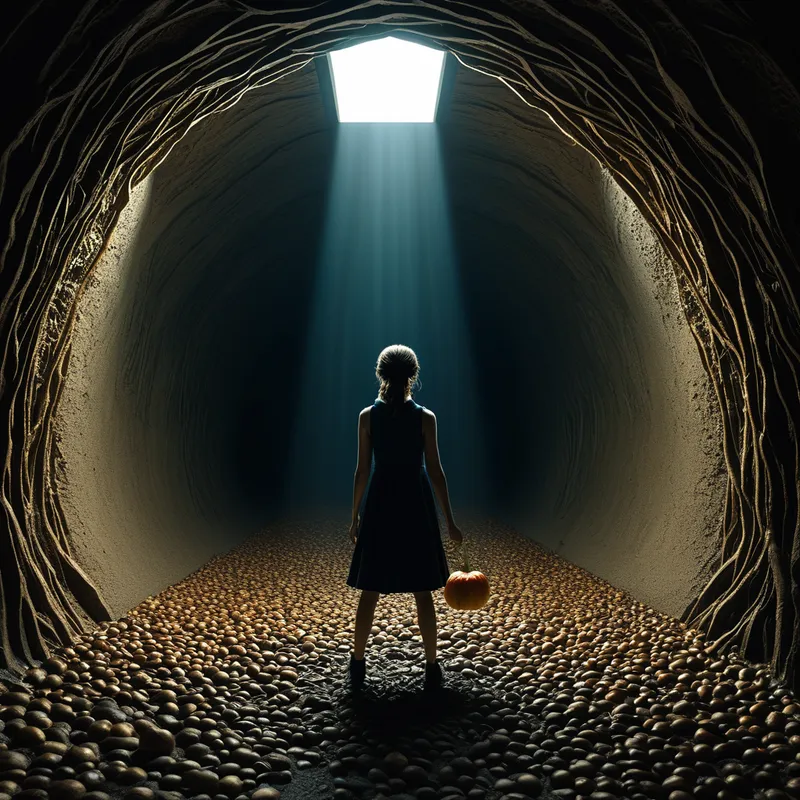
The alchemical process mirrored here is nigredo, the blackening, followed by the emergence of a new, conjuncted self. Persephone’s initial life is the prima materia—pure, unrefined potential. Her abduction is the violent dissolution of that naive state in the vas (vessel) of the underworld.
The throne in Hades is not a prison, but the Lapis Philosophorum—the seat of power forged from the union of above and below.
Her refusal of food is the necessary stage of putrefaction, where the old identity dies. The eating of the seeds is the crucial moment of coagulatio, where the insights of the descent are made substantial and permanent within the psyche. She does not just visit the underworld; she metabolizes it.
For the modern individual, this maps the path of individuation. We are all, at times, the innocent Kore in our sunlit meadows. Life, inevitably, abducts us—through crisis, loss, or simply the slow dawning of our own complexity. The alchemical work is to move from resisting this abduction to consciously eating the seeds: to willingly take in the bitter-sweet truths revealed in our darkness. We become queens and kings of our own dual realms, no longer split between a false light and a denied shadow, but ruling a whole self that moves in compassionate cycles between engagement and retreat, expression and introspection, summer and winter. We become, like Persephone, the authors of the seasons of our own soul.
Associated Symbols
Explore related symbols from the CaleaDream lexicon: