Persephone's Pomegranate Myth Meaning & Symbolism
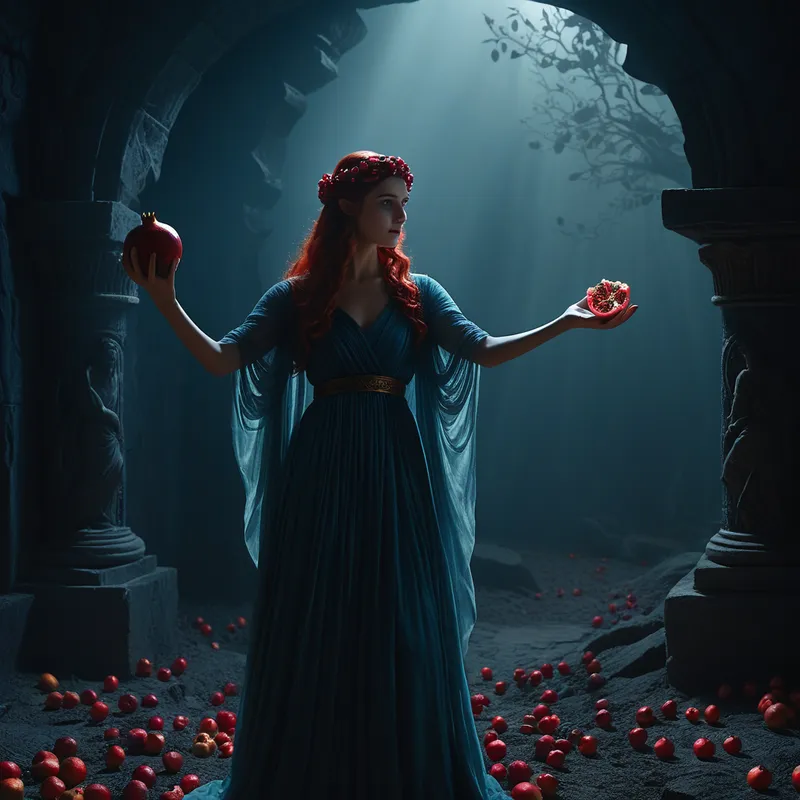
The maiden Persephone is abducted to the underworld. Eating six pomegranate seeds binds her to a cyclical life between light and darkness.
The Tale of Persephone’s Pomegranate
Listen, and hear a tale not of one world, but of two. It begins in the sun-drenched fields of Nysa, where the air hums with the scent of blooming narcissus. Here, Demeter’s daughter, Kore, whom we know as Persephone, gathers flowers with the lightness of a spring breeze. Her laughter is the sound of life itself, unbound and innocent.
But the earth beneath her feet is not solid. It is a lid. And from a chasm that splits the meadow wide, the black horses of Hades thunder forth. The god of the unseen realm, cloaked in the silence of ages, claims what the Fates have woven. His grip is as final as the grave, his chariot a vortex pulling her down, down into the sunless kingdom. The last thing she hears is the fading cry of her nymph companions; the last thing she sees is the light receding to a pinprick, then nothing.
Above, Demeter’s grief is a blight upon the world. She tears her veil, and the green earth withers. She withdraws her blessing, and the first winter descends—a winter with no promise of end. Mortals starve. The gods plead. But a mother’s sorrow is a force older than Olympus.
Below, in the halls of Erebus, a transformation begins. The maiden of the fields walks among the silent shades. Hades, a king in his lonely dominion, offers not cruelty, but a crown. He presents her with the fruit of his realm: a pomegranate, its leathery skin hiding a universe of ruby seeds. It is the fruit of the dead, of binding, of finality. Drawn by a hunger deeper than starvation—a hunger for meaning, for a choice within her captivity—Persephone accepts. She pierces the rind and consumes six of the glistening arils. The sweet-tart juice stains her lips, a indelible signature.
This act becomes the pivot of the cosmos. A bargain is struck in the cold halls of Zeus. For each seed eaten, a month of bondage. Persephone, now truly the Queen of the Underworld, is granted a cyclical destiny: six months in the sunlit world with her mourning mother, and six months ruling beside Hades in the land of shadows.
Her return brings the spring. Her descent brings the fall. The world learns to breathe in halves, and in that rhythm, finds its eternal, trembling balance.

Cultural Origins & Context
This central narrative, known as the Homeric Hymn to Demeter, was not mere entertainment. It was a sacred text, a hieros logos, performed in the context of the Eleusinian Mysteries. For over a millennium, initiates journeyed to Eleusis to be inducted into secrets concerning life, death, and the promise of rebirth, with this myth at its heart. The storytellers were priests and priestesses, and the function was profoundly societal and psychological: to provide a divine template for the most terrifying human realities—the abduction of a child (by death, by marriage, by fate), the crushing grief of loss, and the enigmatic necessity of the cycle of decay and regeneration. It explained the seasons, yes, but more importantly, it sanctified the human experience of them.
Symbolic Architecture
The myth’s power lies in its dense symbolic architecture. Persephone is the anima, the soul-life, that must descend from conscious innocence into the realm of the unconscious. Hades is not merely a villain, but the personification of the shadow and the deep, structuring principles of the psyche. His realm is the underworld of forgotten memories, repressed desires, and the fertile dark where all transformation begins.
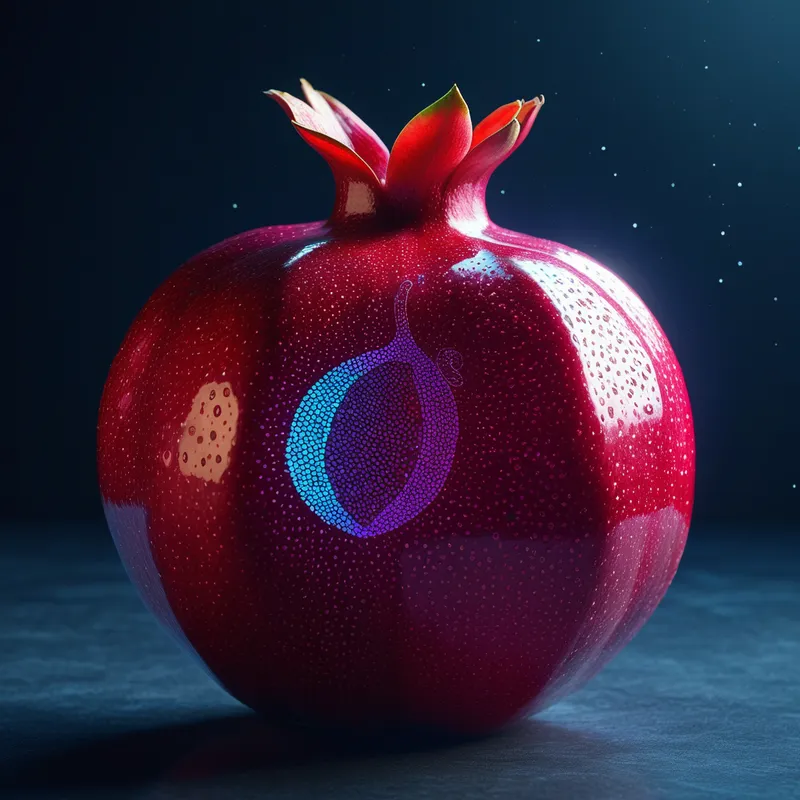
The pomegranate is the contract with the depths. To eat of it is to consciously ingest a piece of the unknown, thereby making it part of one’s own substance.
The six seeds signify a partial, yet binding, integration. She does not eat the whole fruit; she does not become forever only the Queen of Death. She becomes dual, a living paradox: the Maiden of Spring and the Sovereign of the Underworld. This is the archetype of the Lover, not in a trivial sense, but in its deepest form—the one who commits, who binds herself to an experience (even a painful one) and through that commitment, attains a higher, more complex unity. Her abduction is a brutal initiation, but her act of eating is an acceptance, the moment the victim becomes a participant in her own destiny.
The Dreamer’s Resonance
When this myth stirs in modern dreams, it signals a profound psychological process underway. To dream of being pulled underground, of a radiant light being swallowed by earth, or of finding oneself in a beautiful but somber palace, speaks to a necessary descent. The psyche is orchestrating an encounter with what has been repressed—a past trauma, a neglected talent, a powerful emotion like rage or grief.
Dreaming of the pomegranate itself is particularly potent. It may appear as a glowing fruit in a dark place, a box that should not be opened, or food that is both tempting and forbidden. This is the somatic signal of a choice point. The dreamer is being presented with their own “seed”: an insight, a memory, or a truth from the unconscious that, if accepted (eaten, integrated), will irrevocably change them. There is often terror here, the fear of being stained, bound, or lost. But the myth assures us that this ingestion is not annihilation; it is the beginning of sovereignty over a wider realm of the self.

Alchemical Translation
The alchemical journey of individuation is perfectly modeled in Persephone’s cycle. The initial state (the nigredo) is the innocent, unified consciousness in the eternal spring of childhood or a stagnant idealism. The abduction is the shocking, often involuntary, plunge into the solutio—dissolution in the waters of the unconscious, where all familiar forms melt away.
Her time in the underworld represents the coagulatio: the formation of a new, denser psychic substance in the dark. Here, in the quiet of Hades’ hall, the maiden must sit upon a throne she did not seek. This is the heart of the work—facing the shadow, enduring the depression or confusion, and finding authority within the experience itself.
The return is not a return to what was, but the emergence of the albedo, the whitening, as the integrated self brings the treasure of the deep back to the light of day.
Persephone’s annual journey is the individuated life: not a linear escape from darkness, but a sacred, cyclical dialogue between the surface and the depth. The modern individual undergoing this alchemy learns that wholeness requires honoring both the creative, social self (the spring and summer) and the introspective, regenerative self (the fall and winter). We are all bound by the pomegranate seeds of our own deepest choices and integrations. To embrace this cycle is to cease being a victim of the dark and become, like Persephone, a conscious ruler of the entire, beautiful, and terrifying landscape of the soul.
Associated Symbols
Explore related symbols from the CaleaDream lexicon: