Persephone's Descent Myth Meaning & Symbolism
The maiden Persephone is abducted by Hades, causing her mother Demeter's grief to wither the world, leading to a compromise that creates the seasons.
The Tale of Persephone’s Descent
Listen, and hear the story that explains why [the earth](/myths/the-earth “Myth from Hindu culture.”/) grows cold and silent, and why life always returns.
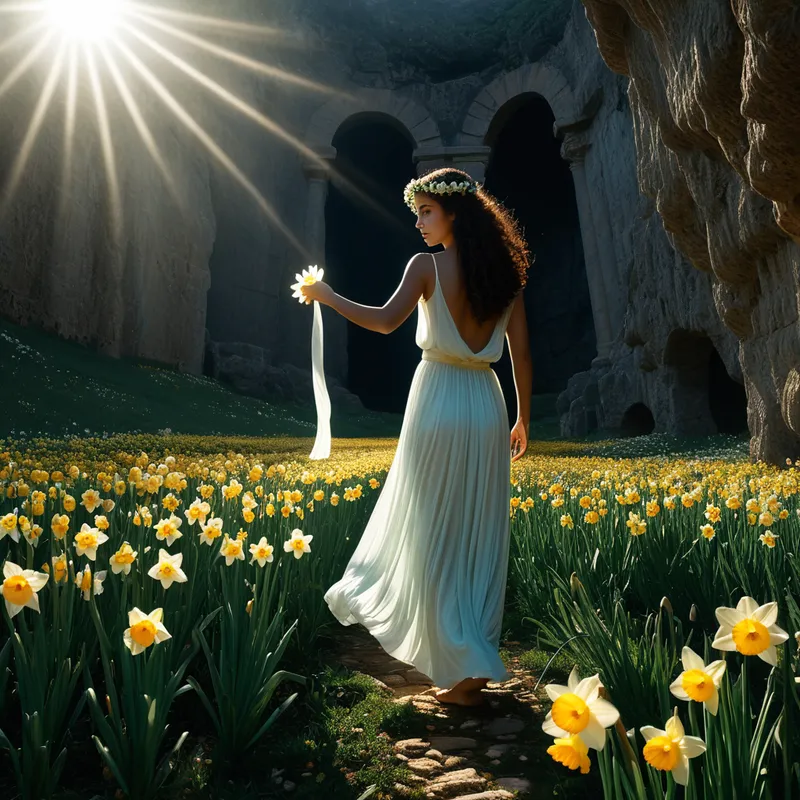
In the first days, when [the world](/myths/the-world “Myth from Tarot culture.”/) was young and green, there lived a maiden of such radiance that flowers sprang up where she walked. Her name was [Persephone](/myths/persephone “Myth from Greek culture.”/), and she was the beloved daughter of Demeter, she who made the grain grow and the earth fruitful. Their joy was [the world](/myths/the-world “Myth from Tarot culture.”/)’s joy. [Persephone](/myths/persephone “Myth from Greek culture.”/) spent her days in the meadows of Sicily, laughing with her nymph companions, weaving garlands, and filling her basket with blossoms.
But beneath the sunlit world, in a kingdom of silent shades and echoing halls, a lonely king watched. [Hades](/myths/hades “Myth from Greek culture.”/), ruler of the unseen realms, longed for a queen. He saw Persephone’s light and knew it could pierce his eternal dusk. With a plea to his brother Zeus, he received silent consent.
One day, as Persephone strayed from her companions, drawn to a [narcissus](/myths/narcissus “Myth from Greek culture.”/) of breathtaking beauty—a flower placed by the earth at Hades’s command—the ground trembled and split. With a sound like thunder from below, a great chasm opened. From the darkness erupted a chariot of blackest obsidian, drawn by immortal steeds. Hades, majestic and terrible, seized the shrieking maiden. Her cry was swallowed by the earth as the chasm closed, leaving only a trampled meadow and a fallen basket of flowers.
Demeter heard the echo of that cry in her soul. For nine days and nights, the great goddess roamed the earth, a torch in each hand, her grief a physical chill. She asked all she met—god, nymph, and mortal—but none dared speak against Zeus’s will. In her despair, she withdrew her blessing. The fertile soil turned to dust. Vines withered, trees shed their leaves, and a bitter frost seized the world. Mankind faced extinction.
The gods, deprived of offerings, grew restless. Finally, the sun god [Helios](/myths/helios “Myth from Greek culture.”/), who sees all, told Demeter the truth. Rage and sorrow warred within her. She declared the earth would remain barren until her daughter was returned.
Zeus, pressured by the cries of starving humanity and the anger of the other gods, sent the messenger [Hermes](/myths/hermes “Myth from Global/Universal culture.”/) down to the realm of Hades to negotiate. [Hermes](/myths/hermes “Myth from Global/Universal culture.”/) found Persephone beside her dark king, no longer a carefree maiden but a woman wrapped in solemn grace. Yet, she had eaten. Tricked by longing or perhaps a dawning acceptance, she had consumed six seeds from a pomegranate, the food of the dead. By the ancient laws, this bound her to [the underworld](/myths/the-underworld “Myth from Greek culture.”/).
A compromise was forged, a decree from Zeus himself. For each seed eaten, Persephone would spend one month of the year in the kingdom of Hades. The rest of the year, she would return to the light and her mother’s arms.
Thus, when Persephone ascends, Demeter’s joy makes the earth bloom into spring and summer. And when the time comes for her to descend again, Demeter’s grief brings autumn’s decay and winter’s sleep. The maiden became the queen, and in her cyclical journey, the rhythm of all life was born.

Cultural Origins & Context
This central myth, known as the Homeric Hymn to Demeter, was not merely a story for the ancient Greeks; it was a sacred narrative at the heart of the most profound religious experience of the classical world: the Eleusinian Mysteries. For nearly two thousand years, initiates from all walks of life—from slaves to emperors—traveled to Eleusis to be inducted into secrets that promised solace from the fear of death.
The myth was performed, chanted, and enacted in rituals. Its primary societal function was twofold. First, it was an etiological myth, providing a divine reason for the changing seasons, a matter of life and death for an agricultural society. Second, and more profoundly, it modeled a theology of hope. Persephone’s return demonstrated that death was not a final end, but part of a cyclical process overseen by benevolent, if sometimes stern, deities. The story was passed down through sacred poetry and ritual drama, making it a living, breathing pillar of Greek spiritual life, far more impactful than the theatrical tales of Olympus.
Symbolic Architecture
At its core, the myth of Persephone is a map of a profound psychological [initiation](/symbols/initiation “Symbol: A symbolic beginning or transition into a new phase, status, or awareness, often involving tests, rituals, or profound personal change.”/). It is not a [story](/symbols/story “Symbol: The symbol of ‘Story’ represents the narrative woven through our lives, embodying experiences, lessons, and emotions that shape our identities.”/) of mere victimhood, but of a necessary, if traumatic, transformation from one state of being to another.
Kore (the Maiden) represents the unconscious [innocence](/symbols/innocence “Symbol: A state of purity, naivety, and freedom from guilt or corruption, often associated with childhood and moral simplicity.”/) of the [psyche](/myths/psyche “Myth from Greek culture.”/)—the potential self, content in the conscious world of the [Mother](/symbols/mother “Symbol: The symbol of ‘Mother’ represents nurturing, protection, and the foundational aspect of one’s emotional being, often associated with comfort and unconditional love.”/) (Demeter). The abduction by [Hades](/symbols/hades “Symbol: Greek god of the underworld, representing death, the unconscious, and hidden aspects of existence.”/) is the inevitable [eruption](/symbols/eruption “Symbol: A sudden, violent release of pent-up energy or emotion from beneath the surface, often representing transformation or crisis.”/) of the unconscious into this idyllic state. It is the call to individuation that feels like a violation, a catastrophic end to the known world.
The descent is not a punishment, but a summons. The underworld is not hell, but the unconscious itself—the realm of forgotten memories, instincts, and the seeds of the future self.
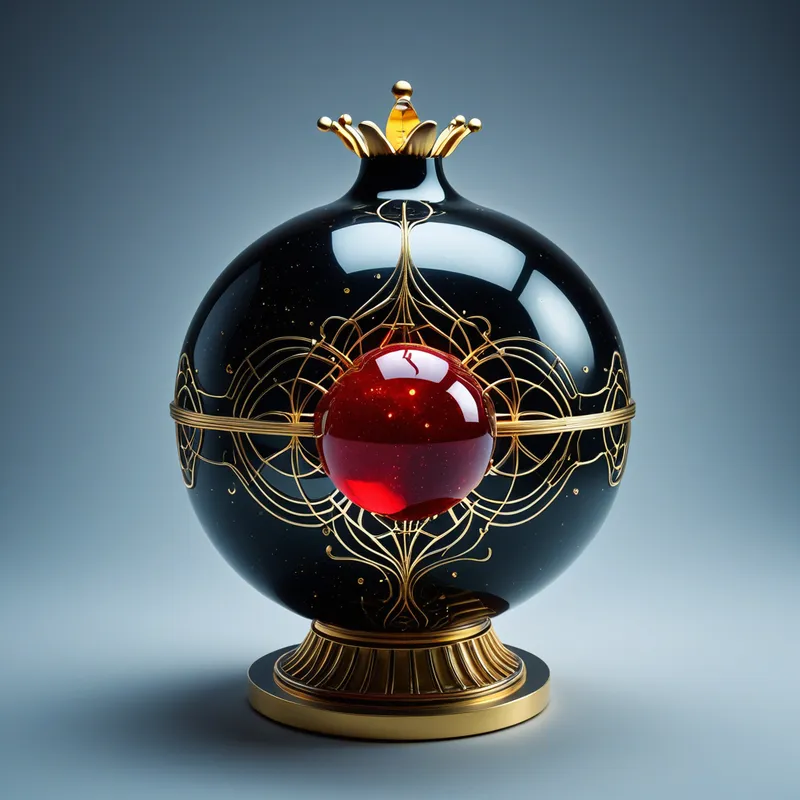
The [pomegranate seeds](/myths/pomegranate-seeds “Myth from Greek culture.”/) are the critical [symbol](/symbols/symbol “Symbol: A symbol can represent an idea, concept, or belief, serving as a powerful tool for communication and understanding.”/). To eat the [food](/symbols/food “Symbol: Food in dreams often symbolizes nourishment, both physical and emotional, representing the fulfillment of basic needs as well as deeper desires for connection or growth.”/) of the [underworld](/symbols/underworld “Symbol: A symbolic journey into the unconscious, representing exploration of hidden aspects of self, transformation, or confronting repressed material.”/) is to consciously integrate a [piece](/symbols/piece “Symbol: A ‘piece’ in dreams often symbolizes a fragment of the self or a situation that requires integration, reflection, or understanding.”/) of that shadowy [realm](/symbols/realm “Symbol: The symbol of ‘Realm’ often signifies the boundaries of one’s consciousness, experiences, or emotional states, suggesting aspects of reality that are either explored or ignored.”/). It is the [moment](/symbols/moment “Symbol: The symbol of a ‘moment’ embodies the significance of transient experiences that encapsulate emotional depth or pivotal transformations in life.”/) [the ego](/myths/the-ego “Myth from Jungian culture.”/) acknowledges the power and [reality](/symbols/reality “Symbol: Reality signifies the state of existence and perception, often reflecting one’s understanding of truth and life experiences.”/) of the unconscious, forging a permanent link. This act transforms Persephone from a passive girl into an active [Queen](/symbols/queen “Symbol: A queen represents authority, power, nurturing, and femininity, often embodying leadership and responsibility.”/), a co-ruler of the deepest realms of the psyche. Her dual [citizenship](/symbols/citizenship “Symbol: Legal and social membership in a nation, representing belonging, rights, duties, and identity within a collective.”/)—above and below—symbolizes the integrated individual who can navigate both the conscious demands of [life](/symbols/life “Symbol: The symbol of ‘Life’ represents a journey of growth, interconnectedness, and existential meaning, encompassing both the joys and challenges that define human experience.”/) and the deep, often dark, waters of the inner world.
The Dreamer’s Resonance
When this mythic pattern stirs in the modern dreamer, it often heralds a profound, non-negotiable initiation. One does not dream of Persephone’s descent during trivial life changes. It appears when the foundational soil of one’s identity is being torn open.
Somatic signs may include a feeling of being pulled down, of gravity increasing, or dreams of earthquakes, sudden falls, or being swallowed by the earth. Psychologically, it manifests as a period of intense depression, a “dark night of the soul,” where all previous sources of joy and meaning (the sunny meadow) lose their vitality. The dreamer may feel abducted by circumstances—a severe loss, illness, or betrayal—that force them into an emotional “[underworld](/myths/underworld “Myth from Greek culture.”/).”
In dreams, the figures are modernized: the Hades figure may be a compelling but shadowy stranger, a demanding new job, or a depressive episode itself. The pomegranate may appear as a forbidden contract, a pill, a piece of crucial but distressing knowledge, or simply a hauntingly beautiful yet ominous fruit. The dreamer’s task is not to escape this realm prematurely, but to endure it, to eventually find the authority and wisdom that can only be forged in such depths. The dream is the psyche’s way of saying, “You are being called to rule a part of yourself you have never dared to visit.”

Alchemical Translation
The alchemical process mirrored in Persephone’s journey is the [nigredo](/myths/nigredo “Myth from Alchemical culture.”/), followed by a paradoxical, cyclical albedo and [rubedo](/myths/rubedo “Myth from Alchemical culture.”/). For the modern individual, the myth models the path of psychic transmutation—individuation—not as a linear ascent to perfection, but as a rhythmic descent and return.
[The first stage](/myths/the-first-stage “Myth from Alchemical culture.”/) (nigredo) is the abduction: the collapse of the conscious [persona](/myths/persona “Myth from Greek culture.”/), the death of an old way of being. This is often experienced as a crisis. The second stage is the dwelling in the underworld: the soul-making. Here, in the darkness, one encounters disowned powers (Hades) and learns to sit with them, eventually finding a seat of authority (the throne). Eating the pomegranate seeds is the crucial act of saying “yes” to this process, of accepting that this darkness is now part of one’s story and substance.
The goal is not to escape the underworld, but to earn the right to leave it, carrying its wisdom back into the light. The integrated self is a cyclical being, comfortable with periods of introspection and withdrawal (winter) as necessary for periods of expression and growth (spring).
The final, ongoing stage is the cyclical return. The individuated person is not someone who has “solved” their psyche, but one who has made peace with its seasons. They know that creativity (Persephone’s spring) is born from periods of fallow darkness, that vitality requires periodic retreat into the nourishing unconscious. The myth teaches that wholeness is found not in perpetual light, but in the sacred agreement between the light and the dark, the mother and the king, the meadow and the throne room. We are, each of us, the maiden, the queen, and the cycle itself.
Associated Symbols
Explore related symbols from the CaleaDream lexicon: