Persephone's annual return Myth Meaning & Symbolism
The story of a goddess abducted to the underworld, whose annual return to the surface brings spring, embodying the eternal cycle of death and rebirth.
The Tale of Persephone’s annual return
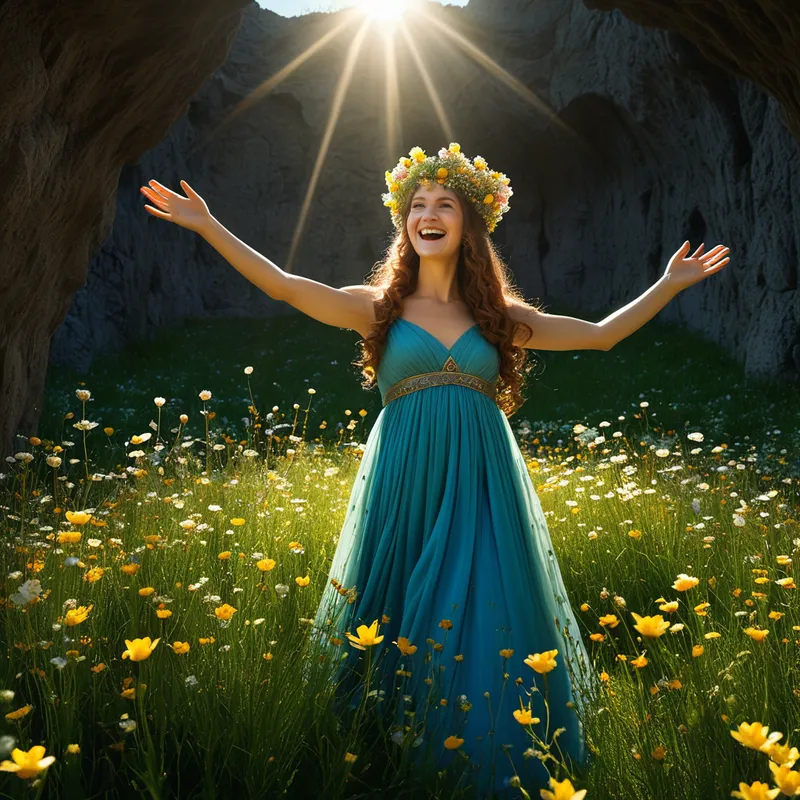
Listen. The world was young and green, and in the sun-drenched fields of Nysa, a girl laughed. Her name was Kore, and her laughter was the sound of buds breaking open. She danced with her companions, the Oceanids, her feet barely touching the earth, her fingers weaving crowns of violet and crocus. Her mother, Demeter, watched from afar, her heart a field of ripe grain, full and golden.
But the earth is not only surface. Deep below, in sunless halls of polished obsidian and echoing silence, a king stirred. Hades, lord of the invisible realm, had seen the maiden’s light. A crack opened in the meadow floor, a chasm of impossible depth and cold. From it erupted a chariot of blackest iron, drawn by steeds whose breath was frost. The king’s hand, strong as a mountain root, closed around the girl’s wrist. Her cry was swallowed by the rushing dark. The earth sealed itself, leaving only a trampled circle of flowers and a silence so profound it was a sound unto itself.
Demeter’s scream was the sound of all growth ceasing. She cast down her crown of grain and took up a torch, its flame a cold, desperate blue. For nine days and nine nights, she wandered the mortal world, a grieving ghost in a living land. She asked the sun, Helios, who told her of the dark pact: her brother Zeus had given their daughter to the king below. Fury turned to ice. She withdrew her blessing. The soil hardened to stone. Trees shed their leaves in high summer. Hunger, a guest never before known, walked among humanity.
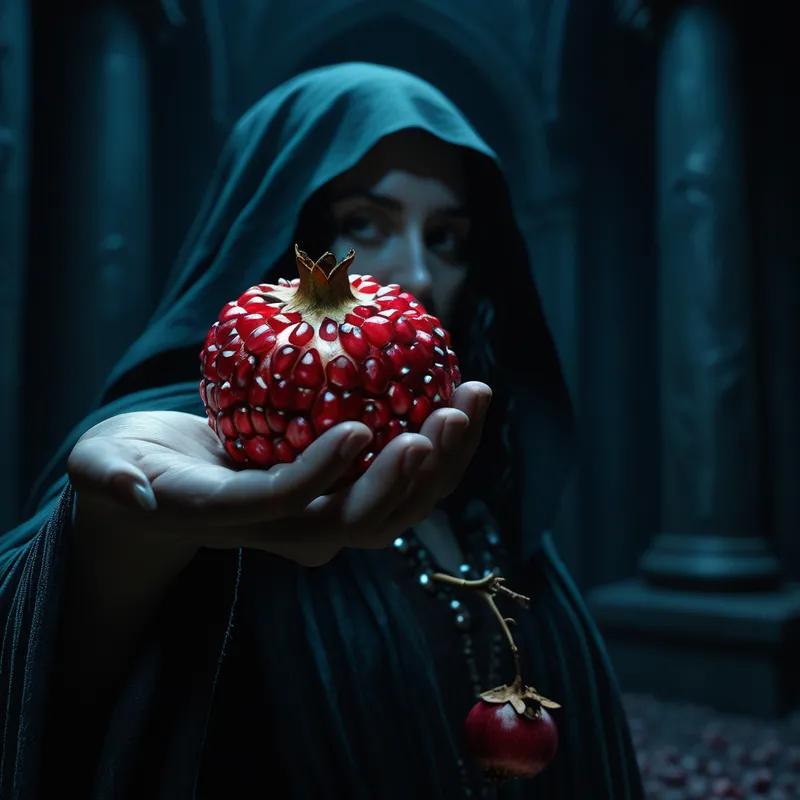
In the underworld, the maiden, now called Persephone, sat on a throne of jet. The kingdom of shades stretched before her, a realm of memory and finality. Hades offered her a fruit, a pomegranate from his own garden, its skin like polished leather holding a universe of ruby seeds. Hungry, lost, and perhaps sensing a new sovereignty, she ate. Not a feast, but a taste. Six seeds passed her lips, their sweet-tart juice a covenant.
Above, the world died. Below, a queen was made. The cries of mortals reached even the throne of Olympus. Zeus, seeing the barren earth, sent the swift messenger Hermes down the dark road. A compromise was struck in the silent halls: for each seed consumed, a month of rule below. For the rest, she could return to the light.
And so, at the world’s edge, a fissure opened once more. Persephone ascended, her gown no longer of spring blossoms but of intricate shadows and woven silver. At the threshold, she saw her mother, aged by grief, her torch guttering. Their embrace was the first thaw. Where Persephone’s feet touched the withered ground, grass uncurled. Where her breath fell, a breeze carried the scent of damp soil and hyacinth. The world exhaled. Spring had returned. But in the queen’s eyes, now lived the knowledge of the deep, and the certainty of her return journey, when the autumn winds would call her home once more.
Cultural Origins & Context
This myth, central to the Eleusinian Mysteries, was not merely a story but a lived, initiatory reality for ancient Greeks. It was the heart of a state-sponsored cult that promised initiates a blessed afterlife, a hope not commonly found in the bleak Homeric vision of Hades. The tale, part of the Homeric Hymn to Demeter, was performed, not just read. It was passed down through ritual re-enactment at Eleusis, where thousands—from slaves to emperors—underwent a profound experiential journey mirroring Persephone’s descent and return.
Its societal function was multifaceted. On the surface, it was an etiological myth explaining the seasons, giving agricultural cycles a divine, narrative logic. On a deeper level, it served as the foundational myth for the Mysteries, offering a template for conquering the fear of death. By ritually identifying with Persephone, the initiate underwent a symbolic death and rebirth, emerging with the assurance that the soul, like the goddess, could find order and even sovereignty in the realm of the dead. It transformed a natural cycle into a spiritual promise, binding the community to the land and the gods through a shared, sacred story.
Symbolic Architecture
The myth is a perfect map of the psyche’s necessary cycles. Persephone, the maiden or Kore, represents the conscious ego in its innocent, dependent state, rooted in the mother-world of Demeter (the nurturing, conscious identity). Her abduction is not a random tragedy but an inevitable call from the unconscious—the Underworld ruled by Hades. This is the moment life forces a descent upon us: trauma, loss, depression, or simply the deep, unsettling call to grow beyond the familiar.
The pomegranate seeds are the most potent symbol of all: they represent the voluntary ingestion of destiny. To eat the food of the other world is to accept its reality, to internalize the experience, and to be irrevocably changed by it.
Demeter’s grief and the resulting famine symbolize the catastrophic collapse of the conscious personality when it refuses the demands of the deeper Self. The world of light and order becomes sterile without integration with the dark. The resolution—the cyclical return—establishes a new psychic structure. Persephone is no longer only Demeter’s daughter; she is Queen of the Underworld. She becomes the mediatrix, the one who can traverse the boundary, holding both innocence and experience, life and death, in her person.
The Dreamer’s Resonance
When this myth stirs in modern dreams, it often manifests as patterns of abrupt transition, captivity, or seasonal inner shifts. Dreaming of being pulled underground, of elevators descending endlessly, or of being in a beautiful yet oppressive garden points to an active “abduction” phase—the psyche is being taken into a necessary but frightening period of introspection, often against the ego’s will.
Dreams of eating a forbidden, darkly enticing fruit (like blackberries, blood oranges, or the pomegranate itself) signal the moment of unconscious assimilation. The dreamer is, on a somatic level, “eating their fate,” accepting a profound change or truth that will tie them to a new phase of life. Conversely, dreams of a frozen or barren landscape mirror Demeter’s grief, indicating a conscious life that has become sterile, perhaps due to resistance to a painful but necessary inner process. The eventual dream of finding a hidden door, of roots turning to stairs, or of emerging into a sudden, unexpected spring marks the beginning of the “return,” carrying the hard-won wisdom of the depths back into daylight living.

Alchemical Translation
For the modern individual striving toward individuation, Persephone’s journey is the ultimate model of psychic alchemy. The goal is not to avoid the underworld, but to learn its governance.
The initial abduction (the nigredo or blackening of alchemy) is the dissolution of the old, solar ego. Life forces a confrontation with the shadow, with loss, with all we have repressed. The descent is the immersion in this prima materia of the soul. The key alchemical operation is the eating of the seeds: the conscious choice to engage with the pain, to analyze the dream, to sit in the depression without fleeing, to “ingest” the lesson. This is the mortificatio, where the old self dies.
The triumph is not in escaping the underworld, but in earning the right to leave it. The crown of the Queen is forged in the dark, not bestowed in the light.
The return is the albedo (whitening) and rubedo (reddening)—the integration and rebirth. The individual who has made this cyclical journey no longer lives only on the surface. They carry the authority of the depths within them. They understand that creativity (spring) is born from periods of fallow darkness (winter), that joy is deepened by the knowledge of sorrow, and that the Self is a sovereign capable of ruling both realms of their experience. They become whole, not by rejecting the dark, but by honoring its claim and returning, season after season, enriched by its timeless wisdom.
Associated Symbols
Explore related symbols from the CaleaDream lexicon: