
Persephone's annual descent Myth Meaning & Symbolism
The maiden Persephone is abducted by Hades, causing eternal winter. Her annual return to the surface brings spring, symbolizing life's cyclical death and rebirth.
The Tale of Persephone’s annual descent
Hear now the story that holds the secret of the turning year, the tale of the maiden who walks between worlds.
In the first days, when [the world](/myths/the-world “Myth from Tarot culture.”/) was young and green with the laughter of Demeter, her daughter [Persephone](/myths/persephone “Myth from Greek culture.”/) danced. She danced in the Nysian plain, where the air was thick with the scent of violets, roses, and crocuses. Her feet, bare and white, barely touched [the emerald](/myths/the-emerald “Myth from Medieval European culture.”/) grass. Her companions, the Oceanids, wove garlands of [hyacinth](/myths/hyacinth “Myth from Greek culture.”/) as her laughter, clear as spring [water](/myths/water “Myth from Chinese culture.”/), echoed under the boundless blue sky. It was a world of pure surface, of light without shadow.
But in the deep, silent chambers beneath the roots of the world, a longing stirred. [Hades](/myths/hades “Myth from Greek culture.”/), lord of the unseen realms, had seen her from his sunless throne. A single shaft of her joy had pierced the eternal dusk, and in that light, he knew a desire more profound than any possession. He went to his brother, Zeus, and received a silent, fateful consent.
On that day, as Persephone reached for a flower of surpassing beauty—a [narcissus](/myths/narcissus “Myth from Greek culture.”/), crafted by Gaia to be a snare—[the earth](/myths/the-earth “Myth from Hindu culture.”/) groaned. The meadow split asunder with a sound like a mountain breaking. From the chasm, black horses snorted steam, pulling a chariot of polished obsidian. A hand, strong as stone and cold as a tomb, seized the maiden’s wrist. Her cry was swallowed by the rushing dark as the gaping earth closed above her, leaving only a scatter of torn flowers and a silence so profound it was itself a scream.
Demeter’s grief was a force of nature. She cast off her divinity, wrapped herself in the guise of an old woman, and walked the mortal roads, her sorrow a blight upon the land. Where her feet fell, green life withered. The soil hardened to iron; seeds rotted in the furrow; a bitter wind scoured the bare branches. An endless winter fell, and humanity faced extinction, their prayers to Olympus rising like smoke from frozen altars.
Driven by desperation, the sun god [Helios](/myths/helios “Myth from Greek culture.”/) revealed the truth: Persephone was below, seated beside Hades as his queen. Armed with this knowledge, Demeter confronted Zeus. The king of gods, seeing the whole order of life unravel, commanded [Hermes](/myths/hermes “Myth from Global/Universal culture.”/), the swift messenger, to descend and bring the maiden back.
In the [Underworld](/myths/underworld “Myth from Greek culture.”/), Persephone had changed. The girl of the meadows now sat, pale and solemn, on a throne of ebony. She was no longer a captive but a ruler who had tasted the fruit of that kingdom. Yet, when Hermes delivered his command, hope flickered in her heart. Hades, bound by the decree of Zeus, could not refuse. But as she turned to go, he offered her a final gift—a pomegranate, its skin like polished garnet. Moved by a complex longing, or perhaps by a new kind of hunger, Persephone ate six of its glistening seeds.
This simple act became the hinge of fate. For whoever tastes the food of the dead is bound to them. A compromise was struck, not by force, but by this voluntary ingestion. For each seed consumed, Persephone would spend one month of the year in the kingdom of shadows. The rest, she could walk again in the light.
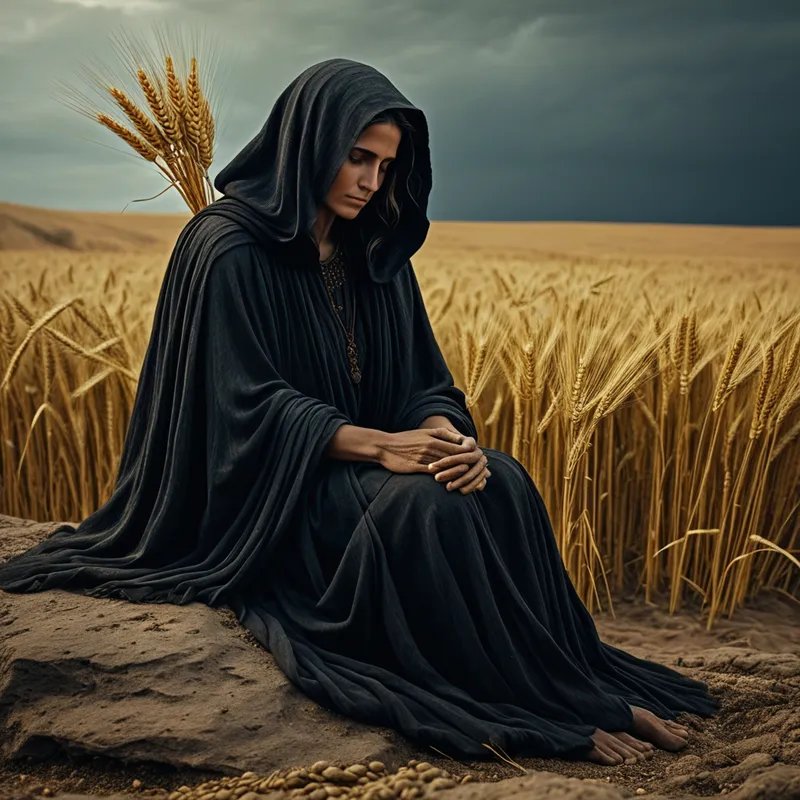
Thus, the great rhythm was born. When Persephone ascends to her mother, Demeter’s joy erupts as spring: the thaw, the bud, the greening wheat. When the time of the seeds arrives and she descends once more to her dark throne, Demeter’s grief brings autumn’s decline and winter’s sleep. The maiden is forever both: the Kore of the upper world, and the dread Persephassa of the lower. Her journey is the breath of the world itself.
Cultural Origins & Context
This myth, central to what we call the Eleusinian Mysteries, was far more than a story. It was a foundational narrative, a sacred drama performed and experienced. Its earliest written form is in the Homeric Hymn to Demeter, a text likely used in ritual contexts. Unlike the epic tales of heroes, this was a story of goddesses, intimately tied to the most basic human anxieties: the failure of the harvest and the mystery of death.
The myth was not merely told; it was enacted. At Eleusis, initiates underwent a ritual process that mirrored Persephone’s descent and return. The details were secret, protected by a vow of silence, but it is believed participants experienced a symbolic journey into darkness and an ecstatic return to light, promising them a blessed fate after death. The myth thus functioned as both agricultural calendar and esoteric hope. It explained the necessary cycle of barrenness and fertility in nature, while simultaneously offering a template for the human soul’s journey through loss and into a form of transcendence. It was society’s way of metabolizing the profound, unavoidable truths of separation, grief, and the hope for renewal.
Symbolic Architecture
The myth’s power lies in its perfect, painful [symmetry](/symbols/symmetry “Symbol: A fundamental principle of balance, harmony, and order, often representing perfection, stability, and the resolution of opposites.”/). It is a map of the [psyche](/myths/psyche “Myth from Greek culture.”/)’s necessary descent into its own [depths](/symbols/depths “Symbol: Represents the subconscious, hidden emotions, or foundational aspects of the self, often linked to primal fears or profound truths.”/).
The pomegranate seed is the signature of the soul’s consent to its own transformation. One cannot be taken; one must also eat.
Persephone represents the nascent ego, the conscious self dwelling in the “[meadow](/symbols/meadow “Symbol: A meadow often symbolizes peace, tranquility, and a connection to nature.”/)” of maternal protection and conscious ideals. Her abduction is not a random tragedy but an inevitable call from the unconscious—the [realm](/symbols/realm “Symbol: The symbol of ‘Realm’ often signifies the boundaries of one’s consciousness, experiences, or emotional states, suggesting aspects of reality that are either explored or ignored.”/) of [Hades](/symbols/hades “Symbol: Greek god of the underworld, representing death, the unconscious, and hidden aspects of existence.”/). This is the shocking, often traumatic, encounter with what has been repressed: [grief](/symbols/grief “Symbol: A profound emotional response to loss, often manifesting as deep sorrow, yearning, and a sense of emptiness.”/), rage, sexuality, [mortality](/symbols/mortality “Symbol: The awareness of life’s finitude, often representing transitions, impermanence, or existential reflection in dreams.”/), the [shadow](/symbols/shadow “Symbol: The ‘shadow’ embodies the unconscious, repressed aspects of the self and often represents fears or hidden emotions.”/). Demeter’s world-withering [grief](/symbols/grief “Symbol: A profound emotional response to loss, often manifesting as deep sorrow, yearning, and a sense of emptiness.”/) symbolizes the catastrophic collapse of the old conscious [attitude](/symbols/attitude “Symbol: Attitude symbolizes one’s mental state, perception, and posture towards life, influencing emotions and actions significantly.”/) when faced with this [loss](/symbols/loss “Symbol: Loss often symbolizes change, grief, and transformation in dreams, representing the emotional or psychological detachment from something or someone significant.”/).
The true [alchemy](/symbols/alchemy “Symbol: A transformative process of purification and creation, often symbolizing personal or spiritual evolution through difficult stages.”/), however, happens in the [underworld](/symbols/underworld “Symbol: A symbolic journey into the unconscious, representing exploration of hidden aspects of self, transformation, or confronting repressed material.”/). Persephone does not merely wait for [rescue](/symbols/rescue “Symbol: The symbol of rescue embodies themes of salvation, support, and liberation from distressing circumstances.”/). She becomes [Queen](/symbols/queen “Symbol: A queen represents authority, power, nurturing, and femininity, often embodying leadership and responsibility.”/). This signifies [the ego](/myths/the-ego “Myth from Jungian culture.”/)’s agonizing but crucial [task](/symbols/task “Symbol: A task represents responsibilities, duties, or challenges one faces.”/) of relating to, and eventually integrating, the contents of the unconscious. She gains [authority](/symbols/authority “Symbol: A symbol representing power structures, rules, and control, often reflecting one’s relationship with societal or personal governance.”/) in the dark. The [pomegranate seeds](/myths/pomegranate-seeds “Myth from Greek culture.”/) are the ultimate [symbol](/symbols/symbol “Symbol: A symbol can represent an idea, concept, or belief, serving as a powerful tool for communication and understanding.”/) of this [integration](/symbols/integration “Symbol: The process of unifying disparate parts of the self or experience into a cohesive whole, often representing psychological wholeness or resolution of internal conflict.”/). By eating them, she voluntarily internalizes a [piece](/symbols/piece “Symbol: A ‘piece’ in dreams often symbolizes a fragment of the self or a situation that requires integration, reflection, or understanding.”/) of that dark [kingdom](/symbols/kingdom “Symbol: A kingdom symbolizes authority, belonging, and a sense of identity within a larger context or community.”/). She is no longer an innocent [victim](/symbols/victim “Symbol: A person harmed by external forces, representing vulnerability, injustice, or sacrifice in dreams. Often symbolizes powerlessness or moral conflict.”/) of the dark; she has a [relationship](/symbols/relationship “Symbol: A representation of connections we have with others in our lives, often reflecting our emotional state.”/) with it. Her annual return is not a full escape, but a cyclical embodiment of wholeness—a [consciousness](/symbols/consciousness “Symbol: Consciousness represents the state of awareness and perception, encompassing thoughts, feelings, and experiences.”/) that now includes, and is tempered by, the [knowledge](/symbols/knowledge “Symbol: Knowledge symbolizes learning, understanding, and wisdom, embodying the acquisition of information and enlightenment.”/) of the depths.

The Dreamer’s Resonance
When this myth stirs in modern dreams, it rarely appears as a classical tableau. Its pattern manifests as a profound somatic and psychological process.
You may dream of being suddenly pulled into a basement, a subway tunnel, or a descending elevator—places that symbolize a movement away from the familiar surface of life. There is often a feeling of inevitability, even if it is frightening. Alternatively, you might dream of a lush garden that inexplicably withers, or of being a parent frantically searching for a lost child. These are the echoes of Demeter’s desolation.
The core process is one of necessary depression. This is not clinical depression, but a psychic wintering, a withdrawal of libido (life-energy) from the external world. It feels like a barren period, a loss of creativity, joy, or connection. The dreamer is in the phase of abduction and descent. The psyche is forcing a confrontation with something that has been avoided—a buried trauma, a neglected talent, a repressed aspect of identity (like power or desire). The dreamer is being made to “sit with” this darkness, to stop trying to immediately “fix” it and return to the light. The resolution in the dream, if it comes, might be finding a strange, beautiful object in the dark (the pomegranate), or realizing you have a role or a throne in this shadowy place. This signals the beginning of the queen-making process.

Alchemical Translation
For the modern individual, Persephone’s journey is the archetypal model of individuation. It is the path from a one-sided, “sunlit” existence to a cyclical, grounded wholeness.
The initial abduction is the crisis that initiates transformation—a job loss, a divorce, an illness, a profound loss. It shatters the conscious [persona](/myths/persona “Myth from Greek culture.”/) and forces a descent into the inner unknown. The Demeter phase—the grief, rage, and barrenness—must be fully lived. We must allow the old self to winter. To bypass this grief with false positivity is to refuse the call to depth.
The throne in the underworld is not a prison, but the seat of earned sovereignty over one’s own hidden nature.
The alchemical work happens in the dark. This is the [nigredo](/myths/nigredo “Myth from Alchemical culture.”/), the blackening. Here, we are to do as Persephone did: not just endure, but engage. We must “eat the seeds”—consciously assimilate the insights from our pain, our shadow, our complexes. What part of this darkness, once integrated, becomes a source of power? Perhaps the grief teaches profound empathy. The rage reveals lost boundaries. The encounter with mortality clarifies true purpose.
The return is never to the old innocence. We return as someone who carries the knowledge of the depths within. We become cyclical beings. Our creativity, our relationships, our vitality will now have their seasons of expression and withdrawal. We learn that to be whole is not to live in perpetual spring, but to honor the full turn of the wheel: to create from the light, and to renew from the dark. We become, at last, both Kore and Queen, capable of holding the beautiful, terrible, and complete truth of our own existence.
Associated Symbols
Explore related symbols from the CaleaDream lexicon: