
Persephone's abduction Myth Meaning & Symbolism
The maiden goddess is abducted to the underworld, causing eternal winter, and returns transformed as its queen, bridging life and death.
The Tale of Persephone’s Abduction
Hear now the story that explains the turning of [the world](/myths/the-world “Myth from Tarot culture.”/), the reason [the earth](/myths/the-earth “Myth from Hindu culture.”/) holds its breath and then sings again. It begins in the eternal spring of Demeter, where her daughter, Kore, danced with the Oceanids in the meadows of Sicily. The air was thick with the scent of iris and violet, and the light was the color of warm honey. Kore was the very soul of that light, her laughter the sound of budding flowers.
But in the sunless depths beneath the dancing feet, a loneliness festered. [Hades](/myths/hades “Myth from Greek culture.”/), lord of the silent majority, had seen her from his obsidian throne. With the tacit consent of his brother, Zeus, he devised a plan. The earth, so firm under Demeter’s care, was made to tremble and crack. From [the abyss](/myths/the-abyss “Myth from Kabbalistic culture.”/), [Hades](/myths/hades “Myth from Greek culture.”/) drove his chariot of black steeds, the sound not of thunder but of a mountain sighing open.
Before Kore stood a flower of impossible beauty—a [narcissus](/myths/narcissus “Myth from Greek culture.”/), planted by Gaia as a lure. Its hundred blossoms glowed like captured suns. As she reached, her fingers closing around the stem, the world split. The ground roared. Iron-strong arms seized her. Her cry was swallowed by the rushing dark as the chasm closed above her, leaving only a trampled meadow and a fading echo.
Demeter’s scream of loss was a scythe that cut the soul of the world. For nine days and nights, she wandered the earth, a torch in each hand, her divine form cloaked in mortal grief. No nymph, no river god, no sun god [Helios](/myths/helios “Myth from Greek culture.”/) would tell her, until finally, [Helios](/myths/helios “Myth from Greek culture.”/), moved by her raw despair, revealed the truth: Zeus had given her daughter to Hades.
Then did the Mother of Grain unleash her desolation. She withdrew her blessing from the soil. Seeds rotted in the furrow. Vines withered on the trellis. A great winter fell upon the land, not of snow, but of barren, frozen dust. Humanity faced extinction. The gods received no smoke from empty altars.
Faced with this cosmic strike, Zeus sent messenger after messenger. Demeter, seated in her temple at Eleusis, was immovable. “No life without my daughter,” was her decree. A world without Kore was a world Demeter would not nourish.
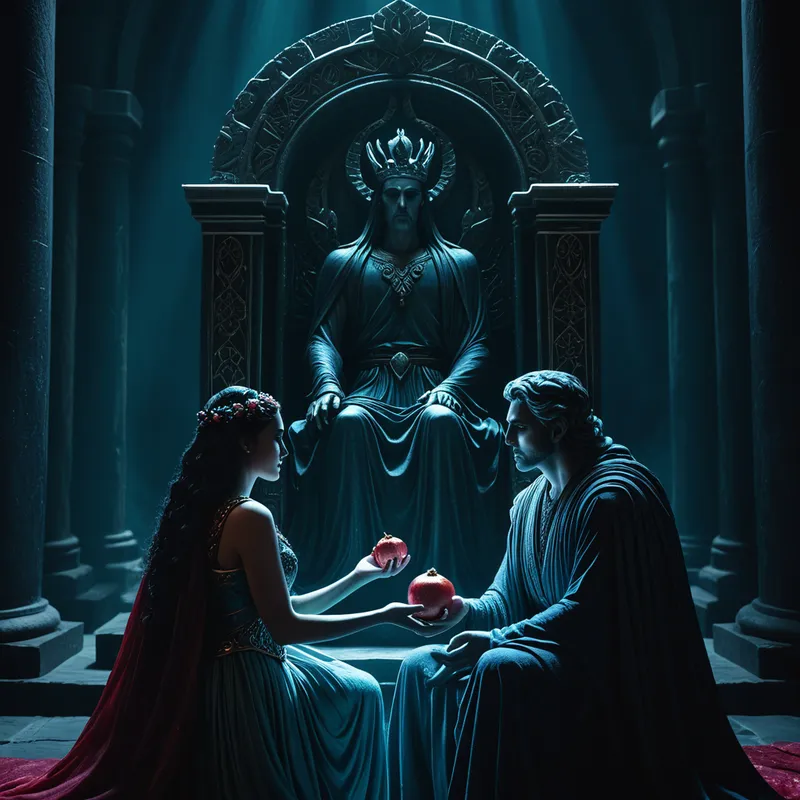
Finally, Zeus commanded [Hermes](/myths/hermes “Myth from Global/Universal culture.”/) to descend and bring [Persephone](/myths/persephone “Myth from Greek culture.”/) back. In the gloom of [the underworld](/myths/the-underworld “Myth from Greek culture.”/), [Hermes](/myths/hermes “Myth from Global/Universal culture.”/) found her beside the austere Hades. But as she rose to leave, a gardener of the dead—some say the [underworld](/myths/underworld “Myth from Greek culture.”/) spirit Ascalaphus—bore witness. The maiden had eaten. In her loneliness, she had consumed four, or six, or seven seeds of a pomegranate, the fruit of the dead. A single taste binds the soul to that realm.
A compromise was struck, not by force, but by the unbreakable law of [the Fates](/myths/the-fates “Myth from Greek culture.”/). For each seed eaten, a month must be spent below. Thus, Persephone—for she was no longer just Kore, the Maiden—would dwell one-third of the year with Hades as his queen, and two-thirds with her mother in the world of light.
Hermes brought her up. Where her feet touched the dead ground, flowers erupted. Mother and daughter embraced, and the earth sighed with relief, bursting into bloom. But the pact stood. And so, when Persephone descends each year, Demeter mourns, and the world grows cold and still. When she ascends, life returns. The maiden was taken, but the queen returns, and in that cycle, all of nature finds its rhythm and its reason.
Cultural Origins & Context
This is not merely a story of seasons, but [the sacred heart](/myths/the-sacred-heart “Myth from Christian culture.”/) of the Eleusinian Mysteries, the most revered and secretive initiatory cult of the ancient Greek world. For nearly two millennia, from Mycenaean times to the Christian era, initiates—from slaves to emperors like Marcus Aurelius—made the pilgrimage to Eleusis. They participated in a ritual re-enactment of Demeter’s search and Persephone’s return, culminating in a visionary revelation that promised solace from the fear of death.
The myth, preserved most completely in the Homeric Hymn to Demeter, served a profound societal function. It provided an etiology for the seasons, yes, but more importantly, it modeled a theology of hope beyond the bleak Greek conception of the afterlife in Hades. Persephone’s dual kingship offered a template for a blessed existence after death, accessible through initiation. It transformed a story of violent abduction into a narrative of sacred order, sovereignty, and cyclical renewal, legitimizing both the agricultural calendar and the deepest spiritual longings of the culture.
Symbolic Architecture
At its core, the myth maps the necessary descent of [consciousness](/symbols/consciousness “Symbol: Consciousness represents the state of awareness and perception, encompassing thoughts, feelings, and experiences.”/) into the unconscious. Persephone, the innocent Kore, represents the conscious ego in its state of naive wholeness, attached to the [mother](/symbols/mother “Symbol: The symbol of ‘Mother’ represents nurturing, protection, and the foundational aspect of one’s emotional being, often associated with comfort and unconditional love.”/)-world of known comforts (Demeter as the nourishing, visible world). Her abduction is not a random tragedy, but an archetypal necessity—the call to individuation.
The soul cannot know its full sovereignty until it has sat upon a throne in its own darkness.
[Hades](/symbols/hades “Symbol: Greek god of the underworld, representing death, the unconscious, and hidden aspects of existence.”/) is not a mere [villain](/symbols/villain “Symbol: A character representing opposition, moral corruption, or suppressed aspects of self, often embodying fears, conflicts, or societal threats.”/), but the personification of the unconscious itself—the rich, fertile, yet terrifying [realm](/symbols/realm “Symbol: The symbol of ‘Realm’ often signifies the boundaries of one’s consciousness, experiences, or emotional states, suggesting aspects of reality that are either explored or ignored.”/) of hidden drives, forgotten memories, and psychic potential. The pomegranate seed is the [symbol](/symbols/symbol “Symbol: A symbol can represent an idea, concept, or belief, serving as a powerful tool for communication and understanding.”/) of irrevocable [choice](/symbols/choice “Symbol: The concept of choice often embodies decision-making, freedom, and the multitude of paths available in life.”/) and commitment to this deeper self. Once tasted, the [psyche](/myths/psyche “Myth from Greek culture.”/) can never fully return to its previous, innocent state. It is now informed by the [depths](/symbols/depths “Symbol: Represents the subconscious, hidden emotions, or foundational aspects of the self, often linked to primal fears or profound truths.”/). The negotiation that follows represents the hard-won [integration](/symbols/integration “Symbol: The process of unifying disparate parts of the self or experience into a cohesive whole, often representing psychological wholeness or resolution of internal conflict.”/): [the ego](/myths/the-ego “Myth from Jungian culture.”/) (Persephone) must learn to rule the unconscious (as [Queen](/symbols/queen “Symbol: A queen represents authority, power, nurturing, and femininity, often embodying leadership and responsibility.”/) of the [Underworld](/symbols/underworld “Symbol: A symbolic journey into the unconscious, representing exploration of hidden aspects of self, transformation, or confronting repressed material.”/)) while maintaining its [connection](/symbols/connection “Symbol: Connection symbolizes relationships, communication, and bonds among individuals.”/) to the conscious world (her return to Demeter). The resulting cycle symbolizes the rhythmic, lifelong process of introspection and engagement, withdrawal and return.

The Dreamer’s Resonance
When this myth stirs in modern dreams, it often manifests as a profound sense of being taken, of a forced descent. Dreamers may find themselves in elevators plummeting through familiar buildings, pulled into dark [water](/myths/water “Myth from Chinese culture.”/), or walking into a basement that expands into a vast, intricate cavern. The somatic feeling is one of weight, pressure, and a chilling isolation—the body sensing the psyche’s plunge.
This is the psyche’s enactment of a necessary, if traumatic, initiation. It signals a period where the conscious personality is being dismantled or overwhelmed by contents from the unconscious—this could be a depression, a life crisis, a creative block, or the eruption of long-suppressed trauma. The dreamer is in the nekyia, the night-sea journey. The figure of Hades in the dream may appear as a shadowy authority figure, an alluring yet frightening stranger, or even as a compelling, dark aspect of the dreamer themselves. The dream’s task is not to escape, but to endure the descent, to find what sustenance (the pomegranate seed) the underworld offers, and to begin the slow process of coming to terms with this new, more complex territory of [the self](/myths/the-self “Myth from Jungian culture.”/).

Alchemical Translation
The alchemical work modeled here is the [nigredo](/myths/nigredo “Myth from Alchemical culture.”/)—the blackening, the descent into the [prima materia](/myths/prima-materia “Myth from Alchemical culture.”/) of the soul. Persephone’s abduction is the shocking, often involuntary beginning of this process. The conscious attitude (Kore) is dissolved in the waters of the unconscious (Hades).
Individuation is not about becoming perfect, but about becoming whole, and wholeness demands a covenant with one’s own shadows.
Demeter’s rage and starvation represent the ego’s initial, catastrophic reaction to this loss of control. The subsequent search is the long, painful work of analysis, of holding the torchlight of consciousness into the darkened corners of one’s history and psyche. The eating of the pomegranate seed is the critical moment of anagnorisis—the recognition and acceptance of one’s own depth, one’s own complicities, one’s own capacity for darkness and sovereignty. This is the binding pact.
The final resolution is not a victory of light over dark, but their [sacred marriage](/myths/sacred-marriage “Myth from Alchemy culture.”/). The modern individual undergoing this alchemy moves from being a child of circumstance (Kore) to becoming a ruler of their inner realm (Persephone). They learn that a part of them must always reside in the underworld—honoring the melancholic, the introspective, the buried truths—while another part brings the wisdom of that depth back to nourish their life in the upper world. The cycle of descent and return becomes a conscious practice, the rhythm of a soul that has made peace with its own necessary winters, knowing that each contains the seed of its own spring.
Associated Symbols
Explore related symbols from the CaleaDream lexicon: