
Persephone in Hades Myth Meaning & Symbolism
The maiden goddess, abducted to the underworld, becomes its queen, embodying the cycle of life, death, and the soul's necessary descent.
The Tale of Persephone in Hades
[The world](/myths/the-world “Myth from Tarot culture.”/) was young and golden, and in the sun-drenched fields of Nysa, the maiden [Persephone](/myths/persephone “Myth from Greek culture.”/) danced. She was the very breath of spring, her laughter the sound of budding flowers, her steps tracing patterns in the meadows where her mother, Demeter, poured forth life. On this day, the air was heavy with the scent of [narcissus](/myths/narcissus “Myth from Greek culture.”/), a hundred blossoms sprung from [the earth](/myths/the-earth “Myth from Hindu culture.”/) at a divine command. As [Persephone](/myths/persephone “Myth from Greek culture.”/) reached to pluck one, its beauty a trap of radiant white, the ground beneath her feet roared and split asunder.
From the chasm, a chariot of blackest iron, drawn by steeds whose breath was mist and shadow, erupted into the light. At its reins stood [Hades](/myths/hades “Myth from Greek culture.”/), his form both terrible and majestic, a king claiming his due. In an instant, the maiden’s cry was swallowed by the closing earth. The sunlit meadow was silent, save for a single torn blossom and the fading echo of her name.
Below, in the realm of Hades, there is no sun, only the phosphorescent glow of strange minerals and the memories of the dead. The god brought her to his palace, not as a prisoner in a cell, but as a queen in a hall of obsidian and gold. He offered her a throne beside his own, the riches of the deep earth, and a sovereignty she had never imagined in her mother’s shadow. Yet, Persephone sat in silent grief, a wilted flower in a jeweled crown, her heart tuned to a world of light she could no longer hear.
Above, Demeter’s grief was a blight upon the world. She roamed the earth, a torch in each hand, her sorrow so profound that the grains refused to sprout, the vines withered, and a great winter fell upon humanity. The laughter of mortals turned to prayers, and the gods of Olympus grew uneasy at the silence of the barren fields.
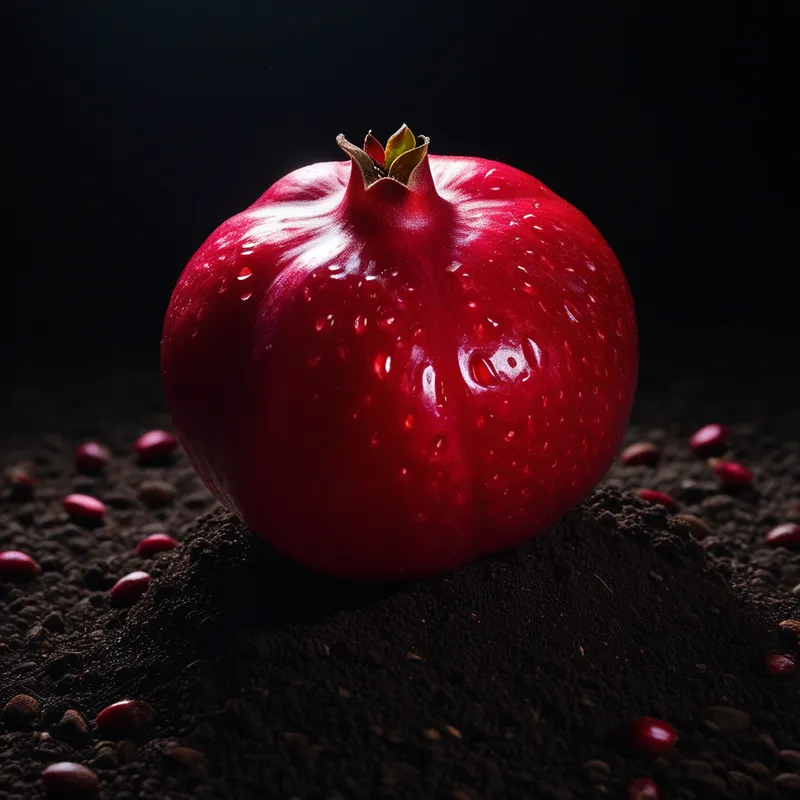
In [the underworld](/myths/the-underworld “Myth from Greek culture.”/), moved by her steadfast sorrow or perhaps by a strategic king’s compassion, Hades offered Persephone a final gift before her potential release: a pomegranate, its skin like polished garnet. Parched from fasting, the maiden accepted. She ate not a whole fruit, but six seeds, their sweet-tart juice a covenant. In that act, the transformation was sealed. She was no longer only the Maiden of the Fields; she had tasted the fruit of [the underworld](/myths/the-underworld “Myth from Greek culture.”/) and taken its essence into herself.
A bargain was struck in the halls of Olympus. For each seed consumed, Persephone would spend a month of the year in the kingdom of shadows. And so, she rises each spring, walking back into her mother’s desperate embrace, and the earth blooms with their joy. But when the autumn winds blow, she descends once more, not as a stolen girl, but as [the anointed](/myths/the-anointed “Myth from Biblical culture.”/) Queen of the [Underworld](/myths/underworld “Myth from Greek culture.”/), and the world above mourns in frost until her return.
Cultural Origins & Context
This central myth, most comprehensively told in the Homeric Hymn to Demeter, was far more than a fanciful explanation for the seasons. It was the sacred narrative at the heart of the Eleusinian Mysteries, the most revered initiatory rites of the ancient Greek world. For over a millennium, initiates—from slaves to emperors—underwent a profound ritual experience at Eleusis, promising them a blessed lot in the afterlife. The myth of Persephone’s abduction, descent, and return was not merely recited; it was enacted and experienced.
The story functioned on multiple cultural levels. Agriculturally, it explained the necessary cycle of sowing (descent) and harvest (return). Societally, it mirrored the ancient Greek woman’s experience of transition from maiden (kore) in her father’s house to wife (nymphe) in her husband’s—a kind of social “abduction” that was both a loss and a conferral of new status. Most powerfully, religiously, it offered a template for conquering the terror of death. Persephone’s journey demonstrated that the underworld was not merely an end, but a realm with its own order and sovereignty, and that a return—or at least a continued, conscious existence—was possible.
Symbolic Architecture
At its core, the myth maps the [soul](/symbols/soul “Symbol: The soul represents the essence of a person, encompassing their spirit, identity, and connection to the universe.”/)’s necessary descent into its own [depths](/symbols/depths “Symbol: Represents the subconscious, hidden emotions, or foundational aspects of the self, often linked to primal fears or profound truths.”/). Persephone represents the conscious ego, the “maiden” [consciousness](/symbols/consciousness “Symbol: Consciousness represents the state of awareness and perception, encompassing thoughts, feelings, and experiences.”/), innocent and identified solely with the light-world of the [mother](/symbols/mother “Symbol: The symbol of ‘Mother’ represents nurturing, protection, and the foundational aspect of one’s emotional being, often associated with comfort and unconditional love.”/) (the nurturing, conscious [psyche](/myths/psyche “Myth from Greek culture.”/)). [Hades](/symbols/hades “Symbol: Greek god of the underworld, representing death, the unconscious, and hidden aspects of existence.”/) is not a [villain](/symbols/villain “Symbol: A character representing opposition, moral corruption, or suppressed aspects of self, often embodying fears, conflicts, or societal threats.”/), but the personification of the unconscious itself—the rich, dark, [fertile ground](/symbols/fertile-ground “Symbol: Fertile ground symbolizes potential, growth, and the promise of new beginnings, reflecting a state where life can thrive.”/) of the [soul](/symbols/soul “Symbol: The soul represents the essence of a person, encompassing their spirit, identity, and connection to the universe.”/) from which all [life](/symbols/life “Symbol: The symbol of ‘Life’ represents a journey of growth, interconnectedness, and existential meaning, encompassing both the joys and challenges that define human experience.”/) ultimately springs and to which it returns.
The abduction is not a crime, but a calling. The soul cannot grow in perpetual spring; it must be taken by a force greater than itself into the realm of what it has avoided, forgotten, or feared.
The [pomegranate seeds](/myths/pomegranate-seeds “Myth from Greek culture.”/) are the quintessential [symbol](/symbols/symbol “Symbol: A symbol can represent an idea, concept, or belief, serving as a powerful tool for communication and understanding.”/) of conscious [choice](/symbols/choice “Symbol: The concept of choice often embodies decision-making, freedom, and the multitude of paths available in life.”/) within the involuntary descent. Persephone’s eating is often framed as a trick, but psychologically, it signifies [assimilation](/symbols/assimilation “Symbol: The process of integrating new experiences, identities, or knowledge into one’s existing self, often involving adaptation and transformation.”/). By taking the [food](/symbols/food “Symbol: Food in dreams often symbolizes nourishment, both physical and emotional, representing the fulfillment of basic needs as well as deeper desires for connection or growth.”/) of the [underworld](/symbols/underworld “Symbol: A symbolic journey into the unconscious, representing exploration of hidden aspects of self, transformation, or confronting repressed material.”/) into her [body](/symbols/body “Symbol: The body in dreams often symbolizes the dreamer’s self-identity, personal health, and the relationship they have with their physical existence.”/), she internalizes its [reality](/symbols/reality “Symbol: Reality signifies the state of existence and perception, often reflecting one’s understanding of truth and life experiences.”/). She says “yes” to the experience, transforming it from something that happened to her into something that becomes a part of her. This is the [moment](/symbols/moment “Symbol: The symbol of a ‘moment’ embodies the significance of transient experiences that encapsulate emotional depth or pivotal transformations in life.”/) the [victim](/symbols/victim “Symbol: A person harmed by external forces, representing vulnerability, injustice, or sacrifice in dreams. Often symbolizes powerlessness or moral conflict.”/) becomes the [queen](/symbols/queen “Symbol: A queen represents authority, power, nurturing, and femininity, often embodying leadership and responsibility.”/). The narcissus flower, the lure, symbolizes the beautiful, enchanting [aspect](/symbols/aspect “Symbol: A distinct feature, quality, or perspective of something, often representing a partial view of a larger whole.”/) of the unconscious that first captures our [attention](/symbols/attention “Symbol: Attention in dreams signifies focus, awareness, and the priorities in one’s life, often indicating where the dreamer’s energy is invested.”/) and leads us [inward](/symbols/inward “Symbol: A journey toward self-awareness, introspection, and the exploration of one’s inner world, thoughts, and unconscious mind.”/).
The Dreamer’s Resonance
When this mythic pattern stirs in modern dreams, it signals a profound initiation underway. The dreamer may find themselves in basements, subways, caves, or descending elevators—all modern [psychopomp](/myths/psychopomp “Myth from Greek culture.”/) landscapes. They may encounter a formidable, dark, yet compelling figure (a stranger, a guide, an authority) or be presented with a potent, [forbidden fruit](/myths/forbidden-fruit “Myth from Christian culture.”/) or food.
Somatically, this process often feels like a depression, a “dark night of the soul,” a loss of vitality and familiar identity. Psychologically, it is [the ego](/myths/the-ego “Myth from Jungian culture.”/)’s confrontation with what it has repressed: grief, rage, primal instincts, or forgotten talents. The dreamer is being “abducted” by their own psyche, pulled away from the sunny, productive, “acceptable” self to confront what lies in the personal and collective shadow. The dream is not a warning, but a map. It confirms the descent is necessary and that a form of sovereignty—a new, more complete identity—awaits on the other side of the encounter with the dark.

Alchemical Translation
The alchemical journey of individuation mirrors Persephone’s path exactly. [The first stage](/myths/the-first-stage “Myth from Alchemical culture.”/), [nigredo](/myths/nigredo “Myth from Alchemical culture.”/) (the blackening), is the abduction itself—the descent into chaos, depression, and the dissolution of the old conscious attitude. In the underworld, the [separatio](/myths/separatio “Myth from Alchemical culture.”/) occurs: the maiden identity is stripped away. Then comes the crucial coniunctio ([the sacred marriage](/myths/the-sacred-marriage “Myth from Various culture.”/)). This is not a literal union with Hades, but the integration of the conscious ego with the powerful, structuring forces of the unconscious (the animus/archetypal masculine, [the Self](/myths/the-self “Myth from Jungian culture.”/)). Persephone on the throne beside Hades is the symbol of this integrated rulership.
The ultimate alchemical product is not the return of the maiden, but the creation of the Queen—a consciousness that can navigate both the upper and lower worlds, that holds life and death, joy and grief, in a single, sovereign gaze.
Her cyclical journey is the model for psychic health. We are not meant to reside permanently in the light of conscious control (Demeter’s eternal summer) nor be lost forever in the depths of unconscious identification (an eternal Hades). True wholeness is the capacity to move between the realms. We must learn to descend consciously into our wounds and shadows to gather their riches, and then return to the world, bringing the depth and gravity of that underworld wisdom to our lived experience. In eating the pomegranate seeds, Persephone performs the ultimate alchemical act: she transmutes a forced fate into a chosen destiny, and in doing so, gives the world its soulful, necessary seasons.
Associated Symbols
Explore related symbols from the CaleaDream lexicon: