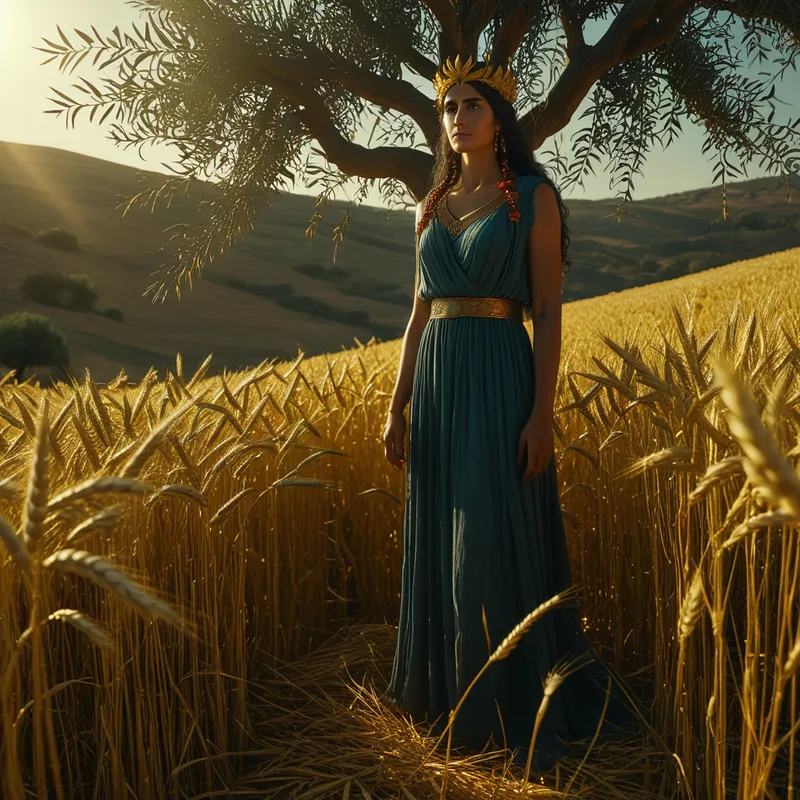
Persephone & Demeter Myth Meaning & Symbolism
The maiden Persephone is abducted into the underworld, plunging her mother Demeter into grief and the world into winter, until a cyclical compromise is forged.
The Tale of Persephone & Demeter
Listen. Before the first winter, the world was an eternal spring. The air hummed with the scent of nectar, and the earth, Demeter, poured forth her bounty without cease. Her joy was her daughter, Kore, a maiden whose laughter made flowers bloom and whose footsteps left trails of hyacinth and violet.
On a day drenched in Sicilian sun, Kore wandered with her companions in a meadow by the lake of Pergusa. She reached for a narcissus of startling beauty, its hundred blooms a trap sprung from the earth. The ground roared and split. From the yawning chasm, a chariot of black adamant erupted, drawn by immortal, smoke-dark steeds. The driver was Hades, lord of the unseen realms, his gaze a weight that stilled the very air. He seized the shrieking maiden. Her cry for her mother was swallowed by the closing earth, and only her torn girdle remained, resting on the trampled grass.
Demeter’s heart shattered. She heard the echo of that cry across the world. Casting aside her divinity, she cloaked herself in the guise of an old woman and walked the mortal roads, a torrent of grief that parched the land. Rivers ran dry. Seeds turned to dust in the furrows. The green world withered, and the first frost—a cold born not of season but of sorrow—crept over the hills.
In her wanderings, she came to Eleusis. There, in the king’s household, she nursed a mortal prince, seeking solace. But her grief was a blight. She attempted to make the child immortal by burning away his mortal flesh in the hearth-fire, an act interrupted by the queen’s scream. Revealing her true, terrible glory, Demeter demanded a temple. And there, in the darkness of her shrine, she sat. The great famine deepened. Humanity teetered on the edge of oblivion.
The cries of dying mortals reached Zeus. He could no longer ignore the unraveling of the cosmos. He commanded Hades to release the girl. Hermes, the swift messenger, flew down the dark paths to the throne of the underworld. There he found Persephone—no longer Kore—seated beside her dark lord, queen of a silent realm. She had eaten. In her loneliness, she had consumed six seeds from a pomegranate, the food of the dead. This simple, fatal act bound her to the land of shadows forever.
A compromise was forged in the halls of Olympus, a divine law. For each seed eaten, a month of winter she would reign as Queen Persephone beside Hades. For the rest of the year, she would ascend to walk the sunlit world with her mother. When Demeter saw her daughter emerge from the cleft in the earth, life surged back. Flowers erupted through the snow. But in Persephone’s eyes, Demeter saw the knowledge of the deep places, the shadow that now lived within the light. The wheel of the year was born, not of mere climate, but of a mother’s love, a daughter’s transformation, and the inescapable pact with the dark.

Cultural Origins & Context
This myth, central to what scholars call the Homeric Hymn to Demeter, was far more than a story. It was the sacred, beating heart of the Eleusinian Mysteries, the most revered and secretive religious rites of the ancient Greek world for nearly two millennia. The myth was not merely recited; it was enacted in a profound ritual drama at Eleusis, near Athens. Initiates—from slaves to emperors—underwent a ceremonial journey that mirrored Persephone’s: a descent into darkness (the katabasis), a revelation of sacred objects (the epopteia), and a return with hope.
Its societal function was multifaceted. On the surface, it was an etiological myth explaining the seasons. More deeply, it addressed fundamental human anxieties: the fear of famine (Demeter’s grief), the terror of death and abduction (Persephone’s fate), and the hope for renewal and a blessed afterlife (her return). It provided a template for understanding profound loss and the cyclical, rather than linear, nature of life. The myth, through the Mysteries, offered solace by promising that death was not an absolute end, but a phase in a greater, sacred cycle known intimately to the goddesses themselves.
Symbolic Architecture
At its core, the myth maps the psyche’s necessary encounter with the unconscious. Persephone is the nascent ego, the “maiden” consciousness, innocent and identified solely with the mother-world of light, growth, and conscious order (Demeter). Her abduction is not a random tragedy but an archetypal necessity—the call of the deeper Self.
The soul cannot remain forever in the sunny meadow; it must be claimed by the depths to become whole.
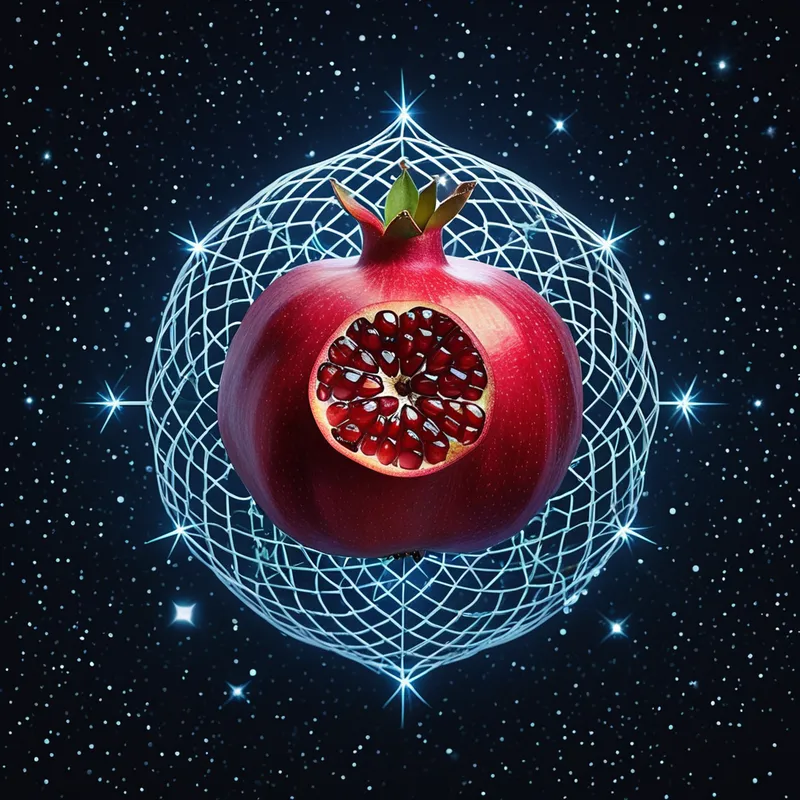
Hades represents the psychopomp and the realm of the shadow, the underworld of the psyche where all that is repressed, forgotten, and potent resides. The pomegranate seeds are the symbol of conscious choice within the unconscious realm—a voluntary ingestion of depth, knowledge, and fate. By eating them, Persephone actively participates in her own transformation from girl to queen, from a passive victim to a sovereign of two realms.
Demeter’s devastating grief symbolizes the ego’s catastrophic reaction when a vital part of the psyche (an innocence, a talent, a relationship) is taken into the unconscious. Her wrath, which brings winter, shows how the refusal to accept this necessary descent paralyzes all life and growth. The resolution—the cyclical sharing of Persephone—models the psyche’s ultimate goal: not the eradication of the unconscious, but a rhythmic, conscious relationship with it. The Self becomes bi-territorial.
The Dreamer’s Resonance
When this myth stirs in modern dreams, it often signals a profound initiation underway. To dream of being abducted, of falling into a hole or basement, of being taken by a dark but compelling figure, is to experience the “rape of Persephone” psychologically. It feels less like sexual violence and more like a forcible, yet fateful, enrollment in a school of the soul. The dreamer may feel a sense of dread, but also a strange allure.
Dreams of a withering garden, a dead mother figure, or being lost in a barren landscape mirror Demeter’s winter—the depressive, frozen state that follows a major psychic loss or rupture. Conversely, dreaming of finding a luminous fruit in the dark, of eating something forbidden in a strange place, or of returning to the surface changed, speaks to Persephone’s integration. The somatic experience is key: a feeling of sinking, of coldness, of being “in the dark,” followed by periods of relief, unexpected warmth, or a sense of carrying a secret knowledge. The dreamer is navigating the negotiation between a familiar, sunny identity and the claims of a deeper, more complex inner sovereignty.

Alchemical Translation
The alchemical journey mirrored in this myth is the nigredo, followed by the albedo, in an eternal cycle. For the modern individual, individuation requires this Persephone-process.
First, the conscious attitude (Kore) must be shattered and drawn down into the shadowy prima materia of the unconscious (Hades’ realm). This is often precipitated by a crisis: a loss, a failure, a depression—the “abduction.” The ego’s initial, Demeter-like response is grief, rage, and a withering of life-energy, a psychic winter where all previous meanings die.
The pomegranate seed is the moment of conscious assent to the unconscious; it is the agreement to be changed by what one encounters in the dark.
The alchemical work happens in the underworld. It is the slow, often lonely, process of sitting with the contents of the unconscious (being Queen of the Dead), learning its laws, and making the fateful choice to internalize its nourishment (the seeds). This is the integration of the shadow, the acceptance of one’s own mortality, complexity, and power. The return is not a return to the old innocence, but the emergence of a new capacity: the ability to move consciously between the depths and the surface, between introspection and action, between the personal and the archetypal. The individual becomes a vessel for the cycle itself—capable of creative fertility (spring/summer) precisely because they can endure and honor periods of fallow introspection and dissolution (autumn/winter). They are no longer just Demeter’s child or Hades’ prisoner, but Persephone, the sovereign bridge between worlds.
Associated Symbols
Explore related symbols from the CaleaDream lexicon: