
Persephone and the Pomegranate Seeds Myth Meaning & Symbolism
The maiden Persephone is taken to the underworld, eats pomegranate seeds, and becomes Queen, forever bridging the worlds of life and death.
The Tale of Persephone and the Pomegranate Seeds
Listen. The world was younger then, and the light had a different weight. In the sun-drenched fields of Sicily, the maiden Persephone wandered. She was the beloved daughter of Demeter, and her laughter was the sound of buds breaking open. Her world was one of nectar and petals, tended by the watchful, loving gaze of her mother.
But beneath the fertile soil, in the sunless halls of the dead, a longing stirred. Hades, lord of the unseen realm, had seen her light. With the silent consent of his brother Zeus, he prepared a snare of terrible beauty. From the heart of the earth, he caused a flower to bloom—a narcissus of such hypnotic radiance that its scent alone could stop the wind. Drawn to its impossible perfection, Persephone reached out.
The earth roared. The meadow split asunder with a sound like a thousand mountains breaking. From the black chasm, a chariot of shadow drawn by horses of night erupted. A hand, strong as granite and cold as a deep river stone, closed around Persephone’s wrist. Her cry was swallowed by the closing earth as Hades claimed his queen, descending with her into the eternal twilight of his domain.
Above, the world felt the loss. Demeter’s grief was a scorching wind that withered the fields. She roamed the earth, a torch in each hand, her form no longer that of a nurturing goddess but of a desolate fury. Crops failed. Rivers dried. Mankind faced extinction, and the gods of Olympus grew weak from lack of tribute.
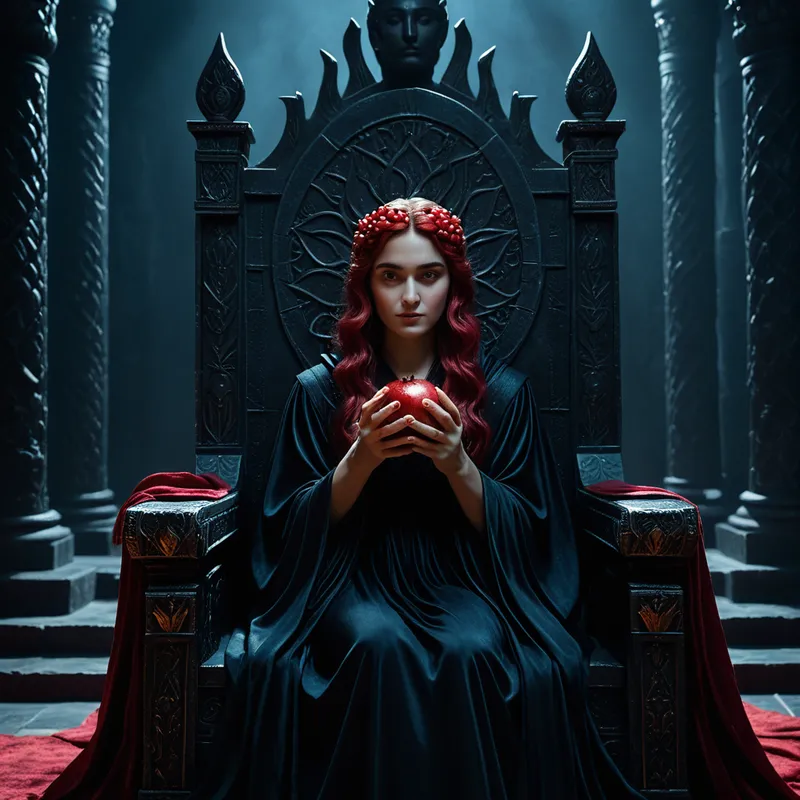
Meanwhile, in the underworld, Persephone sat in silent majesty. She refused all food and drink, a fast of protest against her stolen life. Hades, in his own stern way, did not force her but offered her the throne beside him. The land of the dead was not merely a tomb; it was a kingdom, vast and silent, holding the memories of all that had ever lived. She began to see its solemn order, its profound peace.
Yet, the pull of the world above was a constant ache. A deal was brokered by Hermes: if she had eaten no food of the dead, she could return. But in her loneliness, or perhaps in a dawning acceptance of her new power, Persephone had been tricked—or had she chosen? The gardener of the underworld, Ascalaphus, testified. He had seen her. She had eaten. Not a feast, but a fateful few seeds—four, or six, or seven—plucked from the blood-red heart of a pomegranate.
That small, crimson act was a contract. She who eats the food of a place belongs to it. A compromise was forged, as eternal as the seasons themselves. For each seed consumed, a month of the year she must reign as Queen of the Underworld beside Hades. For the rest, she could walk again in the sun with her mother.
And so, she emerged. When Persephone ascends, Demeter’s joy makes the earth burst into flower and fruit. When she descends, holding the memory of the pomegranate’s sweet-bitter juice on her tongue, Demeter’s mourning draws a veil of frost over the world. The maiden was gone. In her place stood the Queen of Two Worlds.
Cultural Origins & Context
This central myth, known as the Homeric Hymn to Demeter, was not merely a story for the ancient Greeks; it was a sacred narrative underpinning their most profound religious rites: the Eleusinian Mysteries. Performed at Eleusis for nearly two millennia, these mysteries promised initiates a blessed afterlife, a hope directly tied to Persephone’s journey.
The myth functioned on multiple societal levels. Agriculturally, it was the definitive etiological tale for the cycle of seasons, explaining the necessity of fallow winter and abundant summer. Psychologically and spiritually, it provided a framework for understanding life’s most painful transitions—loss, abduction by fate, and the integration of death into the understanding of life. It was passed down not as children’s fable, but as ritual poetry, performed to evoke the very emotions of loss and joyful return that the initiates would experience. The storyteller here was the culture itself, through its priests and poets, embedding the truth of cyclical sacrifice into the heart of civilization.
Symbolic Architecture
The myth’s power lies in its flawless symbolic architecture. Persephone, the Kore, represents the nascent psyche, the innocent ego living in a state of blessed unconsciousness within the mother-world. Her abduction is not a random tragedy, but a necessary hieros gamos (sacred marriage) and initiation. The underworld is the unconscious itself—the realm of shadow, memory, and the forgotten parts of the soul.
The pomegranate seed is the symbol of conscious choice made in the dark. It is the moment the ego, though in exile, tastes the fruit of its new realm and accepts a portion of its power.
Hades is not a villain, but the archetypal animus and king of the interior world. His realm is where wealth (Plouton) is stored—not gold, but the psychic wealth of repressed experiences and latent potential. Demeter embodies the possessive, life-giving aspect of the mother archetype, who must ultimately surrender her child to a larger destiny. The cyclical resolution models the fundamental law of psyche and nature: wholeness requires a rhythmic embrace of opposites—life and death, joy and grief, belonging and sovereignty.
The Dreamer’s Resonance
When this myth stirs in modern dreams, it signals a profound initiation underway. Dreaming of being pulled underground, of finding doors in the earth, or of wandering in beautiful but sunless landscapes points to a necessary descent. The psyche is calling the dreamer into their own underworld: a period of depression, a forced retreat, a confrontation with grief, trauma, or a powerful shadow aspect.
The pomegranate in a dream is a crucial symbol. To refuse it may indicate a resistance to this initiation, a desire to remain an eternal child. To eat it, however, signals a somatic and psychological acceptance of a transformative truth. It is the moment one says “yes” to a difficult but authentic fate—accepting a diagnosis, integrating a painful memory, or claiming authority in a realm (internal or external) that once felt like a prison. The dreamer is becoming queen of their own darkness, finding sovereignty in the very place of their abduction.

Alchemical Translation
The alchemical process mirrored here is the nigredo—the blackening, the descent into the prima materia of the soul. Persephone’s initial despair in Hades’ hall is this blackening. The eating of the seeds is the beginning of the albedo, where the pure essence is separated. She does not merely escape; she is purified into a dual-natured being.
Individuation is not about choosing the light or the dark, but about holding the covenant between them. The modern seeker’s task is to consciously eat their own pomegranate seeds—to acknowledge what part of their darkness they will consciously rule.
For us, the “compromise” is the achieved wholeness. The modern individual must spend their necessary “months” tending to their inner underworld—their depression, their solitude, their creative gestation. The rest of the year is for expression, relationship, and growth in the sunlit world. To reject the descent is to cause a psychic winter, a stagnation of Demeter’s grief. To refuse the return is to become a ghost, identified only with one’s wounds. The myth models the ultimate psychic alchemy: transforming a traumatic abduction into a sacred vocation, thereby giving rhythm and meaning to the entire ecosystem of the self. We are all seasonal beings, and our deepest healing lies in honoring the sovereignty of our own inner Queen of the Dead.
Associated Symbols
Explore related symbols from the CaleaDream lexicon: