
Persephone and the pomegranate Myth Meaning & Symbolism
A maiden's descent into the underworld, sealed by six pomegranate seeds, creates the cycle of life, death, and seasonal rebirth.
The Tale of Persephone and the pomegranate
Listen. The world was young and bright, and all life sprang from the laughter of Demeter. In a sun-drenched meadow, her daughter Kore danced with her nymphs, a blossom among blossoms. Her joy was the earth’s joy. But deep beneath the roots of mountains, in a palace of silence and memory, a loneliness grew. Hades, lord of the unseen realms, watched from the dark, and a desire as vast as his kingdom took root.
He came not with storm, but with the earth’s own consent. At his godly plea, the meadow cracked open. A chasm, black and fragrant with the scent of deep soil and cold stone, yawned at Kore’s feet. From it thundered a chariot of obsidian, drawn by steeds whose breath was mist. A strong, implacable arm encircled the maiden’s waist. Her cry was swallowed by the rushing dark as the earth sealed itself above her, leaving only trampled flowers and a terrible silence.
Demeter’s grief was a blight upon the world. She cast off her divinity, wrapped herself in mortal sorrow, and wandered the earth. Where she walked, green things withered. Frost gripped the fields in summer’s height. Famine stalked the cities. The world began to die of a mother’s heartbreak.
Meanwhile, in the sunless land, a transformation began. The frightened maiden, Kore, was led to a throne of polished basalt. Hades offered her not chains, but sovereignty. He gave her the crown of his realm, the title of Persephone. The silent shades bowed to her. She walked the fields of asphodel, and a strange, melancholic power stirred within her. Yet, a thread of sunlight still pulled at her heart.
The cries of a starving world reached even Zeus. He commanded Hades to release the girl. Hermes, the messenger, flew down the dark path. Persephone’s heart leapt. But as she turned to leave, the gardener of the underworld, perhaps at his lord’s silent wish, offered her a final gift: a pomegranate, its skin like polished leather, holding within it a miniature cosmos of ruby stars.
Perhaps it was hunger for the vivid taste of life. Perhaps it was a gesture of farewell, or a nascent loyalty to the king who had made her his equal. She took the fruit. She ate six seeds. Their sweet-tart juice was a covenant, a binding more potent than any lock.
At the world’s threshold, mother and daughter flew into each other’s arms. Life surged back into the barren soil. But Demeter’s joy turned to ash as Persephone whispered her secret. The Fates themselves had decreed: whoever consumes the food of the dead is bound to them. Six seeds meant six months.
Thus, the great rhythm was born. For six months, Persephone walks the upper world with Demeter, and the earth rejoices in spring and summer. For six months, she descends to her throne beside Hades, and Demeter’s mourning brings autumn and winter. The maiden became the queen, and in her cyclical journey, the very pulse of life and death found its eternal beat.

Cultural Origins & Context
This core narrative is most famously preserved in the Homeric Hymn to Demeter, composed around the 7th century BCE. It was the central sacred story of the Eleusinian Mysteries, among the most important and well-guarded initiatory cults of the ancient world. For over a millennium, initiates—from slaves to emperors—underwent rituals at Eleusis promising a blessed afterlife, with the myth of Demeter and Persephone providing the theological framework. The myth was not mere entertainment; it was a lived, experiential doctrine concerning the greatest human mysteries: the cycle of life and death, the pain of separation, and the hope of renewal. It was told in hushed tones during sacred ceremonies, its details veiled in secrecy, making its psychological impact all the more potent. It functioned as a societal anchor, explaining the necessity of seasonal death (winter) and providing a divine model for the profound transitions of human life, especially the passage of a daughter into womanhood and sovereignty.
Symbolic Architecture
The myth is a perfect symbolic engine for the psyche’s necessary descent into its own depths. Persephone is the innocent, conscious ego, content in the “meadow” of known, sunlit reality. Hades is not a villain, but the personification of the unconscious itself—the deep, autonomous psychic ground that suddenly erupts and “abducts” the ego into a necessary crisis.
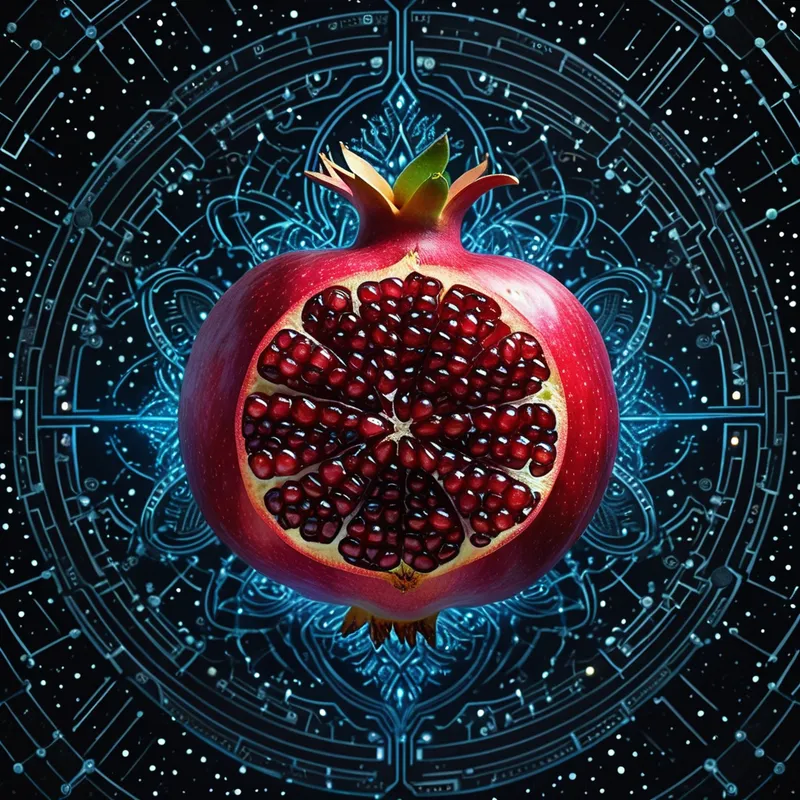
The pomegranate is the fruit of conscious choice within the unconscious realm. To eat its seeds is to assimilate the substance of the shadow, to internalize the reality of the underworld.
Her abduction is the involuntary onset of depression, trauma, or any profound life-crisis that pulls us into a dark, interior space. The crown Hades offers is the latent potential for authority and wisdom that can only be forged in such darkness. Demeter’s rage and grief represent the conscious mind’s desperate, often destructive, resistance to this necessary journey. The resolution is not a rescue, but a sacred compromise. Persephone becomes the liminal queen, the integrated self who is no longer purely the maiden (Kore) nor solely the queen of shadows (Persephone), but the one who consciously navigates both realms. The seasons mirror the inevitable rhythm of the integrated psyche: periods of extroverted growth and fruition (summer/conscious life) must be balanced by periods of introverted dissolution and incubation (winter/the unconscious).
The Dreamer’s Resonance
When this myth pattern activates in modern dreams, it signals a profound initiation underway. Dreaming of being pulled into a cave, down an elevator shaft, or into a basement signifies the ego’s forced encounter with the underworld of the personal unconscious. A dream figure of imposing, silent authority (a dark king, a CEO, a mysterious stranger) may represent the Hades archetype, compelling the dreamer toward a sovereignty they resist.
The pomegranate in a dream is a critical symbol. To see it whole suggests the choice of integration is pending. To eat from it willingly indicates an active, if daunting, process of assimilating shadow material—facing repressed grief, anger, or power. To be tricked into eating it may reflect a feeling that life has forced a bitter wisdom upon you. The somatic feeling in such dreams is often one of weight, gravity, and a chilling awe—a direct experience of the numinous power of the psyche’s depths. This is not a nightmare, but a numinous dream, one that terrifies and transforms in equal measure.

Alchemical Translation
The alchemical process mirrored here is the nigredo, the descent into blackness necessary for all true transformation. The bright maiden (the prima materia) must be dissolved in the waters of the unconscious. Persephone’s time in Hades is this dissolution. Her eating of the seeds is the beginning of the albedo—the extraction of light from darkness, of conscious insight from unconscious content.
Individuation is not about staying in the sunlit meadow. It is about earning the right to be a citizen of two worlds, to hold the duality of life and death within a single, resilient consciousness.
For the modern individual, this myth models the journey from a one-dimensional identity (“I am only a happy/productive/social person”) to a complex, sovereign self. The “abduction” might be a burnout, a divorce, a failure, or a depression—any event that shatters the old meadow. The “underworld work” is the painful, solitary introspection that follows. The “pomegranate seeds” are the hard-won truths we must consciously ingest and own about ourselves: our capacity for darkness, our hidden strengths, our complicity in our own suffering. The return is not a return to who we were, but the emergence of a new capacity. We become, like Persephone, cyclical beings. We learn to honor our creative, outward summers and our introspective, restorative winters, understanding that both are essential to the wholeness of the soul’s eternal rhythm.
Associated Symbols
Explore related symbols from the CaleaDream lexicon: