Persephone and the Narcissus Myth Meaning & Symbolism
A maiden's fateful encounter with a radiant flower leads to her abduction and a profound transformation, dividing the world between light and dark.
The Tale of Persephone and the Narcissus
Hear now a tale of the world’s turning, of a beauty that broke the earth and a light that was swallowed by shadow. In the time before time was divided, Demeter walked the fields, and her joy was her daughter, Kore, whom we call Persephone. She was the very breath of spring, her laughter the sound of budding leaves, her footsteps coaxing blossoms from the stubborn earth.
On that day, the sun hung heavy and golden over the plains of Nysa. Kore wandered with her companions, the Oceanids, their voices like chattering streams as they gathered roses, crocuses, and violets into the folds of their gowns. The air was thick with the scent of life. But in the unseen depths below, a different will stirred. Hades, lord of the silent realms, had seen her radiance and his heart, a thing of stone and memory, was pierced by a longing sharper than any mortal spear. With the silent consent of his brother Zeus, he prepared a snare not of iron, but of irresistible beauty.
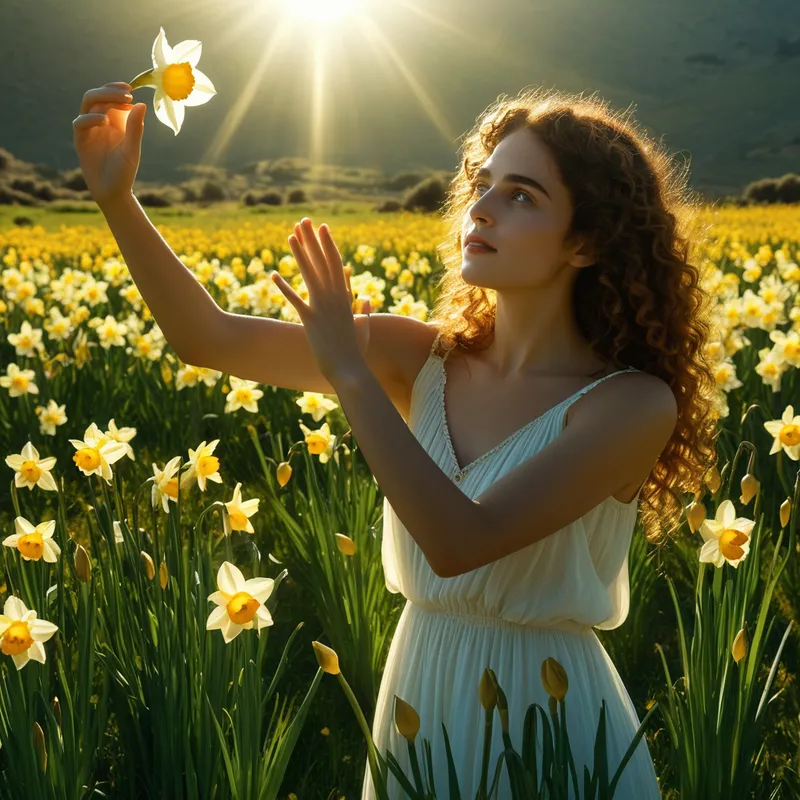
It appeared in a sunlit clearing—a flower. But no ordinary blossom. This was a narcissus, a wonder planted by the hand of Gaia herself. A hundred blooms sprang from a single root, and their fragrance was a drug, a sweet, hypnotic perfume that stopped the very winds. It was a beauty so profound it seemed to hold the concentrated light of the world.
Kore beheld it. Her companions’ voices faded into a distant hum. Drawn as if by a silent call, she stepped away from the safety of the circle, her hand outstretched not in greed, but in pure, awe-struck wonder. Her fingers brushed the radiant petals. In that moment of perfect, innocent contact, the earth groaned. The solid ground of Nysa split asunder with a sound like a mountain breaking. From the yawning chasm, a chariot of blackest obsidian erupted, drawn by immortal, smoke-dark steeds. Hades, in all his dread majesty, seized her. Her cry was swallowed by the closing earth as he swept her down, down into the everlasting twilight of his kingdom. All that remained in the sundered meadow was a scatter of fallen flowers and the fading, haunting scent of the narcissus.
Above, the world grew cold. Demeter’s grief was a blight upon the land. She searched with a torch in each hand, her sorrow turning the green world to stone and frost. It was the all-seeing Helios who finally told her of the fateful flower and Zeus’s complicit silence. The great compromise was forged only when Demeter’s despair threatened all life. Persephone was restored, but having eaten a fateful pomegranate seed in the underworld, she was bound to return to Hades for a portion of each year. Thus, through the lure of a flower, the seasons were born: spring and summer for her steps upon the earth, autumn and winter for her reign in the world below.
Cultural Origins & Context
This foundational myth, central to the Eleusinian Mysteries, was not merely a story but a sacred narrative encoding the realities of life, death, and agrarian survival. It is most famously preserved in the Homeric Hymn to Demeter, a poetic text dating to roughly the 7th century BCE, which served as a liturgical script for the initiatory rites at Eleusis. Here, the myth was performed and experienced, not just heard.
Its societal function was multifaceted. On the most immediate level, it was an etiological tale explaining the cycle of the seasons, providing a divine reason for the barren winter and the hopeful return of spring—a matter of literal life and death for an agricultural society. On a deeper, ritual level, it offered initiates of the Mysteries a profound psychological map. The descent and return of Persephone modeled a mystical journey, promising that the realm of death was not merely an end but a phase in a greater, sacred cycle. The myth thus mediated the fundamental human anxieties around mortality, the fertility of the land, and the transition of young women into marriage (often perceived as a kind of social “abduction” from the mother’s home).
Symbolic Architecture
The myth’s power lies in its dense weave of symbols, each a doorway to understanding a psychic process.
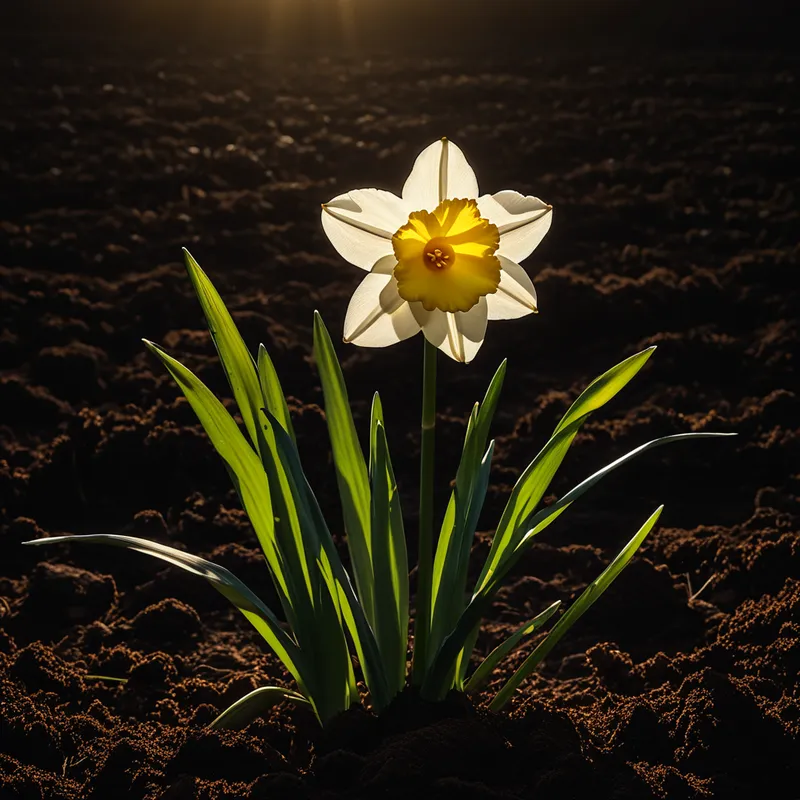
The Narcissus is far more than a pretty trap. It is the lure of the unconscious itself—a beauty so captivating it compels the conscious ego (the maiden Kore) to turn away from the known, sunlit world. It represents the sudden, irresistible call of a fate or a depth that one did not consciously choose. It is the moment when a fascination, a depression, a love, or a vocation grips us with a force beyond reason.
The flower is the beautiful face of fate; its roots are anchored in the kingdom of the dead.
Persephone/Kore embodies the duality of the psyche: the innocent, undeveloped conscious self (Kore, the Maiden) and the initiated, sovereign ruler of the deep, unseen realms (Persephone, Queen). Her abduction is not a mere victimization, but a necessary, if traumatic, inauguration into power and complexity. She is the part of the psyche that must be taken, must descend, to gain authority over the hidden contents of the soul.
Hades is not a villain, but the personification of the unconscious ground of being. He is the lord of all that is repressed, forgotten, feared, and potent. His realm is not hell, but the necessary shadow-land where meaning is stored, where the seeds of life wait in darkness. His desire for Kore is the unconscious’s pull toward integration, demanding recognition and relationship with the light of consciousness.
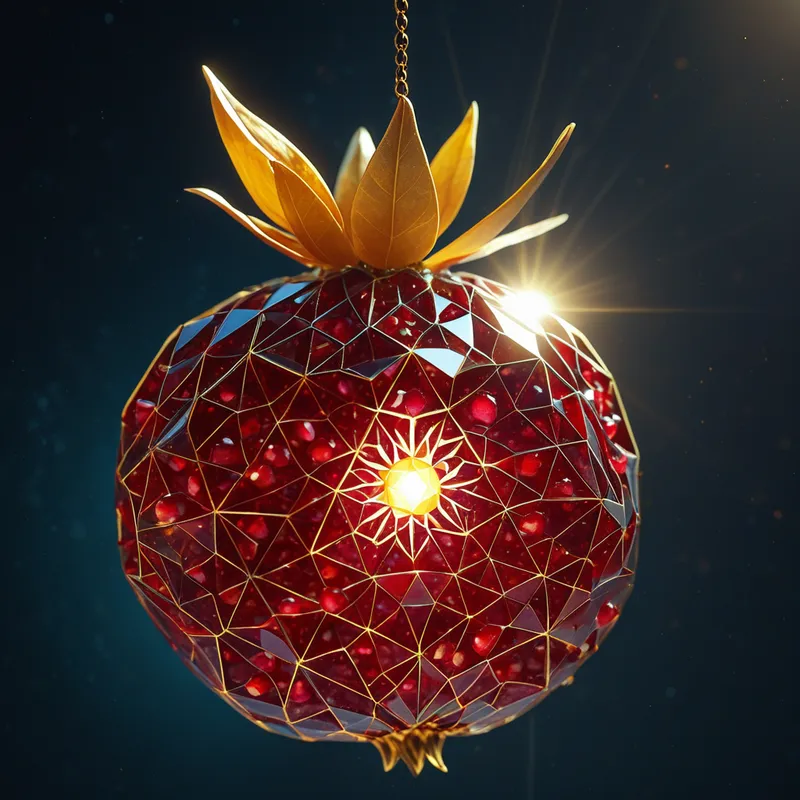
The Pomegranate Seed is the symbol of irreversible commitment to the depths. To eat the food of the underworld is to internalize its reality, to let it become part of one’s substance. It signifies the point of no return in any profound transformation—the insight, the wound, or the choice that forever alters one’s composition and ensures a cyclical return to the work of the depths.
The Dreamer’s Resonance
When this myth stirs in the modern dreamer, it signals a profound initiation underway in the psyche. To dream of a breathtakingly beautiful yet isolating flower, or of being irresistibly drawn to something that leads to a fall or a capture, is to experience the “narcissus moment.” This is the somatic feeling of being fated—captured by a depression, a new path, a relationship, or an idea that separates you from your previous, simpler identity.
Dreams of sudden descents—falling through earth, entering caves, or finding oneself in muted, subterranean landscapes—mirror Persephone’s abduction. The body may feel heavy, trapped, or enveloped. This is not necessarily a nightmare, but often a solemn, numinous dream of being in a place of deep processing. The psyche is engaging with its own Hades: old griefs, buried talents, ancestral patterns, or ignored instincts.
Conversely, dreams of finding a way back to the surface, of negotiating with dark figures, or of holding a luminous object in the dark reflect the integrative phase. The dreamer is working on the “pomegranate seed”—determining what part of this deep, often difficult experience must be consciously integrated to allow for a cyclical wholeness. The dream ego is moving from Kore, the one who is taken, to Persephone, the one who rules where she once was imprisoned.
Alchemical Translation
The myth of Persephone and the Narcissus is a perfect allegory for the alchemical and Jungian process of individuation. It maps the journey from naive unity (the eternal spring with Demeter) through necessary fragmentation and descent, to a recovered, more complex wholeness.
The first stage, nigredo or the blackening, is the abduction itself. The conscious attitude (Kore) is plunged into the prima materia of the unconscious (Hades’ realm). This is a dark, disorienting, and often involuntary crisis—a depression, a failure, a loss. The ego feels robbed of its light and life. Yet this is the essential beginning of the work.
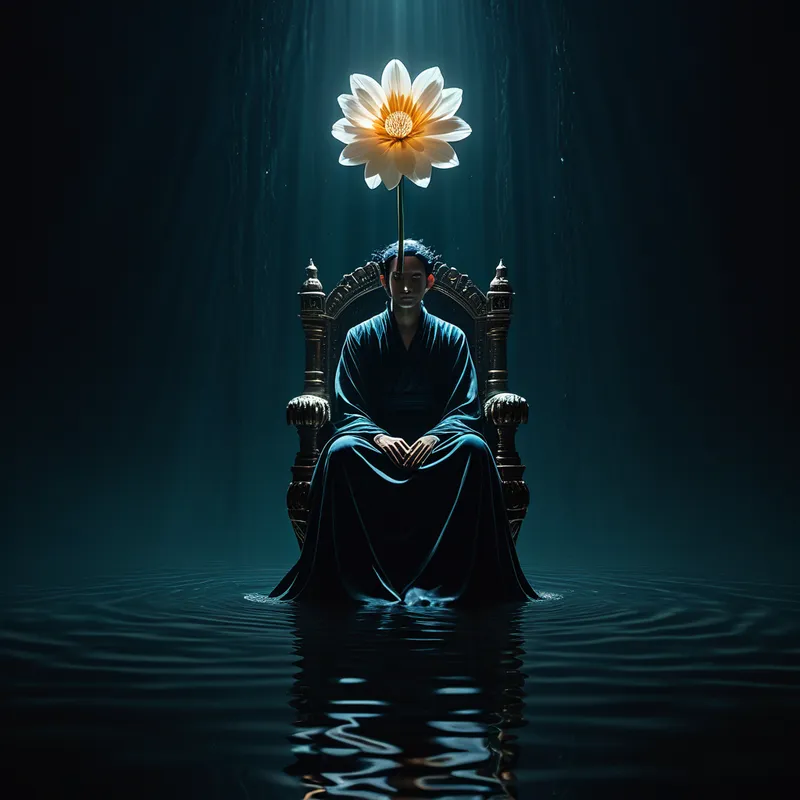
The underworld is the alembic where the soul is broken down to its essential elements, so that gold may be separated from dross.
The second stage involves the separatio and coniunctio within the depths. Persephone, in the underworld, is both separate from her mother (her old identity) and in a sacred marriage (hieros gamos) with Hades. Psychologically, this is the long, quiet work of relating to the contents of the unconscious—facing shadows, dialoguing with complexes, and ultimately forming a conscious relationship with the autonomous power of the deep psyche. She learns its laws and becomes its queen.
The eating of the pomegranate seed is the moment of rubedo, the reddening or conscious integration. It is the decision to own this depth, to let it nourish and change you permanently. You are no longer a visitor to your own darkness; you carry its mark.
The final, cyclical return represents the achieved state of individuation. The individual is no longer only the “maiden” of conscious innocence, nor only the “queen” of unconscious identification. They move between worlds—capable of engagement in the outer world (summer) and periodic, necessary retreat into the inner world for renewal and governance (winter). The narcissus, the initial beautiful wound, is understood in retrospect not as a malicious trick, but as the numinous call that began the entire sacred process of becoming whole. The self is now rooted in both heaven and earth, light and dark, forever enriched by the fateful beauty it once reached for in the sunlit field.
Associated Symbols
Explore related symbols from the CaleaDream lexicon: