
Persephone and Pomegranate Seeds Myth Meaning & Symbolism
The maiden Persephone is taken to the Underworld. Eating six pomegranate seeds binds her there for half the year, creating the cycle of seasons.
The Tale of Persephone and Pomegranate Seeds
Listen, and hear the story that explains why [the earth](/myths/the-earth “Myth from Hindu culture.”/) grows cold and silent, and why it blooms again with relentless hope.
Once, when [the world](/myths/the-world “Myth from Tarot culture.”/) was younger and the gods walked closer, there was a maiden of such luminous beauty that the very meadows sighed when she passed. Her name was [Persephone](/myths/persephone “Myth from Greek culture.”/), daughter of Demeter, whose power made the wheat grow tall and the grapes swell heavy. [Persephone](/myths/persephone “Myth from Greek culture.”/)’s laughter was the sound of spring itself, and she spent her days in the sun-drenched fields of Sicily, weaving garlands with her nymph companions amidst oceans of violets, lilies, and saffron crocuses.
But deep beneath the joyful earth, in a realm of silent shades and forgotten echoes, a lonely god watched. [Hades](/myths/hades “Myth from Greek culture.”/), lord of the invisible wealth, ruler of all that lies beneath. He saw her light and was pierced by a desire darker and more absolute than any known on Olympus. He went to his brother, Zeus, and received a terrible permission.
The betrayal came on a day like any other. As Persephone reached for a [narcissus](/myths/narcissus “Myth from Greek culture.”/) of stunning, hypnotic beauty—a flower placed by Hades himself—the very fabric of the meadow tore. With a thunderous roar, the earth cracked open. From [the abyss](/myths/the-abyss “Myth from Kabbalistic culture.”/), a chariot of blackest obsidian drawn by immortal, smoke-dark horses erupted. A hand, strong as fate and cold as stone, seized the shrieking maiden. The [nymphs](/myths/nymphs “Myth from Greek culture.”/)’ cries were lost in [the wind](/myths/the-wind “Myth from Various culture.”/) as Hades plunged back into the depths, and the earth sealed itself above them, leaving only a scar upon the grass and a single fallen garland.
Demeter’s grief was a force of nature. She cast off her divinity, wrapped herself in the cloak of a mortal crone, and wandered the earth, her sorrow a blight upon the land. Fields froze in mid-growth. Seeds rotted in the soil. The laughter of seasons died. The world began to starve.
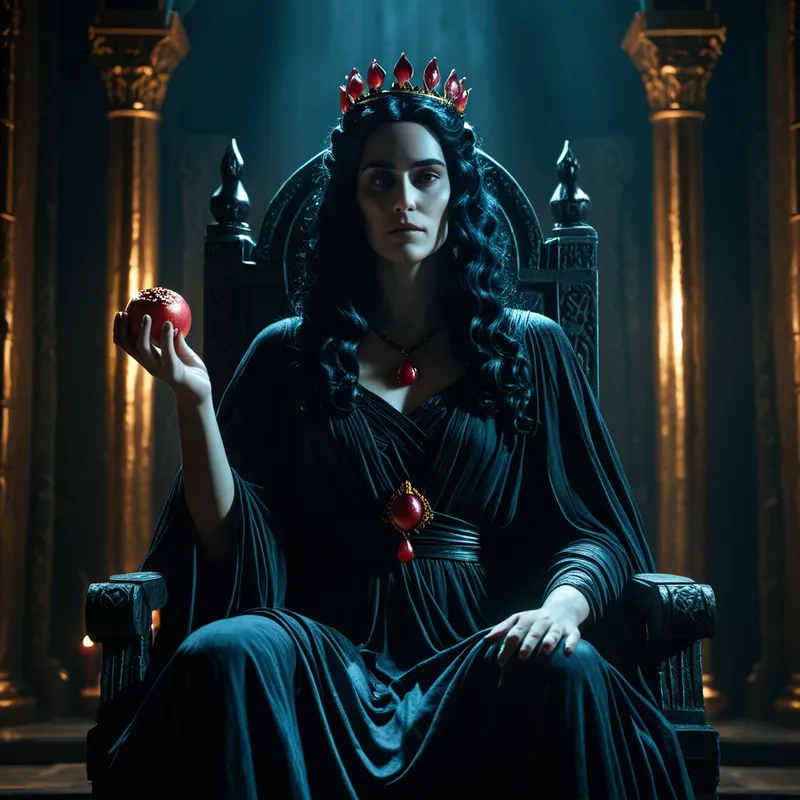
Meanwhile, in the sunless kingdom, Persephone sat upon a throne of ebony, a queen in a gilded cage. Hades, in his own stark way, offered her every honor of his realm—the title of Queen, riches, respect. But she refused all food and drink, for [the law](/myths/the-law “Myth from Biblical culture.”/) of the [Moirai](/myths/moirai “Myth from Greek culture.”/) was clear: whoever consumed the food of the dead must remain among them. Her fast was her last tie to the world above.
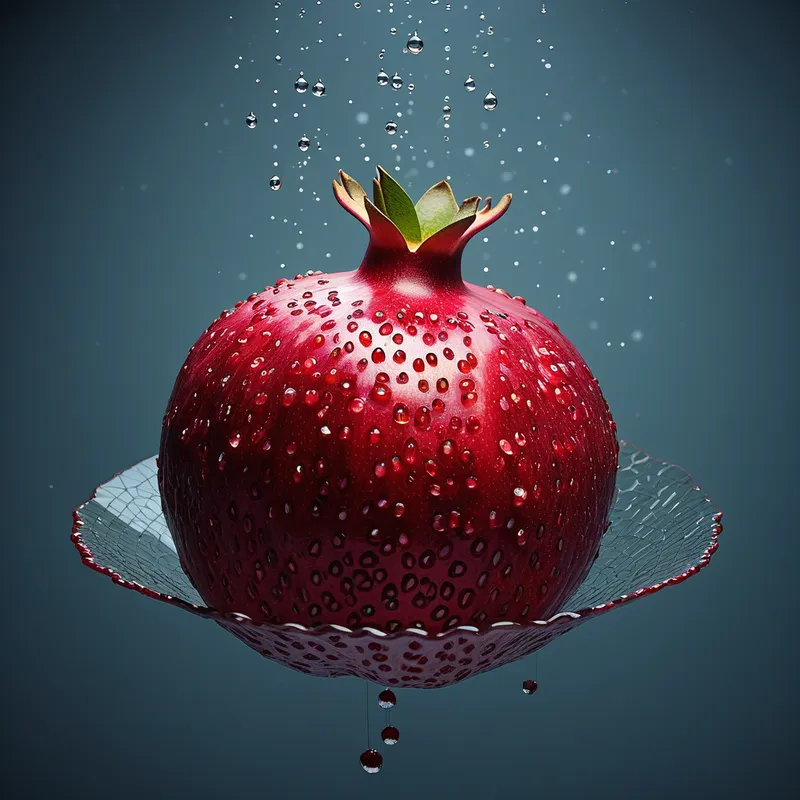
Yet, in her loneliness and despair, a subtle shift began. The maiden, Kore, was fading. In her place, something else was being forged in the dark. Sensing her resolve weakening, or perhaps as a final, cunning gambit, Hades offered her a pomegranate—a fruit as red as heart’s blood, its juice a promise of life even here, in the land of death. Overcome by thirst, by a new and complicated yearning, or perhaps by a dawning acceptance of her own power in this strange kingdom, Persephone ate. Not the whole fruit, but six of its glistening seeds.
Their sweet-tart juice was a contract signed in her own blood.
Her fate was sealed. When the sun god [Helios](/myths/helios “Myth from Greek culture.”/) revealed the truth to Demeter, and Zeus was forced to intervene to save a barren world, a compromise was struck. Because she had eaten the food of the dead, Persephone must return to [the Underworld](/myths/the-underworld “Myth from Greek culture.”/) for a portion of each year. For every seed consumed, a month of darkness.
Thus, she emerges each spring, a goddess transformed, walking the earth with her mother as life erupts in joyous reunion. And when the autumn winds grow cold, she descends once more to her shadowed throne, and Demeter’s grief casts the world into winter. The maiden became the queen, and in her cyclical journey, the very rhythm of life, death, and rebirth was born.
Cultural Origins & Context
This central myth, most completely told in the Homeric Hymn to Demeter, was not mere entertainment. It was the sacred narrative underpinning the most famous Eleusinian Mysteries, the profound religious rites practiced near Athens for nearly two millennia. The myth provided the hieros [logos](/myths/logos “Myth from Christian culture.”/) (sacred story) for initiates who sought knowledge of life, death, and the promise of rebirth beyond the grave.
Told and retold in ritual contexts, its function was societal and deeply psychological. It explained the inescapable agricultural cycle upon which Greek civilization depended, personifying it through divine drama. More importantly, it offered a template for understanding female transition—from maiden (kore) to married woman (gyne)—a journey often perceived as a kind of social “abduction” from the mother’s home. The myth gave this universal, often traumatic, rite of passage a cosmic significance, validating the pain of separation and the power gained in a new realm. It was a story told by a culture deeply aware of life’s dualities, offering not a solution, but a sacred pattern for enduring them.
Symbolic Architecture
The myth is a perfect symbolic map of the [psyche](/myths/psyche “Myth from Greek culture.”/)’s necessary descent.
Persephone represents the conscious ego, the “innocent” self, content in the known world (the conscious mind, the [mother](/symbols/mother “Symbol: The symbol of ‘Mother’ represents nurturing, protection, and the foundational aspect of one’s emotional being, often associated with comfort and unconditional love.”/) [realm](/symbols/realm “Symbol: The symbol of ‘Realm’ often signifies the boundaries of one’s consciousness, experiences, or emotional states, suggesting aspects of reality that are either explored or ignored.”/)). Her abduction by [Hades](/symbols/hades “Symbol: Greek god of the underworld, representing death, the unconscious, and hidden aspects of existence.”/) is the inevitable [eruption](/symbols/eruption “Symbol: A sudden, violent release of pent-up energy or emotion from beneath the surface, often representing transformation or crisis.”/) of the unconscious—the [shadow](/symbols/shadow “Symbol: The ‘shadow’ embodies the unconscious, repressed aspects of the self and often represents fears or hidden emotions.”/), the repressed, the complex—that shatters conscious control. This is not a random tragedy but a call to wholeness.
Hades is not merely a [villain](/symbols/villain “Symbol: A character representing opposition, moral corruption, or suppressed aspects of self, often embodying fears, conflicts, or societal threats.”/); he is the [lord](/symbols/lord “Symbol: The symbol of ‘Lord’ represents authority, mastery, and control, along with associated power dynamics in relationships.”/) of the [underworld](/symbols/underworld “Symbol: A symbolic journey into the unconscious, representing exploration of hidden aspects of self, transformation, or confronting repressed material.”/) of the psyche, the keeper of all that is buried: [memory](/symbols/memory “Symbol: Memory symbolizes the past, lessons learned, and the narratives we construct about our identities.”/), [trauma](/symbols/trauma “Symbol: A deeply distressing or disturbing experience that overwhelms the psyche, often manifesting in dreams as unresolved emotional wounds or psychological injury.”/), instinct, and latent power. His realm is not evil, but other. He is the necessary catalyst for transformation, the archetypal force that ends psychic stagnation.
The Pomegranate Seed is the ultimate [symbol](/symbols/symbol “Symbol: A symbol can represent an idea, concept, or belief, serving as a powerful tool for communication and understanding.”/) of conscious [choice](/symbols/choice “Symbol: The concept of choice often embodies decision-making, freedom, and the multitude of paths available in life.”/) within the unconscious ordeal.
To eat the food of the underworld is to consciously assimilate a piece of that shadowy reality. It is the moment the ego stops merely resisting its fate and begins to integrate its experience.
The six seeds bind her, but they also grant her sovereignty. She is no longer a [victim](/symbols/victim “Symbol: A person harmed by external forces, representing vulnerability, injustice, or sacrifice in dreams. Often symbolizes powerlessness or moral conflict.”/); she is a [queen](/symbols/queen “Symbol: A queen represents authority, power, nurturing, and femininity, often embodying leadership and responsibility.”/) who has tasted the [fruit](/symbols/fruit “Symbol: Fruit symbolizes abundance, nourishment, and the fruits of one’s labor in dreams.”/) of her new domain and claimed [authority](/symbols/authority “Symbol: A symbol representing power structures, rules, and control, often reflecting one’s relationship with societal or personal governance.”/) over it.
The Cyclical Return is the myth’s great psychological [revelation](/symbols/revelation “Symbol: A sudden, profound disclosure of truth or insight, often through artistic or musical means, that transforms understanding.”/). Wholeness is not achieved by permanently residing in the light or the dark, but in the [capacity](/symbols/capacity “Symbol: A measure of one’s potential, limits, or ability to contain, process, or achieve something, often reflecting self-assessment or external demands.”/) to move between them. The integrated self is amphibious, comfortable both in the cultivated fields of conscious [life](/symbols/life “Symbol: The symbol of ‘Life’ represents a journey of growth, interconnectedness, and existential meaning, encompassing both the joys and challenges that define human experience.”/) and the rich, dark [soil](/symbols/soil “Symbol: Soil symbolizes fertility, nourishment, and the foundation of life, serving as a metaphor for growth and stability.”/) of the unconscious.
The Dreamer’s Resonance
When this myth pattern stirs in modern dreams, it signals a profound initiation underway. Dreaming of being pulled underground, of finding oneself in labyrinthine basements, or of sudden, disruptive encounters with dark, authoritative figures points to a somatic feeling of life being upended—a depression, a loss, a diagnosis, a rupture in relationship. The body feels the “chthonic pull.”
Psychologically, it is the process of ego dissolution. The old identity (the eternal maiden) is no longer viable. The dreamer may experience intense grief (Demeter’s loss), rage, and a sense of betrayal. Dreams of eating strange, forbidden fruits in dark places mirror Persephone’s choice: the beginning of active engagement with the crisis. The dreamer is not just suffering; they are, however reluctantly, beginning to feed on the experience, to seek meaning in the darkness. This is the nascent queen sensing her power. The dream pattern confirms the ordeal is not meaningless annihilation, but a brutal, sacred gestation.

Alchemical Translation
The alchemical journey—[nigredo](/myths/nigredo “Myth from Alchemical culture.”/) (blackening), albedo (whitening), [rubedo](/myths/rubedo “Myth from Alchemical culture.”/) (reddening)—is perfectly modeled here. The abduction is the nigredo, the descent into the primal, chaotic matter of the soul, the utter blackness of despair and disintegration.
Persephone’s fast and eventual acceptance is the albedo. In the absolute dark, a new consciousness is purified. The maiden-self dies, and a lunar, reflective understanding emerges. She sees the kingdom for what it is and her place within it.
The eating of the pomegranate seeds is the rubedo—the critical, crimson moment of integration. The blood-red juice symbolizes the vital, life-giving essence extracted from the ordeal itself. The unconscious material is no longer foreign; it is taken in, digested, and becomes the very substance of one’s renewed authority.
For the modern individual, the myth instructs us not to flee our personal underworlds—be they grief, failure, illness, or shadow—but to be claimed by them fully. Our task is to sit on that shadowed throne, to feel the weight of it, and ultimately, to consciously choose to ingest a piece of that reality. We must “eat the seeds.” This binds us to the truth of our suffering, but it also grants us the title of Queen or King of our own experience. We become bi-conscious, rulers of a dual citizenship. We learn that our vitality (our spring) is dependent upon our willingness to periodically descend, to honor the dark, fertile half of our soul where the seeds of renewal silently wait. The myth does not promise rescue; it promises meaning, sovereignty, and the eternal return of a self made whole through its own cyclical dissolution and rebirth.
Associated Symbols
Explore related symbols from the CaleaDream lexicon: