Peony Goddess Myth Meaning & Symbolism
A celestial maiden defies the winter emperor to bring life and beauty to the mortal world, becoming the eternal queen of flowers.
The Tale of Peony Goddess
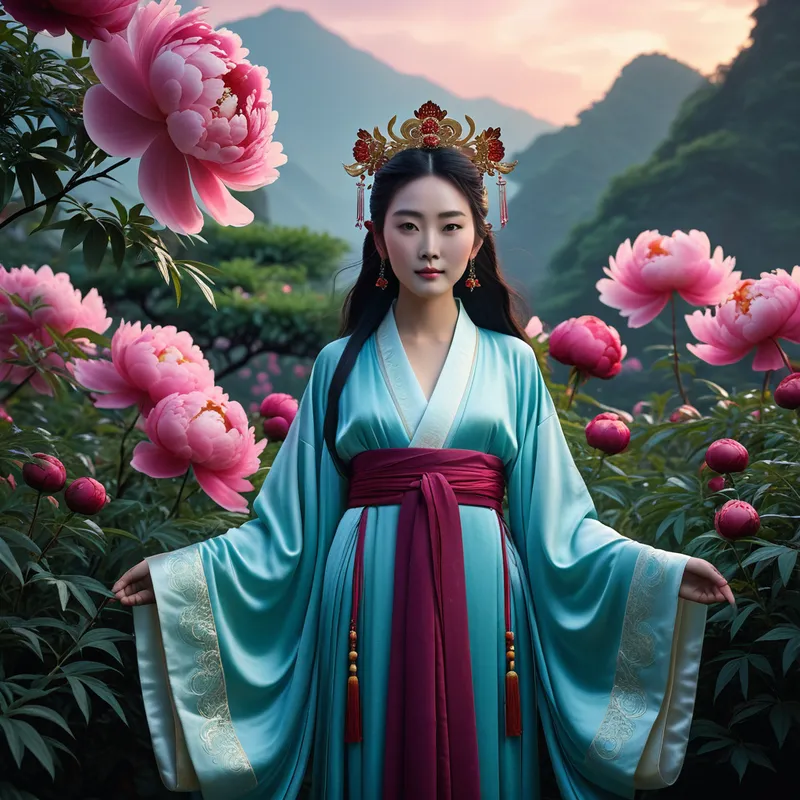
Listen, and let the scent of a thousand springs carry you back. The tale begins not on the green earth, but in the vaulted halls of the [Jade Emperor](/myths/jade-emperor “Myth from Chinese culture.”/)‘s court. Here, in a garden where seasons were but obedient servants, bloomed a maiden of such grace that the very stars paused to admire her reflection in the jade pools. She was the spirit of the [Peony](/myths/peony “Myth from Chinese culture.”/), the undisputed sovereign of all blossoms, her robes woven from the first light of dawn and the deepest hue of aged wine.
Her life was one of ordered, eternal perfection. Yet, her heart held a secret longing. From her high balcony, she would gaze upon the mortal realm below—a world of stark contrasts, of bitter winters and fleeting, hard-won springs. She saw the people toiling in the cold, their spirits as grey as the dormant earth, and she felt a pang that no celestial nectar could soothe.
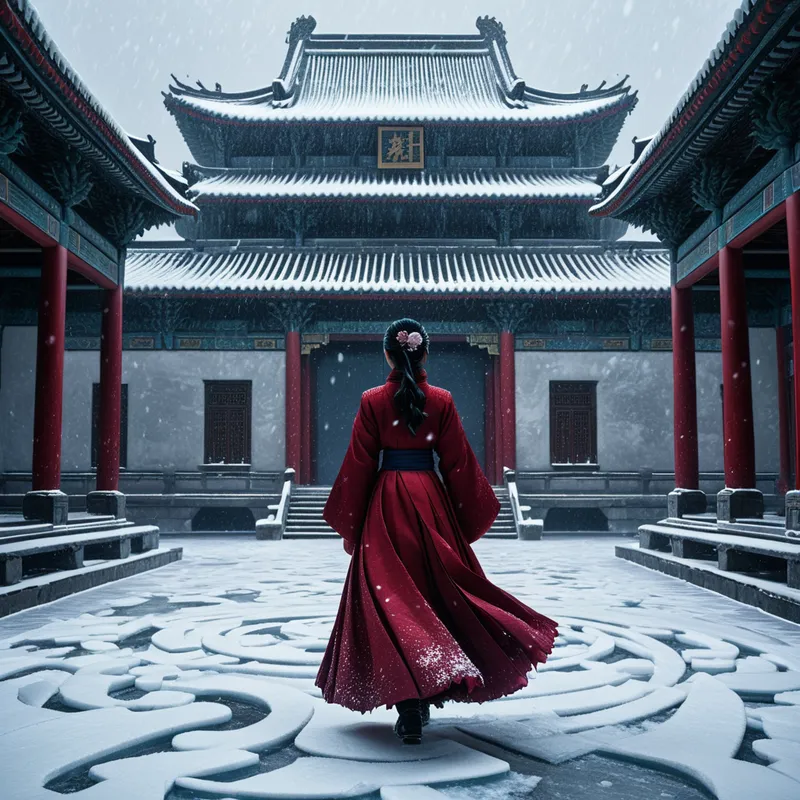
One year, the Winter Sovereign, a deity of hoarfrost and unyielding silence, overstayed his mandate. He commanded [the earth](/myths/the-earth “Myth from Hindu culture.”/) to remain locked in ice, refusing to yield to the gentle advance of Spring. Famine whispered through the valleys; despair took root where crops should have. The Peony Maiden witnessed this tyranny. The ordered beauty of heaven felt like a gilded cage. A fire, warmer than any sun, kindled within her—a fire of compassion that burned brighter than any celestial decree.
In an act of sublime defiance, she gathered the essence of a hundred springs, the promise of life itself, into her being. She descended from the jade clouds, a solitary streak of color against the leaden sky. Where her feet touched the frozen ground, the ice sighed and turned to rivulets. She moved through the sleeping world, and at her command, from the hard, cold soil, erupted a miracle. Not just any flower, but peonies in a riot of impossible colors—crimson as heart’s blood, white as virgin snow, pink as a maiden’s blush. They bloomed not with permission, but with proclamation.
Word, carried on the still-frigid wind, reached the Winter Sovereign. His rage was a blizzard given sentience. He confronted her in a field now blazing with her defiance. “You disrupt the celestial order!” his voice cracked like splitting glaciers. “Return to your garden, or be cast out forever!”
The Peony Maiden did not cower. She stood amidst her blossoms, a queen without a throne. “My order is life,” she replied, her voice soft yet unbreakable as a diamond stem. “My mandate is beauty. I will not see this world perish under your endless cold.”
The Winter Sovereign, in his fury, pronounced her punishment: banishment. She would be exiled from the eternal spring of heaven and rooted forever in the mortal realm, subject to its cycles of growth and decay. As the decree took hold, her celestial form began to change. Her silken robes fused with petals, her spirit merging with the very flowers she had gifted to [the world](/myths/the-world “Myth from Tarot culture.”/). She did not wither. She transformed. From a celestial maiden, she became the eternal soul of the peony itself—the Hua Wang, rooted in the earth, blooming with a beauty that defied tyranny, a permanent testament to the courage of compassion.
Cultural Origins & Context
The figure of the Peony Goddess, or the personified spirit of the peony, is not anchored to a single, canonical text like some Xian tales. She is a myth born from the soil of collective admiration, cultivated over centuries of Chinese poetry, folklore, and imperial patronage. Her story is a folk narrative, passed down through oral tradition and literary allusion, most vividly alive in the Tang and Song dynasties when the peony’s cultivation reached an artistic and cultural zenith.
The peony (mudan) was famously adored by Empress Wu Zetian of the Tang dynasty, and legends of her commanding flowers to bloom in winter intertwine with this mythic substrate. The tale functioned on multiple levels: as a simple pourquoi story explaining the flower’s lush beauty and spring bloom; as a moral fable about the virtue of compassion over rigid authority; and as a subtle, poetic commentary on the nature of true nobility—not that which is granted by a distant emperor, but that which springs from inherent worth and benevolent action. It was told by gardeners to explain the flower’s pride, by poets to symbolize unyielding beauty, and by the common people as a tale of a celestial force choosing to stand with them against a harsh, unfeeling power.
Symbolic Architecture
At its [heart](/symbols/heart “Symbol: The heart symbolizes love, emotion, and the core of one’s existence, representing deep connections with others and self.”/), this is a myth of the [Lover](/symbols/lover “Symbol: A lover in dreams often represents intimacy, connection, and the emotional aspects of relationships.”/) [archetype](/symbols/archetype “Symbol: A universal, primordial pattern or prototype in the collective unconscious that shapes human experience, behavior, and creative expression.”/) in radical [action](/symbols/action “Symbol: Action in dreams represents the drive for agency, motivation, and the ability to take control of situations in waking life.”/). The [Peony](/symbols/peony “Symbol: A flower symbolizing prosperity, romance, and spiritual healing, often linked to feminine energy and divine protection.”/) [Goddess](/symbols/goddess “Symbol: The goddess symbolizes feminine power, divinity, and the nurturing aspects of life, embodying creation and wisdom.”/) is not a passive object of [beauty](/symbols/beauty “Symbol: This symbol embodies aesthetics, harmony, and the appreciation of life’s finer qualities.”/) but its active, defiant principle. Her [journey](/symbols/journey “Symbol: A journey in dreams typically signifies adventure, growth, or a significant life transition.”/) maps a profound psychological transition.
The [celestial garden](/symbols/celestial-garden “Symbol: Symbolizes growth, abundance, and the nurturing of ideas and relationships in a cosmic space.”/) represents the initial, unconscious state of perfection—a [paradise](/symbols/paradise “Symbol: A perfect, blissful place or state of being, often representing ultimate fulfillment, harmony, and transcendence beyond ordinary reality.”/) that is also a [prison](/symbols/prison “Symbol: Prison in dreams typically represents feelings of restriction, confinement, or a lack of freedom in one’s life or mind.”/) of complacency. It is [the ego](/myths/the-ego “Myth from Jungian culture.”/)’s identification with a safe, ordered, but ultimately sterile self-[image](/symbols/image “Symbol: An image represents perception, memories, and the visual narratives we create in our minds.”/). The frozen mortal [realm](/symbols/realm “Symbol: The symbol of ‘Realm’ often signifies the boundaries of one’s consciousness, experiences, or emotional states, suggesting aspects of reality that are either explored or ignored.”/) symbolizes the neglected, suffering aspects of the [psyche](/myths/psyche “Myth from Greek culture.”/)—the inner [winter](/symbols/winter “Symbol: Winter symbolizes a time of reflection, introspection, and dormancy, often representing challenges or a period of transformation.”/) of depression, rigidity, or emotional coldness that we often ignore from our “heavenly” perch of supposed control.
The most profound defiance is not against another, but against the inner winter that would freeze compassion at its source.
Her descent is the crucial [movement](/symbols/movement “Symbol: Movement symbolizes change, progress, and the dynamics of personal growth, reflecting an individual’s desire or need to transform their circumstances.”/) of enantiodromia—the plunge of [consciousness](/symbols/consciousness “Symbol: Consciousness represents the state of awareness and perception, encompassing thoughts, feelings, and experiences.”/) into the opposite. It is the heart choosing feeling over order, [empathy](/symbols/empathy “Symbol: The capacity to understand and share the feelings of others, often manifesting as emotional resonance or intuitive connection in dreams.”/) over [safety](/symbols/safety “Symbol: Safety represents security, protection, and the sense of being free from harm or danger, both physically and emotionally.”/). The blooming [peonies](/symbols/peonies “Symbol: Peonies symbolize prosperity, romance, and lush beauty, often associated with love and good fortune.”/) are the miraculous eruptions of [life](/symbols/life “Symbol: The symbol of ‘Life’ represents a journey of growth, interconnectedness, and existential meaning, encompassing both the joys and challenges that define human experience.”/) that occur when the [soul](/symbols/soul “Symbol: The soul represents the essence of a person, encompassing their spirit, identity, and connection to the universe.”/)’s [compassion](/symbols/compassion “Symbol: A deep feeling of empathy and concern for others’ suffering, often involving a desire to help or alleviate their pain.”/) touches the frozen ground of the psyche. They symbolize unexpected creativity, emotional thawing, and the beauty that can only emerge from engagement with suffering.
Her [punishment](/symbols/punishment “Symbol: A dream symbol representing consequences for actions, often tied to guilt, societal rules, or internal moral conflicts.”/)—[exile](/symbols/exile “Symbol: Forced separation from one’s homeland or community, representing loss of belonging, punishment, or profound isolation.”/) and transformation—is the myth’s deepest [truth](/symbols/truth “Symbol: Truth represents authenticity, honesty, and the quest for knowledge beyond mere appearances.”/). There is no return to innocent [heaven](/symbols/heaven “Symbol: A symbolic journey toward ultimate fulfillment, spiritual transcendence, or connection with the divine, often representing life’s highest aspirations.”/) after such an act of conscious compassion. The psyche is irrevocably changed. She becomes the flower. This is the [symbol](/symbols/symbol “Symbol: A symbol can represent an idea, concept, or belief, serving as a powerful tool for communication and understanding.”/) of individuation: the conscious [personality](/symbols/personality “Symbol: Personality in dreams often symbolizes the traits and characteristics of the dreamer, reflecting how they perceive themselves and how they believe they are perceived by others.”/) (the maiden) must die into its true, embodied essence (the peony). Her beauty is no longer an [ornament](/symbols/ornament “Symbol: An ornament often symbolizes celebration, beauty, and the adornment of life during special occasions.”/); it is her very substance, hard-won and rooted in [reality](/symbols/reality “Symbol: Reality signifies the state of existence and perception, often reflecting one’s understanding of truth and life experiences.”/).
The Dreamer’s Resonance
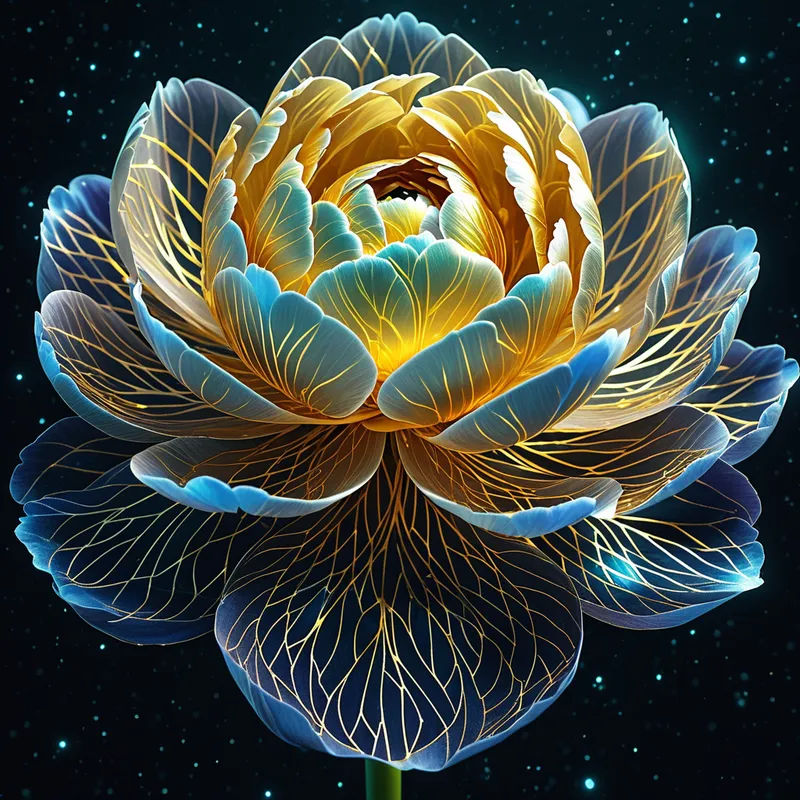
When this myth stirs in the modern dreamer, it often signals a profound confrontation between a cultivated self-image and a raw, compassionate impulse. To dream of a peony blooming in snow, or of being a flower in a frozen landscape, is to feel the somatic tension of life forcing its way through psychic ice.
The dreamer may be experiencing a “celestial” success that feels empty, or a “winter” of emotional or creative sterility in their life. The Peony Goddess pattern emerges as the soul’s rebellion against this stasis. The somatic process is one of warming and pressing—a feeling of heat in the chest (the kindled compassion) and a pressure to act, to express, to bloom despite the perceived rules (the inner Winter Sovereign’s decree). It is the psyche’s instinct to heal its own coldness by sacrificing a pristine but false self for a rooted, authentic, and vulnerable beauty. The conflict feels urgent and deeply personal: Do I maintain the orderly facade, or do I let my true colors show, even if it means being exposed to the elements?
Alchemical Translation
The alchemy here is the transmutation of aesthetic appreciation into embodied beauty, and of pity into sacrificial compassion. The modern individual’s journey mirrors the goddess’s path.
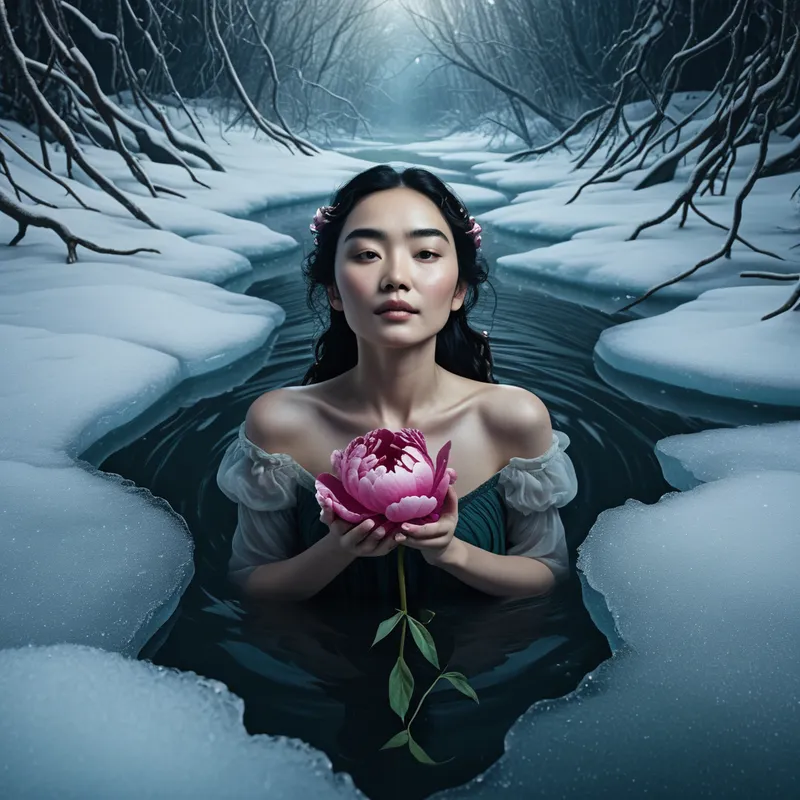
The [prima materia](/myths/prima-materia “Myth from Alchemical culture.”/) is the initial state: a life that may look perfect (the celestial garden) but is disconnected from the fertile mess of genuine feeling and connection. The [nigredo](/myths/nigredo “Myth from Alchemical culture.”/), the blackening, is the confrontation with the inner winter—the recognition of one’s own emotional coldness, or the oppressive, frozen structures in one’s life. This is the blizzard of the Winter Sovereign.
The albedo, the whitening, is the moment of clarity and decision: the pure, white-hot impulse of compassion that refuses the old order. This is the maiden’s descent. The citrinitas, the yellowing, is the flowering—the initial, glorious, and often disruptive emergence of new life, creativity, or vulnerability (the peonies blooming out of season).
The final gold is not the flower, but the becoming of it. The philosopher’s stone is the rooted self that blooms from its own decayed ideals.
The [rubedo](/myths/rubedo “Myth from Alchemical culture.”/), the reddening, is the culmination: the exile and transformation. This is the most challenging phase. It is the acceptance that acting from one’s deepest, loving truth will change one’s fundamental identity. You cannot unsee the suffering, you cannot unfeel the compassion, and you cannot go back to the old, untroubled heaven. You are exiled from naive innocence. But in that exile, you become what you always were at your core—not a visitor to life, but life itself, in all its vulnerable, magnificent, cyclical beauty. You are no longer someone who appreciates beauty; you have become a source of it, rooted in the dark earth of your own experience, weathering the seasons, forever blooming from the courage of a compassionate heart.
Associated Symbols
Explore related symbols from the CaleaDream lexicon: