Pentecostal Tongues of Fire Myth Meaning & Symbolism
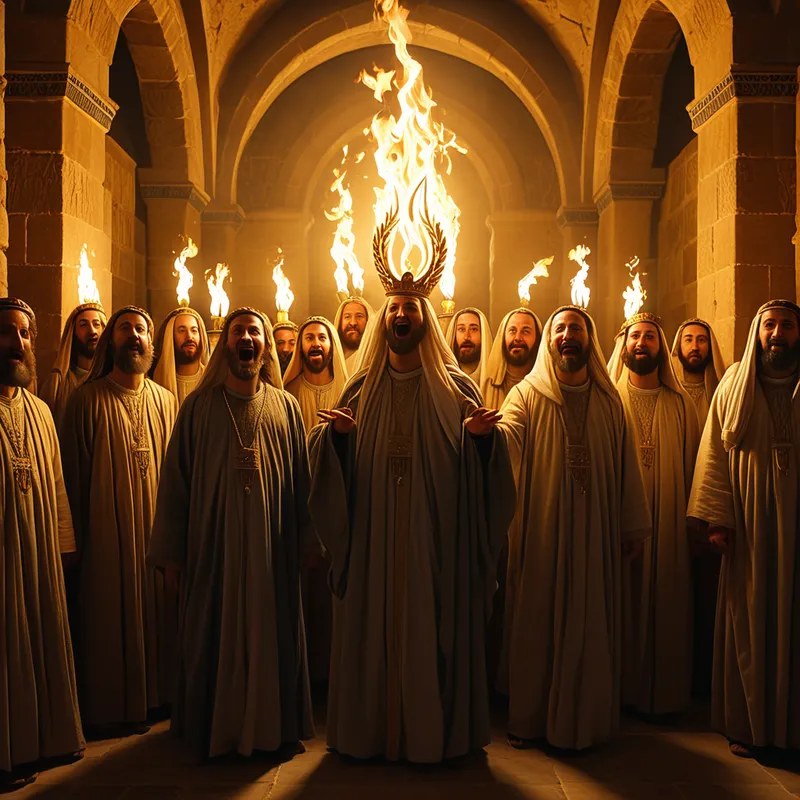
The descent of the Holy Spirit as tongues of fire upon the apostles, granting them miraculous speech and birthing the universal church.
The Tale of Pentecostal Tongues of Fire
The city was a tomb of whispered grief. [Jerusalem](/myths/jerusalem “Myth from Biblical culture.”/), swollen with pilgrims for the feast of Shavuot, hummed with a noise that could not reach the [upper room](/myths/upper-room “Myth from Biblical culture.”/). There, behind a locked door, the air was thick with memory and loss. The ones who had followed the Nazarene huddled together—fishermen, a tax collector, a zealot—their certainty shattered like the body of their master on the Roman wood. They were ghosts of a promise, waiting for a wind that had died.
Then, it began.
Not with a sound, but with the absence of all sound, a pressure in the ears like the moment before a storm breaks. And then [the wind](/myths/the-wind “Myth from Various culture.”/) came—a rushing, violent breath that was not of [the world](/myths/the-world “Myth from Tarot culture.”/), tearing through the stone walls as if they were parchment, filling the room with the scent of ozone and distant rain. It was a wind that did not blow upon them, but through them, shaking the dust from their bones and the fear from their hearts.
And then, the fire.
It descended from the unseen, not as a single conflagration, but as divided, living flames—tongues of pure, silent light. Each tongue, a flickering, intelligent ember, sought out a bowed head and came to rest. The heat was not of burning, but of a profound, inner warmth, like the first truth understood. The light from these tongues cast no shadow; it illuminated from within.
And their mouths were opened.
A sound burst forth, not from their throats, but from the very fire upon them. Words tumbled out—languages of Parthia and Cappadocia, of Libya and Rome—languages they had never learned, dialects of lands they had never seen. It was not babble, but perfect, fluent proclamation. The locked door was thrown open, not by hand, but by [the force](/myths/the-force “Myth from Science Fiction culture.”/) of this new-born sound.
Below, in the teeming streets, pilgrims from every corner of the empire froze. The cacophony of the feast melted away as they heard, clear as a bell in their own mother tongues, the wonders of God being declared by these simple Galileans. Some marveled, whispering of divine wine. Others scoffed, naming it madness. But the ones who listened felt a crack open in the world, a seam through which a spirit, wild and unifying, had poured, stitching the scattered human family back together with threads of understood fire.
Cultural Origins & Context
The account is found in the Acts of the Apostles, Chapter 2, authored by Luke. It is positioned as the foundational, generative event of the institutional Church, occurring fifty days after Easter (hence [Pentecost](/myths/pentecost “Myth from Christian culture.”/)) and ten days after the Ascension. This timing is profoundly symbolic, overlaying the new covenant onto the old: Shavuot commemorated the giving of the Law to [Moses on Sinai](/myths/moses-on-sinai “Myth from Jewish/Christian culture.”/), an event for one people. Luke’s narrative reframes it as the giving of the Spirit to all peoples.
Societally, it served a critical legitimizing function. The early Christian movement was a scattered, persecuted sect emerging from a failed messianic revolt. The Pentecost myth provided divine authorization for its leaders (the apostles), explained the phenomenon of ecstatic, inspired speech (glossolalia), and established its core mission as universal, transcending ethnic and linguistic barriers. It was the mythic moment where a traumatized, private group was transformed into a public, proclaiming body.
Symbolic Architecture
At its [heart](/symbols/heart “Symbol: The heart symbolizes love, emotion, and the core of one’s existence, representing deep connections with others and self.”/), Pentecost is a myth of inspiration in its most literal sense: inspirare, to breathe into. The divine wind ([pneuma](/myths/pneuma “Myth from Greek culture.”/)) and fire represent the infusion of a transcendent, animating force into the [human](/symbols/human “Symbol: The symbol of a human represents individuality, complexity of emotions, and social relationships.”/) [vessel](/symbols/vessel “Symbol: A container or structure that holds, transports, or protects something essential, representing the self, emotions, or life journey.”/).
The tongue of fire is the alchemical point where the ineffable divine will becomes articulated human word. It is the sacrament of communication itself.
The fire is multifaceted. It is the purifying fire of Elijah, consuming doubt. It is the illuminating fire of wisdom, dispelling the darkness of [confusion](/symbols/confusion “Symbol: A state of mental uncertainty or disorientation, often reflecting internal conflict, lack of clarity, or overwhelming choices in waking life.”/). Critically, it is divided yet shared—a [symbol](/symbols/symbol “Symbol: A symbol can represent an idea, concept, or belief, serving as a powerful tool for communication and understanding.”/) of individualized calling within a collective experience. Each person receives their own flame, yet all are lit by the same [source](/symbols/source “Symbol: The origin point of something, often representing beginnings, nourishment, or the fundamental cause behind phenomena.”/).
The [tongue](/symbols/tongue “Symbol: Represents communication, self-expression, and the power of words.”/) is the [organ](/symbols/organ “Symbol: An organ symbolizes vital aspects of life and health, often representing one’s emotional or physical state.”/) of speech, of culture, of [boundary](/symbols/boundary “Symbol: A conceptual or physical limit defining separation, protection, or identity between entities, spaces, or states of being.”/). The miracle is not that everyone speaks one holy [language](/symbols/language “Symbol: Language symbolizes communication, understanding, and the complexities of expressing thoughts and emotions.”/), but that every human language becomes a vessel for the holy. This reverses the [curse](/symbols/curse “Symbol: A supernatural invocation of harm or misfortune, often representing deep-seated fears, guilt, or perceived external malevolence.”/) of Babel, not by returning to a monolithic [tongue](/symbols/tongue “Symbol: Represents communication, self-expression, and the power of words.”/), but by sanctifying diversity. The symbol attacks the root of human alienation: the inability to be truly heard and understood.
Psychologically, the apostles represent [the ego](/myths/the-ego “Myth from Jungian culture.”/) in a state of post-traumatic collapse, locked in the “upper [room](/symbols/room “Symbol: A room in a dream often symbolizes the self, representing personal space, mental state, or aspects of one’s identity.”/)” of its own defenses. The descending [Spirit](/symbols/spirit “Symbol: Spirit symbolizes the essence of life, vitality, and the spiritual journey of the individual.”/) represents the overwhelming influx of [energy](/symbols/energy “Symbol: Energy symbolizes vitality, motivation, and the drive that fuels actions and ambitions.”/) from the Self, which initially feels like a violent wind (psychic [chaos](/symbols/chaos “Symbol: In Arts & Music, chaos represents raw creative potential, uncontrolled expression, and the breakdown of order to forge new artistic forms.”/)) before it differentiates into individuated gifts (the separate tongues).
The Dreamer’s Resonance
To dream of tongues of fire is to dream of a crisis and a gift of communication emerging from the core of one’s being.
A modern dreamer might find themselves in a boardroom, a family gathering, or alone before a blank page, when suddenly, light rests upon them. They speak, and their words—which they fear are too technical, too emotional, too strange—are received with profound understanding by others. Or, conversely, they may be in a crowd where everyone is speaking in a beautiful, fluent language they alone cannot comprehend, until a quiet flame touches them, and meaning floods in.
Somatically, this dream pattern correlates with a release in the throat chakra (Vishuddha), a physical sensation of tightness dissolving, of breath expanding. Psychologically, it signifies the moment when a deeply held, perhaps unconscious, personal truth—forged in the fires of experience or suffering—demands and finally finds its authentic expression. It is the dream of the introvert finding public voice, the artist discovering their medium, the lover speaking their heart without fear. The “wind” in the dream is the often-disorienting build-up of this internal pressure seeking release.

Alchemical Translation
The Pentecost myth is a precise map for the alchemical stage of individuation known as illuminatio—illumination. It models the transformation of latent potential ([prima materia](/myths/prima-materia “Myth from Alchemical culture.”/)) into active, world-engaging power.
The process begins in the locked room of the [persona](/myths/persona “Myth from Greek culture.”/). This is the constructed self, identified with its roles (fisherman, tax collector) and its traumas (abandonment, failure). It is sterile, waiting. The descent of the pneuma represents the eruption of the unconscious—the [nigredo](/myths/nigredo “Myth from Alchemical culture.”/) or chaotic dark night—which shatters the ego’s defenses. This is often experienced as a life crisis, a depression, or a surge of inexplicable emotion that feels alien and overwhelming.
The fire does not ask permission to alight; it claims its vessel. Individuation is not a gentle request from the Self, but a divine seizure.
The differentiation of the single wind into many tongues is the crucial stage of [separatio](/myths/separatio “Myth from Alchemical culture.”/) and coagulatio. The raw, chaotic psychic energy is distilled into a specific, unique gift. The universal becomes personal. For one, it may be the gift of articulate counsel; for another, artistic creation; for another, the capacity for deep listening. The “tongue” is the specific, embodied form the spirit takes in you.
Finally, the unlocked door and the proclamation to the “nations” symbolize integration. The newly illuminated Self must engage with the outer world (the multitudes). The gift is not for private ecstasy but for communication, for building bridges of understanding across the inner divides of the [psyche](/myths/psyche “Myth from Greek culture.”/) and the outer divides of the world. The individuated person becomes a conduit, translating the language of the soul into a dialect the world can hear, completing the alchemical work by turning leaden isolation into golden communion.
Associated Symbols
Explore related symbols from the CaleaDream lexicon: