Pentecostal Flame Myth Meaning & Symbolism
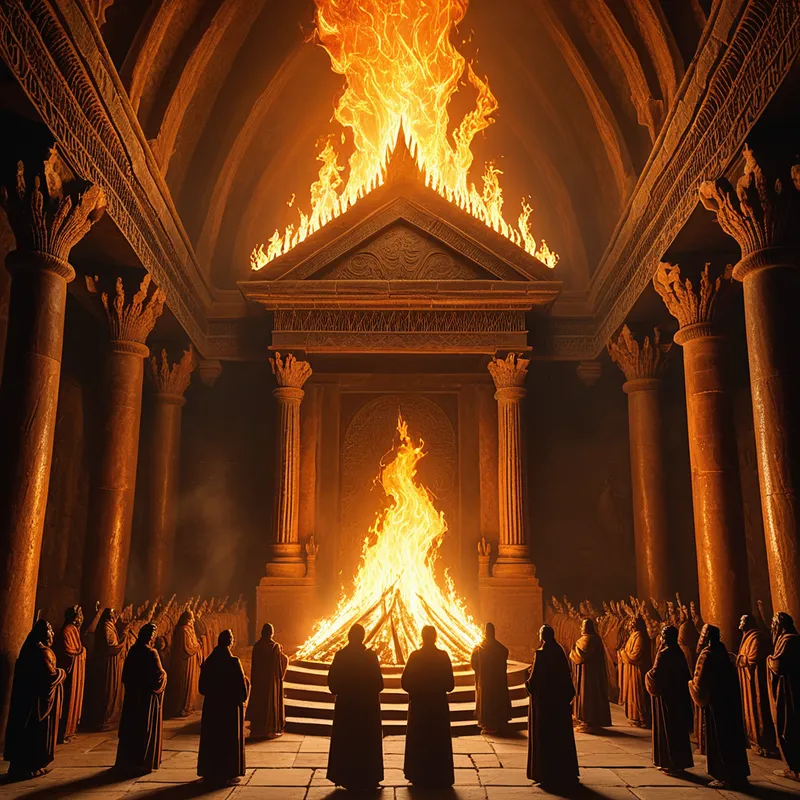
A divine wind and tongues of fire descend, shattering language barriers and igniting a universal consciousness within a gathered community.
The Tale of Pentecostal Flame
The air in the city was thick with the memory of loss and the fragile scent of hope. For fifty days, they had waited, a scattered flock huddled in a secret room, their hearts a locked chamber of grief and whispered promise. [The world](/myths/the-world “Myth from Tarot culture.”/) outside was a cacophony of tongues—pilgrims from every corner of the empire, each word a wall, each dialect a division.
Then, it came.
Not with a [herald](/myths/herald “Myth from Greek culture.”/)’s trumpet, but with the sound of a gathering storm, a roar that filled the house from foundations to rafters. It was the breath of [the desert](/myths/the-desert “Myth from Biblical culture.”/) wind, the sigh of the cosmos, made audible. And in that rushing, swirling atmosphere, they saw it: fire. But this was no flame of hearth or sacrifice. It separated, divided, became a crown of individual tongues—flickering, dancing, alive—and rested upon each of them.
A heat bloomed within their chests, not of burning, but of sudden, unbearable fullness. The locked chamber of the heart burst open. And from their mouths poured not the familiar, clumsy syllables of Aramaic or Greek, but a torrent of praise, of poetry, of profound declaration in the languages of Parthia, Media, Elam, Mesopotamia, Judea, Cappadocia, [Pontus](/myths/pontus “Myth from Greek culture.”/), Asia, Phrygia, Pamphylia, Egypt, Libya, and Rome. The very sound was a miracle—the confusion of Babel undone not by a single, imposed tongue, but by a symphony of understanding.
They spilled into the streets, these ignited ones, their faces alight. The crowd gathered, a sea of bewildered faces. “They are filled with new wine!” some mocked. But others listened, and heard their own mother’s tongue speaking of mighty deeds of God. The wall of sound had become a bridge. The flame that descended was not to consume, but to communicate; not to judge, but to join. A new people was born not of blood or soil, but of spirit and fire, their first sacrament the impossible, shared word.
Cultural Origins & Context
This account, found in the second chapter of the Acts of the Apostles, is the foundational myth of the Christian church’s birth. It is situated precisely fifty days after Passover (and the crucifixion narrative), coinciding with the Jewish festival of <abbr title=“The Jewish “Feast of Weeks,” a harvest festival”>Shavuot, which celebrated the giving of [the Law](/myths/the-law “Myth from Biblical culture.”/) to [Moses](/myths/moses “Myth from Biblical culture.”/) on [Mount Sinai](/myths/mount-sinai “Myth from Biblical culture.”/). The narrative thus consciously positions itself as a new covenant, not of stone tablets, but of inspired hearts.
Passed down within early Christian communities, it functioned as an etiological myth—answering the question, “How did we, a disparate group, become one body with a mission to all nations?” It legitimized the explosive, often chaotic, phenomenon of glossolalia (“speaking in tongues”) within the early church, framing it not as madness but as a divine endowment for universal proclamation. The story served to shatter parochial boundaries, authorizing a message intended to transcend the specific cultural vessel of Second Temple Judaism.
Symbolic Architecture
At its core, the Pentecostal Flame is a [symbol](/symbols/symbol “Symbol: A symbol can represent an idea, concept, or belief, serving as a powerful tool for communication and understanding.”/) of catalyzed [consciousness](/symbols/consciousness “Symbol: Consciousness represents the state of awareness and perception, encompassing thoughts, feelings, and experiences.”/). The upper [room](/symbols/room “Symbol: A room in a dream often symbolizes the self, representing personal space, mental state, or aspects of one’s identity.”/) represents the [interior](/symbols/interior “Symbol: The interior symbolizes one’s inner self, thoughts, and emotions, often reflecting personal growth, vulnerabilities, and secrets.”/) world, the [psyche](/myths/psyche “Myth from Greek culture.”/) in a state of expectant [incubation](/symbols/incubation “Symbol: A period of internal development, rest, or hidden growth before emergence, often associated with healing, creativity, or transformation.”/). The rushing wind ([pneuma](/myths/pneuma “Myth from Greek culture.”/)) is the animating force of [life](/symbols/life “Symbol: The symbol of ‘Life’ represents a journey of growth, interconnectedness, and existential meaning, encompassing both the joys and challenges that define human experience.”/) and intelligence that cannot be seen, only felt and heard in its effects.
The flame is the archetypal image of transformation: it destroys the old form to release its essence, and it provides the light by which to see anew.
The “tongues as of fire” are profoundly precise. The [tongue](/symbols/tongue “Symbol: Represents communication, self-expression, and the power of words.”/) is the [organ](/symbols/organ “Symbol: An organ symbolizes vital aspects of life and health, often representing one’s emotional or physical state.”/) of speech, of [logos](/myths/logos “Myth from Christian culture.”/), of bringing the inner world into the shared outer [reality](/symbols/reality “Symbol: Reality signifies the state of existence and perception, often reflecting one’s understanding of truth and life experiences.”/). Fire is [energy](/symbols/energy “Symbol: Energy symbolizes vitality, motivation, and the drive that fuels actions and ambitions.”/), [passion](/symbols/passion “Symbol: Intense emotional or physical desire, often linked to love, creativity, or purpose. Represents life force and deep engagement.”/), purification, and [illumination](/symbols/illumination “Symbol: A sudden clarity or revelation, often representing spiritual awakening, intellectual breakthrough, or the dispelling of ignorance.”/). Combined, they symbolize inspired speech—communication that carries the transformative power of the [speaker](/symbols/speaker “Symbol: A speaker often represents communication, self-expression, and the conveying of ideas or emotions.”/)’s entire ignited being. This is not mere [information](/symbols/information “Symbol: Information signifies knowledge, communication, and the processing of facts or insights.”/) transfer; it is communion. The reversal of Babel’s [curse](/symbols/curse “Symbol: A supernatural invocation of harm or misfortune, often representing deep-seated fears, guilt, or perceived external malevolence.”/) signifies the healing of the primal wound of [human](/symbols/human “Symbol: The symbol of a human represents individuality, complexity of emotions, and social relationships.”/) [separation](/symbols/separation “Symbol: A spiritual or mythic division between realms, states of being, or consciousness, often marking a transition or loss of connection.”/). The miracle is not in the speaking, but in the hearing; it represents the [emergence](/symbols/emergence “Symbol: A process of coming into being, rising from obscurity, or breaking through a barrier, often representing birth, transformation, or revelation.”/) of a deep, symbolic [language](/symbols/language “Symbol: Language symbolizes communication, understanding, and the complexities of expressing thoughts and emotions.”/) of the [soul](/symbols/soul “Symbol: The soul represents the essence of a person, encompassing their spirit, identity, and connection to the universe.”/) that can be understood across all barriers of ego and [identity](/symbols/identity “Symbol: Identity represents the sense of self, encompassing personal beliefs, cultural background, and social roles.”/).
Psychologically, the flame represents the sudden, often disruptive, [eruption](/symbols/eruption “Symbol: A sudden, violent release of pent-up energy or emotion from beneath the surface, often representing transformation or crisis.”/) of [the Self](/myths/the-self “Myth from Jungian culture.”/) (Jung’s [term](/symbols/term “Symbol: The term often represents boundaries, defined concepts, or experiences that have a specific meaning in a given context.”/) for the central, unifying [archetype](/symbols/archetype “Symbol: A universal, primordial pattern or prototype in the collective unconscious that shapes human experience, behavior, and creative expression.”/) of the total [personality](/symbols/personality “Symbol: Personality in dreams often symbolizes the traits and characteristics of the dreamer, reflecting how they perceive themselves and how they believe they are perceived by others.”/)) into the confined [space](/symbols/space “Symbol: Dreaming of ‘Space’ often symbolizes the vastness of potential, personal freedom, or feelings of isolation and exploration in one’s life.”/) of the conscious ego. It is a numinous experience that breaks old structures of thought and identity to forge a new, more expansive [relationship](/symbols/relationship “Symbol: A representation of connections we have with others in our lives, often reflecting our emotional state.”/) with the world.
The Dreamer’s Resonance
To dream of this flame is to be in a state of profound psychic readiness for an awakening. The dreamer may be in their own “[upper room](/myths/upper-room “Myth from Biblical culture.”/)”—a period of isolation, contemplation, or grief that feels like a holding pattern. The descent of the fire in a dream often correlates with a somatic sensation of sudden warmth, energy, or a “click” of understanding in waking life.
Such a dream signals that a latent potential within the psyche is demanding expression and connection.
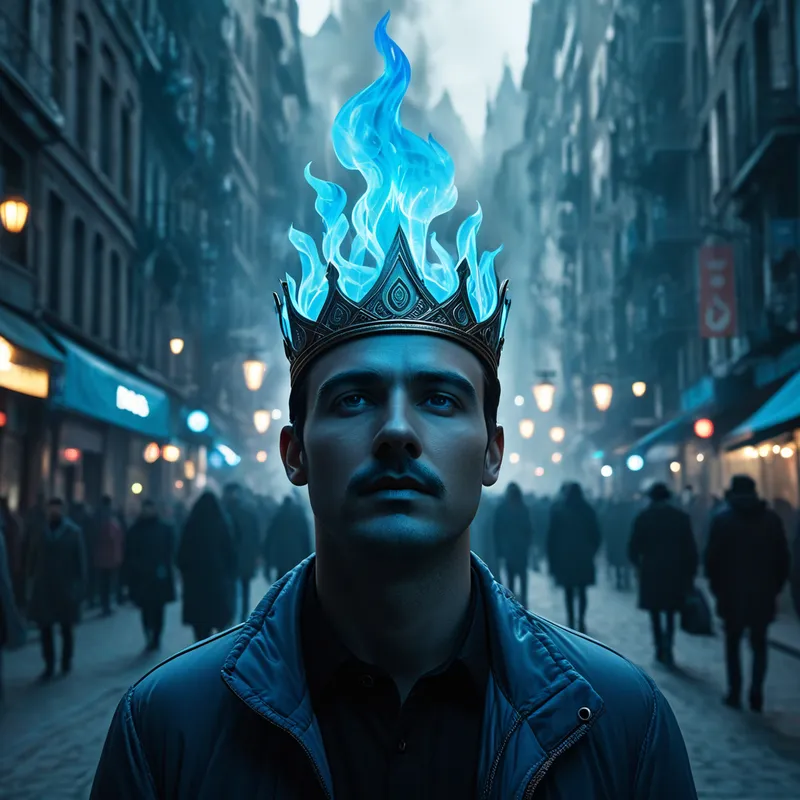
The modern manifestation might not be literal linguistic translation. Instead, the dreamer may find themselves in a dream crowd, speaking with a newfound clarity that resolves conflicts, or they may hear others speaking and suddenly grasp the deeper, emotional truth beneath their words. The flame crowns the head—the seat of intellect and identity—suggesting that the transformation is integrating one’s highest intelligence with one’s deepest passion. It is a dream of empowerment for authentic communication, where one’s true “voice” is ignited and cannot be contained. The accompanying “wind” may be felt as a sense of inevitable, rushing change, a destiny that can no longer be postponed.
Alchemical Translation
The alchemical process mirrored here is sublimatio—the volatilization of the solid into the spiritual, the raising of base matter (the disciples’ fear, confusion, and isolation) into a higher, unified state (a prophetic, connected community). The fixed, leaden state of grief and hiding is subjected to the agent of fire and wind, causing it to ascend.
For the modern individual pursuing individuation, the [Pentecost](/myths/pentecost “Myth from Christian culture.”/) myth models the critical shift from ego-centeredness to Self-centeredness. [The ego](/myths/the-ego “Myth from Jungian culture.”/) is the single, familiar language we speak. The work of analysis, crisis, or deep introspection creates the “upper room,” a contained space where the contents of the personal and collective unconscious gather. The inflowing pneuma is the acceptance of this unconscious material. The ignition is the moment of synthesis, where these contents are not just seen but spoken—integrated into the personality in a way that transforms one’s relationship to the outer world.
The ultimate goal is not private enlightenment, but communicative power. The ignited Self seeks to participate in the world through a language of authentic being.
The “speaking in other tongues” translates to the developing capacity for empathy—the ability to “speak” the emotional language of another, to translate one’s own experience into forms that can bridge divides. The individual becomes a vessel for a transpersonal energy, finding their unique voice precisely in the service of a connection that transcends their former, isolated self. The flame does not burn alone; it is part of a shared conflagration that lights up the dark, not for itself, but so that all faces might be seen, and all tongues understood.
Associated Symbols
Explore related symbols from the CaleaDream lexicon: