Pentecost Myth Meaning & Symbolism
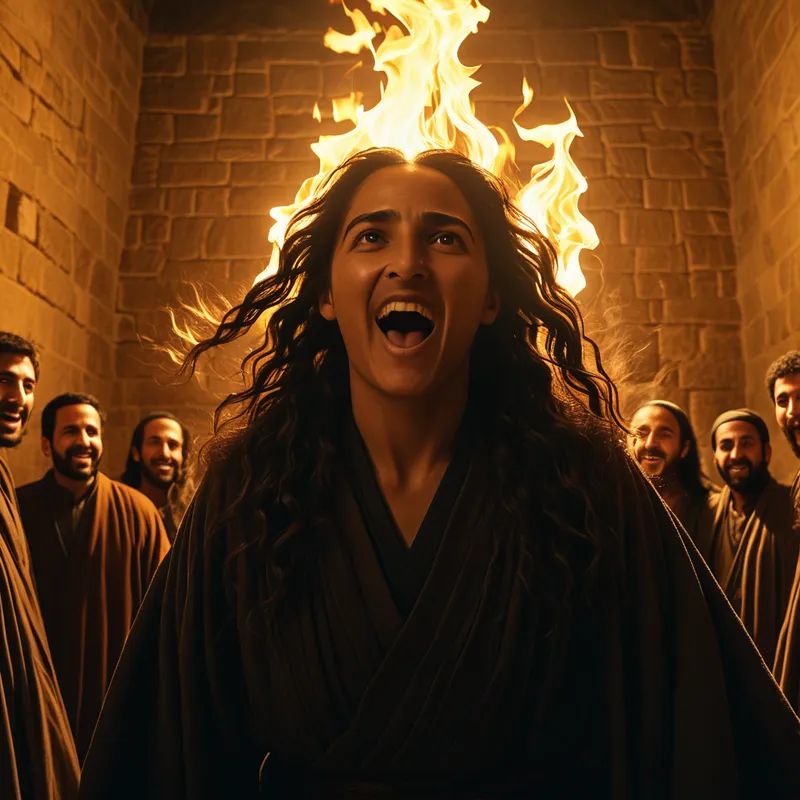
Apostles, gathered in fear, are engulfed by a rushing wind and tongues of fire, granting them the power to speak in all languages and ignite a new faith.
The Tale of Pentecost
The air in the upper room was thick with the scent of old wood, lamp oil, and unspoken fear. Fifty days had passed since the unthinkable—since the teacher they called Yeshua had been taken from them, lifted into the sky, leaving only the ghost of a promise and a gaping wound of absence. They were gathered, as he had asked, a huddled constellation of fishermen, tax collectors, and followers, their voices hushed, their hearts a tangled knot of memory and dread. The world outside was the bustling, indifferent world of Jerusalem, a city that had swallowed their hope and now moved on.
Then, it began.
Not with a sound, but with a feeling—a deep, subterranean tremor in the soul. It grew into a roar, a rushing, mighty wind that tore through the sealed room, yet stirred not a single thread of their garments. It was a wind from the inside out, a hurricane of spirit. And then, the fire. Not from the hearth, not from the sun, but from the very fabric of the air itself. Tongues of flame, searing yet cool, descended and separated, coming to rest upon the head of each one gathered. It did not burn; it baptized.
A gasp, collective and sharp, was swallowed by the roaring silence of the wind. And in that moment, the knot in their hearts unraveled. A new language, born not of tongue but of spirit, erupted from them. It was a torrent of praise, of proclamation, a sound so foreign and yet so utterly familiar it felt like remembering a name from a forgotten dream. The fear was gone, incinerated in that holy fire, replaced by a ferocious, unshakable certainty.
Driven by this new force, they spilled into the streets. The festival crowds, pilgrims from every corner of the empire—Parthians, Medes, Elamites, visitors from Rome, Crete, and Arabia—turned in bewilderment. These Galileans, known for their rough accent, were speaking. But each listener heard the wonders of God declared in their own native tongue. The miracle was not in the speaking, but in the hearing. Confusion gave way to amazement, then to a prickling awe. “What does this mean?” some murmured. Others, sneering, attributed the ecstasy to new wine. But Peter, the rock who had once crumbled, now stood firm, his voice ringing with the authority of the flame. He spoke not of drunkenness, but of prophecy fulfilled, of a spirit poured out on all flesh. That day, the wind and fire seeded three thousand souls, and the community of the Way was born, not from a sword, but from a shared breath of understanding.
Cultural Origins & Context
The story of Pentecost is rooted in the earliest strata of the Christian movement, recorded in the Acts of the Apostles, a text composed in the latter half of the first century. It is profoundly syncretic, deliberately layered upon the Jewish festival of Shavuot, which commemorated the giving of the Torah to Moses at Mount Sinai. The author of Acts performs a masterful act of theological alchemy: just as the old covenant was inaugurated with fire, smoke, and the divine word at Sinai (Exodus 19-20), the new covenant is inaugurated with fire, wind, and the divine word in Jerusalem.
Societally, the myth served multiple critical functions for a nascent, persecuted sect. It provided an etiological narrative for the explosive growth and missionary zeal of the early church, answering the question, “How did this begin?” It legitimized the apostles’ authority as direct recipients of the Holy Spirit. Most importantly, it addressed the central crisis of a movement born in a specific cultural and linguistic context (Aramaic-speaking Judaism) but destined for a global, multicultural empire. The miracle of tongues was the mythic solution to the problem of Babel—not a reversal to a single language, but a transcendence of the barrier itself, signifying that the message was universal, intended for every nation and tongue.
Symbolic Architecture
At its core, Pentecost is a myth of psychic invasion and collective empowerment. The upper room symbolizes the insulated, fearful ego-complex, huddled in confusion after a central organizing principle (the Christ figure) has departed. The rushing wind represents the pneuma, the uncontrollable, animating breath of the unconscious itself, breaking into the sealed chamber of conscious control.
The flame that illuminates without consuming is the archetypal symbol of transformative energy that refines rather than destroys.
The “tongues as of fire” are the critical image. Fire is purification, illumination, and passion. That they are tongues fuses the symbol of transformative energy with the faculty of communication and logos. This is not random ecstasy; it is inspired, intelligible speech. The psychological event is the ignition of what we might call the transpersonal function—the capacity of the individual psyche to become a vessel for a meaning that transcends personal concerns and connects to the collective. The confusion of the crowd mirrors the ego’s initial resistance to messages from the deep unconscious; the miracle of understanding signifies the moment when that content breaks through into conscious integration, speaking a “language” the ego can finally comprehend.
The Dreamer’s Resonance
When this mythic pattern stirs in the modern dreamer, it often signals a crisis of communication and a pending eruption of creative or spiritual energy. To dream of a powerful, invisible wind in a confined space points to a building pressure from the unconscious, a feeling that one’s current “room” or mindset is too small, and a greater psychic force demands entry.
Dreams of speaking in a fluent but unknown language, or of others understanding you despite a seeming barrier, speak directly to the Pentecost archetype. This is the somatic signal of a new complex or a profound insight seeking to articulate itself. The dreamer may be on the verge of finding their authentic “voice”—a mode of expression that feels divinely inspired, effortless, and capable of connecting with others on a level beyond conventional discourse. Conversely, dreaming of being in a crowd where everyone speaks a different, incomprehensible language reflects the pre-Pentecost state: isolation within the psyche, where different internal parts (personas, complexes, archetypes) cannot communicate, leading to paralysis and fear.

Alchemical Translation
The alchemical process modeled by Pentecost is the sublimation of grief and paralysis into inspired action and community. The prima materia is the disciples’ state after the Ascension: a confused, fragmented group, defined by loss (the nigredo). Their gathering is the containing vessel. The descent of the wind and fire is the infusion of the spiritus, the quickening agent that initiates the transformation (the albedo, the whitening, the illumination).
The miracle is not that one language is spoken, but that all languages are understood. Individuation is not about achieving a single, monolithic self, but about integrating the many “languages” of the psyche into a coherent, communicative whole.
The true alchemical gold produced is not just personal empowerment, but the creation of the communitas—the spiritual community. For the modern individual, this translates to the journey from a state of isolated, ego-bound consciousness to becoming a participant in what Jung called the collective unconscious. It is the process where personal suffering and confusion become the fuel for a creativity or a purpose that serves something larger than oneself. The “speaking in tongues” is the ability to translate deep, often non-verbal, archetypal energies into a form that can be offered to the world—be it through art, leadership, healing, or authentic relationship. It marks the birth of the Self as a mediating, communicative center, replacing the fearful ego as the ruler of the psychic city. The wind blows where it wills, and the fire ignites not to create solitary geniuses, but to weave a new understanding across the inner and outer Babel.
Associated Symbols
Explore related symbols from the CaleaDream lexicon: