
Penia Myth Meaning & Symbolism
The myth where Penia, the spirit of need, cunningly conceives a child with Poros, the god of resource, giving birth to the god of love, Eros.
The Tale of Penia
Listen, and hear a tale not of glorious heroes or thundering gods, but of a whisper in the dark, a chill at the edge of the feast. This is the story of Penia.
The world was celebrating. For Aphrodite, born of sea-foam and sky, a great birthday feast was held on the soft, green slopes of Olympus. The air was thick with the scent of nectar and roasting ambrosia. Laughter rang like silver bells, and the gods reclined on couches of cloud, their cups never empty, their bellies always full. Abundance was the very fabric of the day.
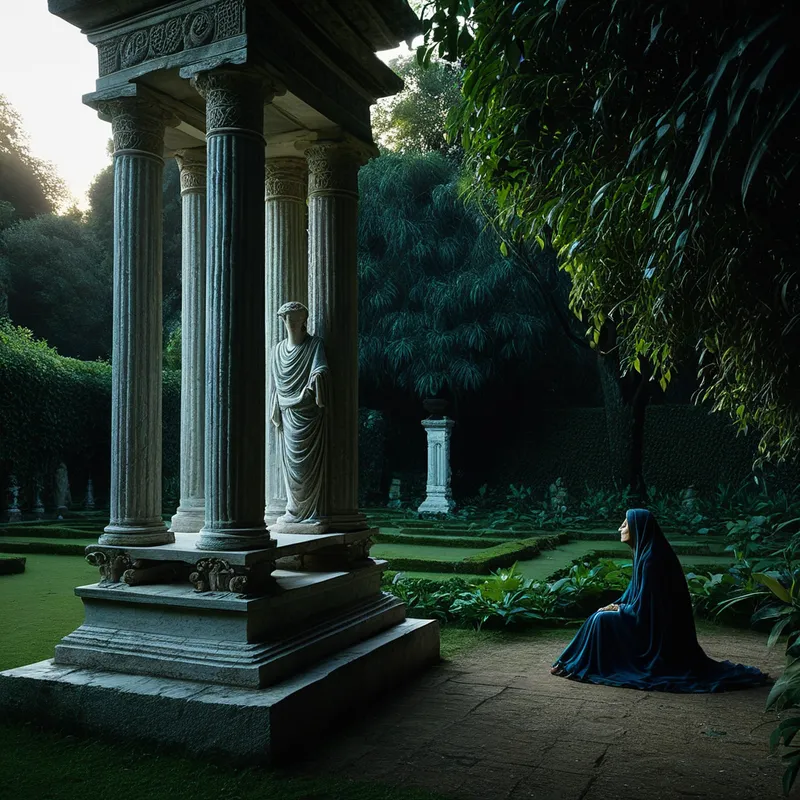
But on the periphery, where the light of the divine torches grew thin and the music faded to an echo, she waited. Penia. She was not invited. How could she be? She was the embodiment of all that this celebration denied—the hollow stomach, the threadbare cloak, the empty hand. Her form was not monstrous, but gaunt, a silhouette of profound absence. Her eyes held the deep, patient hunger of the void. She watched from the shadows, a living embodiment of need amidst the deafening chorus of plenty.
As the night deepened and the nectar flowed, a son of Metis, the clever Poros, drank his fill. He was the god of the clever way through, the finder of passages, the master of resource. Overcome by the richness, he stumbled away from the revelry, seeking a quiet place to sleep. He found a secluded corner in Zeus’s garden, where the roses smelled sweetest, and there, on a bed of soft grass, he fell into a deep, drunken slumber.
This was the moment. From her place of shadow, Penia saw her chance. Not with violence, not with plea, but with a cunning born of infinite desperation. She moved silently, a wisp of chill air, and lay down beside the sleeping form of Plenty’s son. In that act of profound audacity, the uninvited guest united with the embodiment of all means. In the stillness, under a moon that witnessed both lack and resource, a spark was kindled in the dark.
From that union, conceived not in love’s grace but in need’s stark calculation, a child was born. And this child was Eros. Not the chubby, playful Cupid of later tales, but the primal, driving force of Desire itself. Thus, Love entered the world, born not from fullness, but from the fertile, aching ground of Poverty.
Cultural Origins & Context
This haunting narrative comes to us not from the epic cycles of Homer, but from the philosophical symposium. It is preserved in Plato’s Symposium, spoken by the character of Diotima of Mantineia. Here, the myth is not mere entertainment; it is a philosophical argument, a metaphysical origin story for the nature of Love.
In the highly ritualized, male-dominated context of the Athenian symposium—a drinking party centered on conversation—myths were tools for probing truth. Diotima uses the tale to explain Eros’s intermediate, daimonic nature. Love is always in need, always seeking, because its mother is Penia. Yet Love is also clever, resourceful, and capable of beautiful things, because its father is Poros. The myth served to ground an abstract philosophical concept (the nature of desire) in a memorable, personified narrative. It was a story told to thinkers, meant to be unpacked, a seed for dialogue about the human condition’s most central drive.
Symbolic Architecture
The myth presents a foundational alchemy of the human psyche. Penia and Poros are not opposites in conflict, but complementary poles whose union is creatively essential.
Penia is the void that calls forth the world. She is not merely “poverty” in a material sense, but the fundamental experience of lack—the gap between what is and what could be, the yearning for completion, the ache of the unfinished soul. She is the creative tension itself.
Poros is the latent potential within the system. He is not just “plenty,” but the innate resource, the clever path, the hidden passage that appears when one is truly pressed by need. He is the ingenuity born of constraint, the solution sleeping within the problem.
Their child, Eros (Desire), is therefore the dynamic force that bridges the gap. Desire is the active child of passive lack and latent resource. It is the engine of all seeking, all art, all philosophy, all love. The myth tells us that true, world-shaping desire is never born from satiety. It is born from an honest confrontation with our poverty—of spirit, of knowledge, of connection—coupled with the faith that a way through (poros) exists.
The Dreamer’s Resonance
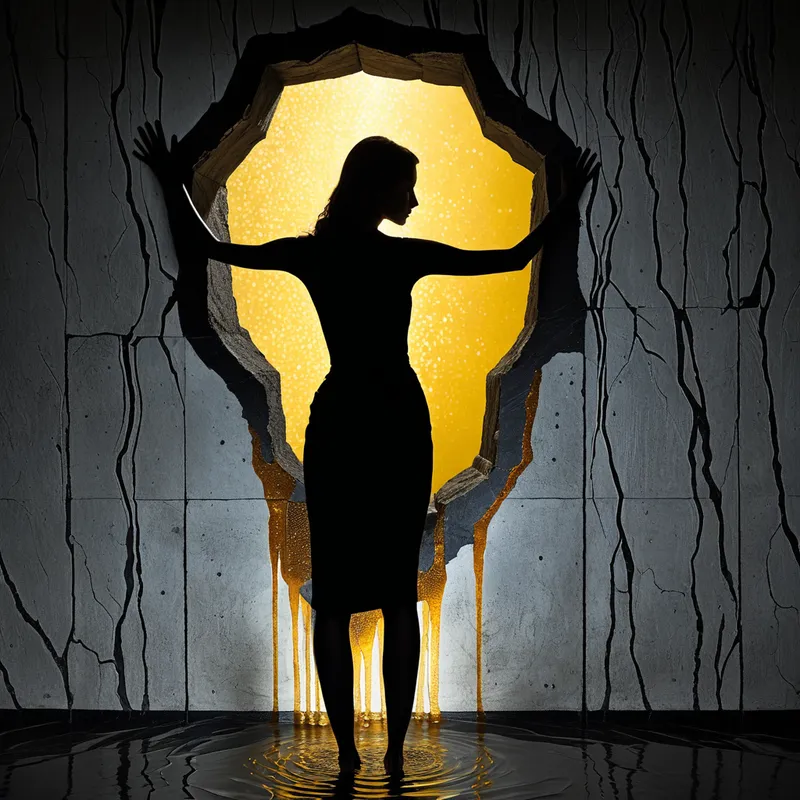
When the pattern of Penia whispers through modern dreams, it often manifests as somatic experiences of profound lack or ingenious solutions emerging from confinement. One might dream of an endless, empty mansion they must furnish, or of being trapped in a small, dark room only to discover a hidden door in the floor. The dreamer could be searching frantically for a lost, vital object, or standing hungry outside a brightly lit banquet hall they cannot enter.
These are not nightmares of persecution, but dreams of primal need. The psyche is presenting its own state of Penia—a feeling of insufficiency in some core area of life: creativity, love, purpose, or self-worth. The dreaming mind is forcing a confrontation with this “poverty,” not to despair, but to initiate the search for the inner Poros. The tightness in the chest, the ache of longing in the dream—these are the somatic signatures of the creative void preparing to give birth. The dream is the garden where lack and resource are brought together by the cunning of the unconscious.
Alchemical Translation
For the modern individual on the path of individuation, the myth of Penia models the essential, often painful, first stage of psychic transmutation. We must become conscious of our Penia.
This means turning towards, not away from, our experiences of inner poverty—the feelings of not being enough, of having nothing to offer, of being fundamentally lacking. Spiritual bypassing, the rush to “positive thinking” without integration, is a refusal to acknowledge the goddess at the feast’s edge. The alchemical work begins in this shadowy corner.
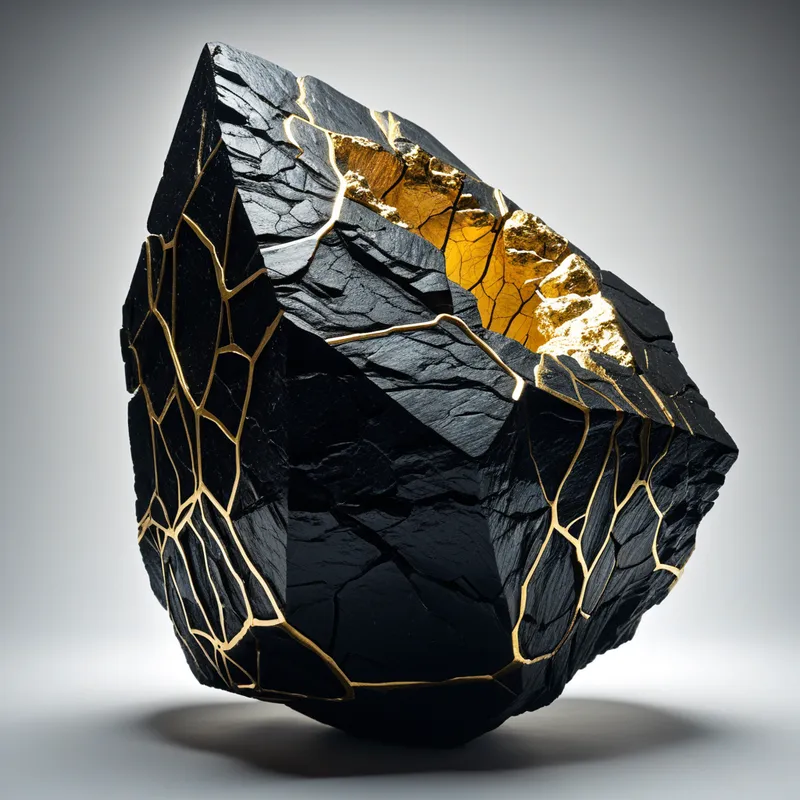
The gold is not found in spite of the lead; it is released from it through a process of heat and pressure. Our “Poros,” our inner resource and genius, often lies dormant, asleep in a drunken stupor of comfort, distraction, or old narratives. It is only the relentless, cunning pressure of acknowledged need (Penia) that can rouse it.
The “child” of this union is the new, desiring, motivated Self. It is the Eros that drives us to connect deeply, create authentically, and seek wisdom passionately. We do not find our purpose in fullness; we conceive it in the fertile emptiness of honest self-appraisal. The myth instructs us to honor our need, to sit with our lack, for it is the mother of all true desire and the necessary catalyst for discovering the ingenious paths (poroi) that lead to a more complete and authentic life. Our deepest creativity is always, at its source, a love child of poverty and resource.
Associated Symbols
Explore related symbols from the CaleaDream lexicon: