Peng Myth Meaning & Symbolism
The story of a vast fish-bird whose transformation and flight beyond the heavens symbolizes the soul's journey to ultimate freedom and perspective.
The Tale of Peng
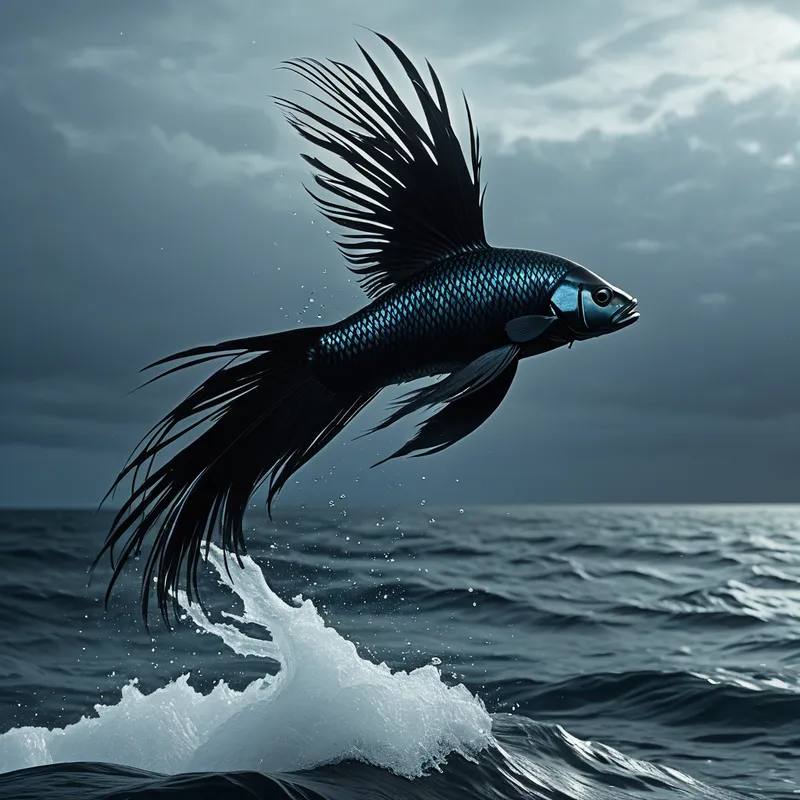
In the dim, primordial north, there lies a sea named Ming. Its waters are not of our world; they are deep, black, and cold, holding the weight of forgotten epochs. In this abyssal darkness, a being slumbered. It was not a fish as men know fish, but a leviathan of such impossible scale that its name was Kun. For centuries, for millennia, the Kun rested in the deep, a continent of living flesh, its slow thoughts moving with the tectonic pulse of the ocean floor.
But in the heart of the Kun, a fire was kindled—not of heat, but of longing. A yearning for a different element, a memory of a different form, whispered from a place beyond the waves. And so, in a season that calendars cannot mark, the Kun began to stir. The sea trembled. It gathered its immeasurable mass, coiling ancient muscles in the dark. Then, with a surge that sent mountains of water crashing against the void, the Kun leaped.
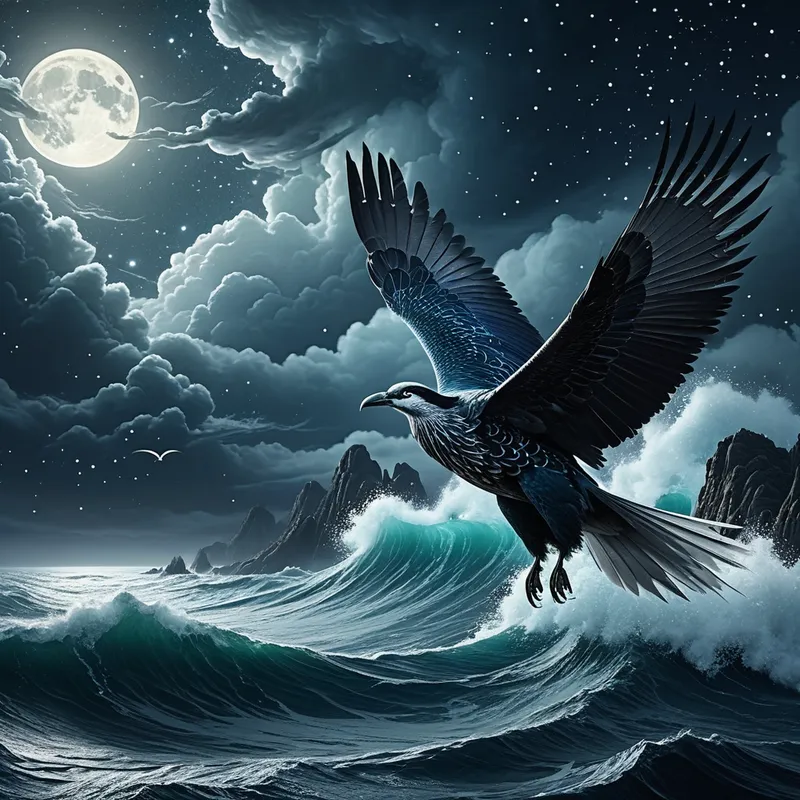
It did not leap for prey or for flight, but for transformation. As it breached the boundary between water and air, a great alchemy occurred. Its vast, slick scales dried in the screaming wind and became feathers—not soft down, but great, iron-dark plumes, each one the size of a lake. Its fins stretched and hardened into wings that could blot out the sky. Its gills sealed, and from its throat came a cry that was neither fish nor fowl, but the sound of the universe bending. The Kun was no more. In its place, beating wings that churned the sea into mist, was Peng.
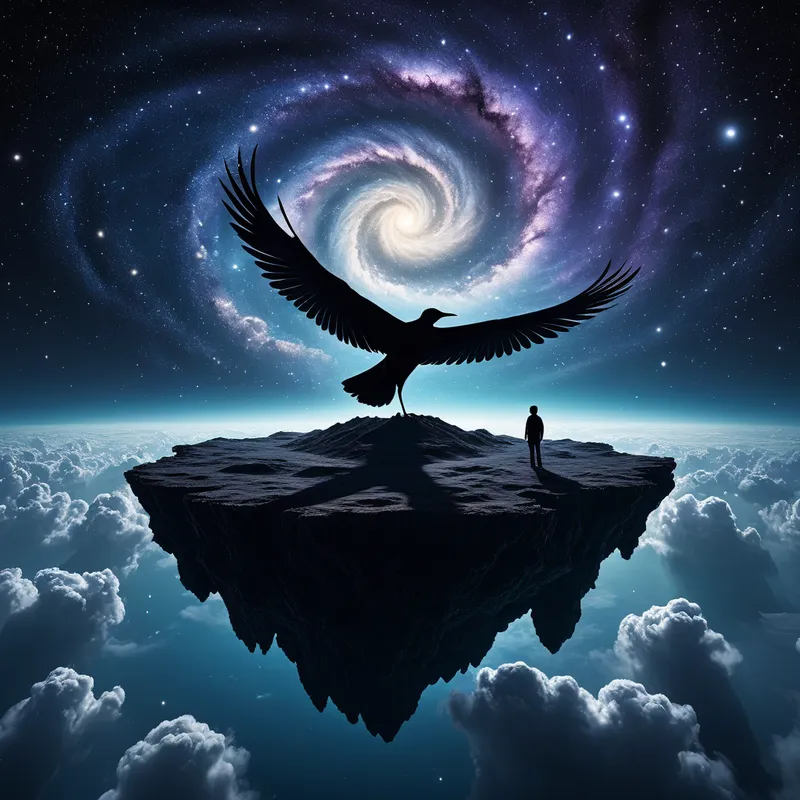
The Peng rose. It did not simply fly; it ascended, leaving the world of forms behind. It climbed the whirlwind, riding the very axis of the earth, its back against the southern sky. For six moons it climbed, never resting, its shadow vanishing from the lands below. It journeyed to the Lake of Heaven, a vast, tranquil expanse of air and light at the roof of creation. And there, at last, it looked down. From that impossible height, the nine provinces of the earth were specks of dust, and the gathered clouds appeared as a herd of grazing sheep. The cicada and the little dove, chattering in their tree, could not conceive of such a journey. But the Peng needed no one’s conception. It had become the journey itself, a sovereign of boundless space, gazing upon all of existence from the vantage point of the absolute.
Cultural Origins & Context
This transcendent narrative comes to us from the mind of the Daoist sage Zhuangzi</ab- br>, who lived during the Warring States period (4th century BCE). It is not a state myth of imperial foundation, nor a folktale of moral instruction passed down through villages. It is, instead, a philosophical parable, a crafted story designed to shatter conventional thinking.
Zhuangzi used the tale of the Peng in the very first chapter of his text, titled “Free and Easy Wandering.” Its primary function was societal and intellectual subversion. In an era obsessed with social rank, political strategy, and rigid Confucian hierarchies, the story of the Peng presented a radical alternative: a vision of absolute spiritual freedom (xiaoyao). It was told to fellow philosophers, students, and rulers to illustrate the poverty of limited perspectives. The cicada and dove who mock the Peng’s ambition represent all who are trapped in petty, ego-bound views. The myth’s purpose was to lift the listener’s gaze, to invite them to consider a scale of being and a mode of existence that renders worldly anxieties trivial.
Symbolic Architecture
At its core, the myth of Peng is a master symbol of psychic and spiritual metamorphosis. The Kun represents the latent, unconscious potential of the psyche—vast, deep, and submerged in the primordial waters of the unknown. It is the unactivated Self, containing everything but expressing nothing in its current form.
The transformation from Kun to Peng is the archetypal act of becoming: the moment the soul decides its current form is a prison, and the elements themselves must be rearranged.
The northern Ming Sea is the womb of potential, but also a place of obscurity. To leave it requires a violent, total commitment—the great leap. This is not a gentle evolution but a catastrophic rebirth, where one’s entire substance is changed. The wings of the Peng symbolize the achieved capacity for transcendence; they are the tools of liberation forged in the crucible of decisive action.
Finally, the journey to the Lake of Heaven and the panoramic view represents the attainment of objective consciousness. It is the “view from above,” a state where one sees the interconnectedness and relative smallness of all things, including one’s former struggles. This is the perspective of the integrated Self, no longer identified with any single, partial aspect of existence.
The Dreamer’s Resonance
When this myth stirs in the modern unconscious, it often manifests in dreams of profound metamorphosis or sublime flight. One might dream of being a deep-sea creature suddenly breaching the surface into blinding light, or of growing immense wings in a moment of crisis. The somatic experience is crucial: a feeling of colossal expansion in the chest, the sensation of rising without effort, or the terrifying-yet-exhilarating vertigo of leaving everything familiar behind.
Psychologically, these dreams signal a critical threshold in the individuation process. The dreamer is likely grappling with a deep, instinctual feeling that their current life “container”—their job, identity, relationships, or self-concept—has become the dark sea, a nurturing but now limiting environment. The psyche is preparing for a leap. The anxiety in the dream (the churning sea, the dizzying height) mirrors the ego’s fear of such total change. The dream is the unconscious affirming the possibility, and the necessity, of becoming something unimaginably greater.
Alchemical Translation
For the individual, the Peng’s journey is a precise map for psychic alchemy. The first stage is Recognizing the Kun: honoring the deep, often dormant, potential within. This is the creative impulse, the spiritual hunger, or the genius that lies fallow. It requires listening to the “dark sea” of the unconscious.
The second, most critical stage is The Leap of Faith: This is the alchemical solve et coagula—the dissolution of the old form and the coagulation of the new. In human terms, it is the irrevocable decision: to leave the secure job to pursue art, to end the suffocating relationship, to publicly speak one’s truth. It is a conscious, willed act of self-destruction and self-creation. It is messy, violent, and absolutely necessary.
The whirlwind it rides for six months is the sustained effort and turbulence of integration. One does not simply decide to change; one must endure the long, arduous process of becoming the change.
Finally, arriving at the Lake of Heaven is the achievement of inner objectivity. It is not about literal superiority, but about the internal state where one’s personal dramas are seen as part of a vast, beautiful pattern. The small-minded “cicadas” of doubt, fear, and social judgment no longer have power. The Self, having realized its boundless nature, dwells in a peaceful emptiness, free and easy, having completed the ultimate exploration: the journey home to its own vastness.
Associated Symbols
Explore related symbols from the CaleaDream lexicon: