Pendragon Banner Myth Meaning & Symbolism
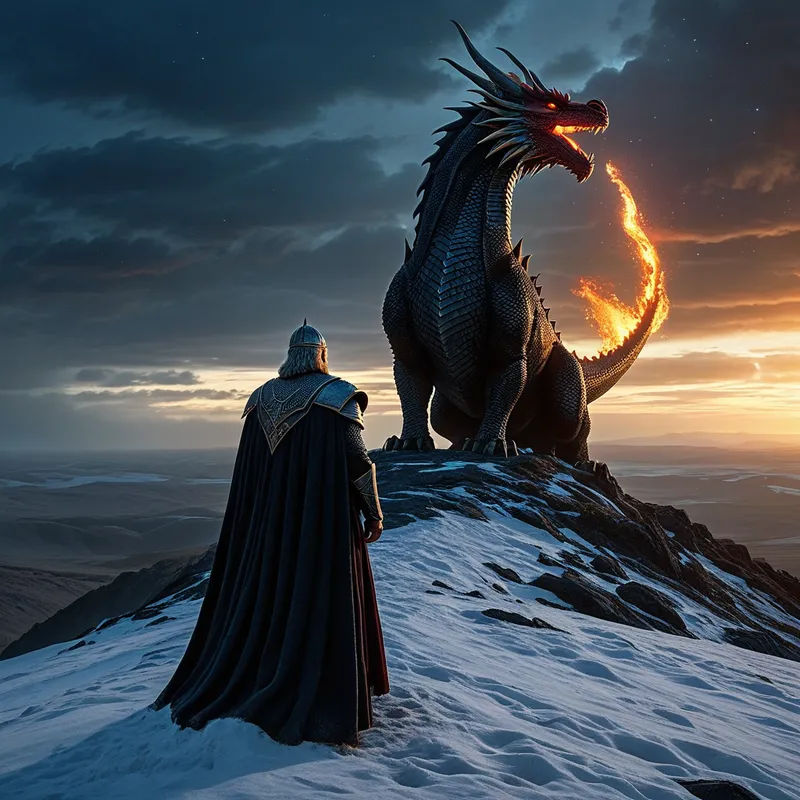
The tale of Uther Pendragon, who saw a dragon-star and raised a dragon banner, binding his destiny and his kingdom's soul to a celestial omen.
The Tale of Pendragon Banner
Listen. The wind on the high moors carries more than the scent of rain and heather. It carries the memory of a king’s breath, caught between a prayer and a curse. In the days after the great Ambrosius Aurelianus fell, the land of Logres was a body without a head, a sword without an arm to wield it. The sea-wolves snarled at the shores, and the old gods slept fitfully in their barrows.
Then came Uther, brother to the fallen king, a man of storm and iron. He walked the land with a heart heavy as a burial stone, seeking a sign, a word from the silent earth or the cold stars. He gathered his chieftains at Tintagel, not for feasting, but for vigil. They built a great fire on the headland, its sparks fleeing upward like souls seeking escape.
As the night deepened, a murmur ran through the host. A scribe from the East, a man who read the sky as others read parchment, pointed a trembling finger. There, burning a path through the velvet dark, was a star of terrible beauty. Its head was a brilliant, unwavering point of white fire, and from it streamed a tail—not of light, but of shimmering, blood-red flame that twisted and coiled like a serpent in its death-throes. It was a dragon of the heavens, a celestial omen written in fire.
A cry went up from the men. “A dragon! A dragon-star!” Uther stood silent, his face carved from moonlight and shadow. The Merlin, who had been a still pool in the tumult, spoke then. His voice was not loud, but it cut through the wind. “The star is yours, Uther. Its fire is your lineage. The dragon is your spirit, and the spirit of the land that cries out for a king. You are no longer Uther, son of Constantine. You are Uther Pendragon.”
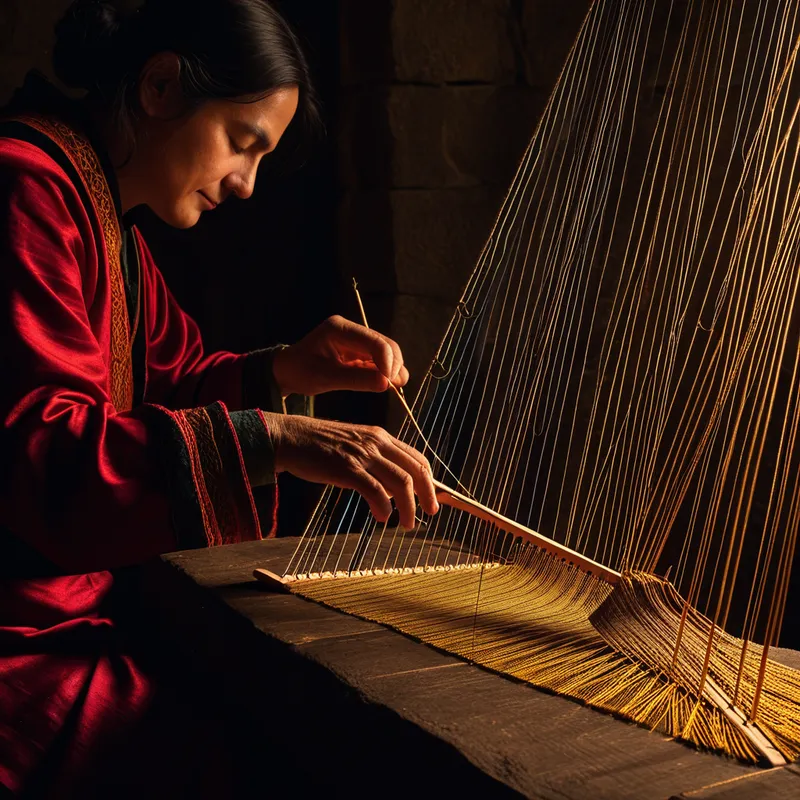
And so the command was given. Not for a new sword or a higher wall, but for a banner. They brought the finest silk, white as a winter moon. The most skilled weavers, dyers who knew the secrets of roots and berries, and a bard whose songs could charm color into thread. For three days and nights they worked as the dragon-star blazed above. They did not stitch a mere symbol; they sought to catch the star’s essence, to weave the very omen into cloth. The dye vats bubbled with a crimson that had no name, a red pulled from the heart of the comet’s tail. When they lifted the cloth, it was not a flag. It was a living piece of the sky-dragon, a rectangle of captured fate. The great red beast reared upon the white field, its form at once serpentine and leonine, its eye a stitch of gold that held the cold intelligence of the star.
Where Uther went, the Pendragon Banner went. It was not carried; it led. In battle, its red seemed to drink the sunlight and bleed it back as terror and courage. Men fought not for gold, but for the dragon on the wind. It unified the fractious tribes into a single body with the banner as its beating heart. It promised a kingdom. But banners cast shadows as long as their glory. The dragon demanded a king’s whole soul. Uther’s victories were bought with a slow surrender of the man to the symbol. He became the Pendragon, and the man named Uther faded, like a fire consumed by the very blaze it created. The banner raised a kingdom, but it cost a king.
Cultural Origins & Context
The tale of the Pendragon Banner emerges from the fraught, fog-shrouded period of post-Roman Britain, a time historians call the Sub-Roman or “Arthurian” age. It is not a story from a single text, but a coalescence of fragments from early Welsh tradition and later chronicles like Geoffrey of Monmouth’s Historia Regum Britanniae. This was an era where history, desperate hope, and myth were woven together on the same loom.
The function of this myth was profoundly political and psychological. In a land fractured by Saxon invasion and the collapse of Roman order, the concept of a unifying, divinely-sanctioned kingship was a matter of survival. The banner was more than a heraldic device; it was a totem for the soul of the nation. It was likely propagated by bards and storytellers in the halls of aspiring warlords, a narrative tool to legitimize Uther’s (and by extension, Arthur’s) rule. The celestial origin—the dragon-star—elevates kingship from mere military power to a cosmic mandate. It answers the desperate question of a people in chaos: “Who has the right to rule us?” The myth replies: “The one chosen by the sky itself, whose symbol binds our fates together.”
Symbolic Architecture
At its core, the Pendragon Banner is an archetypal symbol of the Solar King conjoined with the Chthonic Dragon. The white field represents the ordered, conscious realm of kingship, law, and civilization. The red dragon is the raw, untamed, instinctual power of the land, the people’s will to live, and the fierce, often destructive, fire of destiny.
The banner is the visible point where fate pierces the veil of history, demanding a human vessel.
The dragon-star is the numinosum—the overwhelming psychic event—that erupts into a leader’s life, conferring immense power and an even greater burden. Uther’s act of having the banner made is the critical human response: the conscious effort to name, shape, and containerize this raw, unconscious power into a symbol that can be carried, understood, and followed. Yet, the myth wisely shows the cost. The symbol can consume the man. Uther’s identity is subsumed into his title; he becomes the vessel for the collective’s projection, losing his individual humanity in the process. The banner, therefore, is also a symbol of the Persona at a collective level—a glorious, empowering, yet ultimately draining mask of leadership.
The Dreamer’s Resonance
When the Pendragon Banner appears in a modern dream, it rarely manifests as a medieval flag. It may be a brilliant, troubling logo for a company, a tattoo that feels more alive than the skin it’s on, a family crest that pulses with expectation, or simply an overwhelming feeling of being “chosen” for a daunting task under a glaring, public spotlight.
Somatically, this dream pattern often accompanies a period of intense initiation into a new role—a promotion, parenthood, founding an enterprise, or becoming the face of a cause. The body may feel the weight of the “mantle,” with tension in the shoulders and chest. Psychologically, the dreamer is grappling with the eruption of a powerful new archetypal energy (the dragon-star) into their personal life. They are in the process of “weaving the banner”—that is, trying to construct a professional identity, a public self, or a personal philosophy that can adequately express and manage this new, formidable power. The conflict lies in the fear of being consumed, of the role (the Pendragon) erasing the individual (Uther). The dream asks: Can you carry the dragon without becoming it?
Alchemical Translation
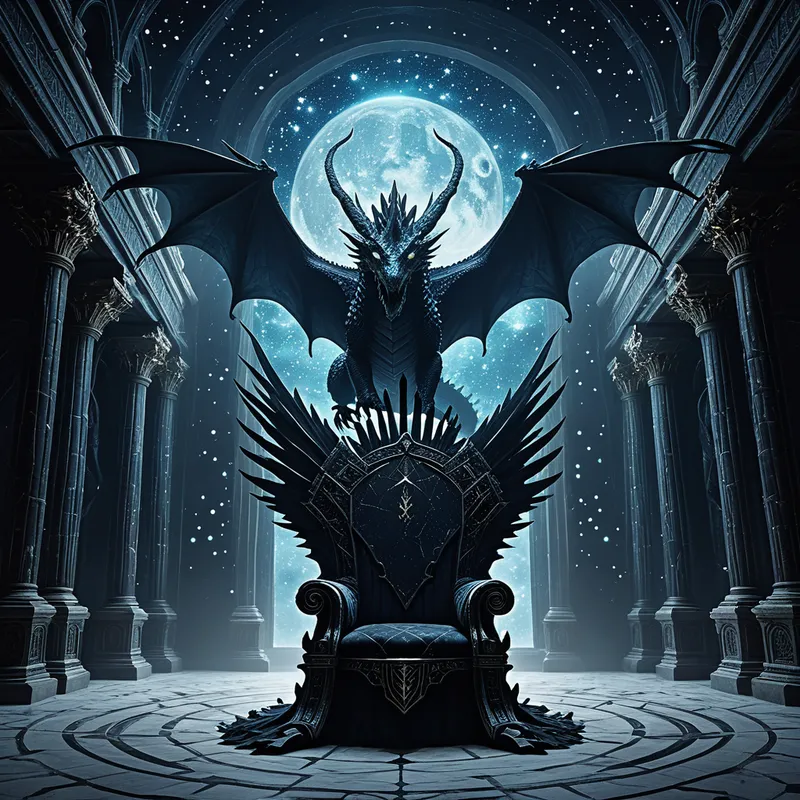
The myth models the alchemical Individuation process, specifically the stage of Albedo (the white field) confronting and integrating the Rubedo (the red dragon). The initial, unconscious state is the “land without a king”—a psyche adrift, lacking a central, governing principle.
The dragon-star is the shocking, involuntary call from the Self. It is the moment of profound vocation or crisis that demands a complete reorientation of one’s life. Uther’s vigil and his command to create the banner represent the ego’s conscious, disciplined engagement with this call. This is the opus—the great work.
The weaving of the banner is the slow, meticulous work of building a conscious attitude capable of holding the paradoxical union of disciplined order (king) and passionate instinct (dragon).
For the modern individual, this is the lifelong task of building a personality that can express one’s deepest, often daemonic, gifts and passions in the world in a sustained and constructive form. The warning in the myth is the peril of inflation. If one identifies solely with the glorious symbol (the banner/Pendragon), the individual ego is lost, consumed by the archetype. True alchemical triumph would be Uther being able to lay the banner down, to be both king and man. The myth, in its ancient wisdom, stops short of that, showing us the perennial tension. Our work is not to avoid the dragon-star, but to learn the sacred craft of weaving its fire into a banner we can carry without being burned away—to serve the symbol without becoming its slave.
Associated Symbols
Explore related symbols from the CaleaDream lexicon: