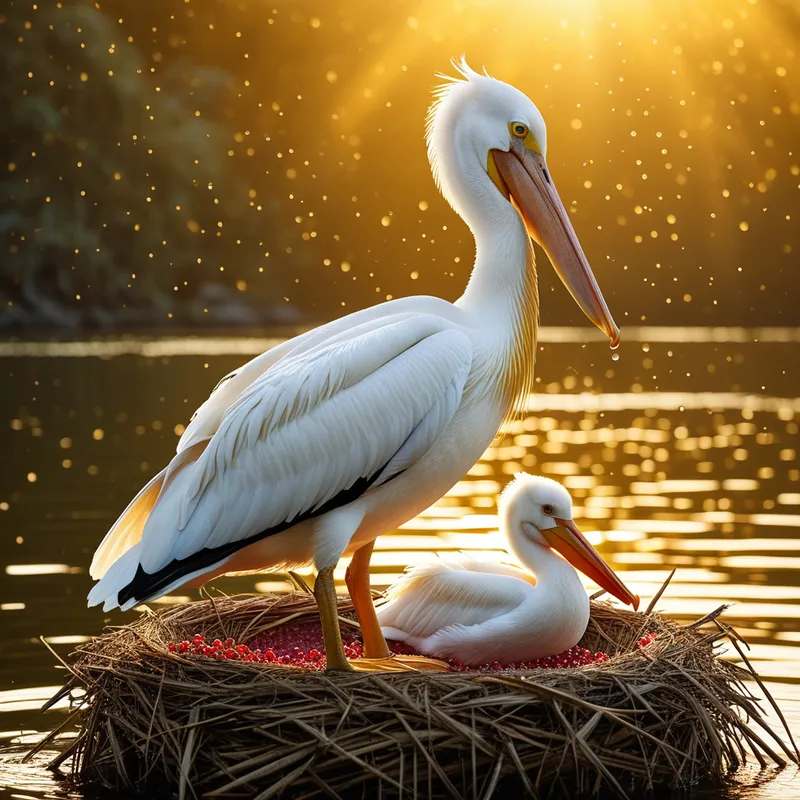
Pelican of Piety Myth Meaning & Symbolism
A myth of a mother pelican wounding herself to feed her young with her own blood, becoming an ancient symbol of ultimate sacrifice and redemptive love.
The Tale of Pelican of Piety
Listen, and let the silence of the marsh settle upon your soul. In a time before time was measured, in the liminal world of reeds and still water, there lived a Pelican of Piety. Her nest, woven from the whispers of the wind and the strength of the bulrush, cradled her brood—a clutch of downy chicks whose eyes held the reflection of a cloudless sky. She was their world, their warmth, their provider of silver fish from the murky depths.
But a shadow fell, not from the sun, but from the very air. A pestilence, silent and cold, crept from the mist. It was a serpent of absence, a venom of stillness. One by one, the vibrant chirps ceased. The eager, gaping beaks fell slack. The life-light in their eyes guttered and went out. The mother returned from her foraging to a nest of chilling silence, to forms that were but hollow echoes of her children. The world of the marsh, once a chorus of life, became a cathedral of grief.
Her cry was not a sound, but a rent in the fabric of the world—a keen of pure, undiluted love facing the abyss of absolute loss. She paced the rim of the nest, her wings a shroud of despair. The wisdom of earth and water offered no solace, no remedy for this death. In that moment of ultimate severance, a knowledge older than instinct awoke within her. It was a terrible, luminous truth.
With a resolve that stilled the very wind, she bowed her long neck. She turned her sharp beak, not toward the hostile world, but inward, upon herself. There was no hesitation, only the flawless geometry of sacrifice. She struck her own breast.
The first drop of blood was a dark jewel against her white plumage. Then came a flow, a sacred river from her own heart. She let it fall upon the cold, still forms of her young. One drop, then another, bathing them in the warmth of her very essence. She gave not from her surplus, but from her substance; not from her harvest, but from her holy of holies.
And as her life ebbed onto them, a miracle, quiet and profound, unfolded. The cold grey of death began to recede like a tide. A faint tremor, then a stirring. The downy feathers, matted and still, fluffed with returning warmth. Small beaks opened, not for food, but for breath—a new, vibrant breath infused with her own spirit. They lived. They rose, nourished and resurrected not by the bounty of the marsh, but by the boundless, self-wounding love of their mother. She stood among them, wounded yet radiant, the source and the salvation become one.

Cultural Origins & Context
The tale of the Pelican of Piety, or Pelican in her Piety, is not a myth with a single author or a canonical biblical verse. It is a physiologus tradition, a form of allegorical natural history that flourished in the medieval world. It entered Christian symbolism through bestiaries—illuminated manuscripts that described animals and imbued them with moral and theological meaning.
Scholars trace its possible origins to ancient natural misunderstandings. Observers may have seen the pelican’s large, pendulous lower beak and believed it used it to wound its breast to feed its young. This observed (or imagined) behavior was instantly seized upon by early Christian thinkers as a perfect type for the sacrifice of Christ. The pelican who gives her blood to revive her dead children became a direct mirror of the Savior who shed his blood on the cross for the redemption of a spiritually dead humanity.
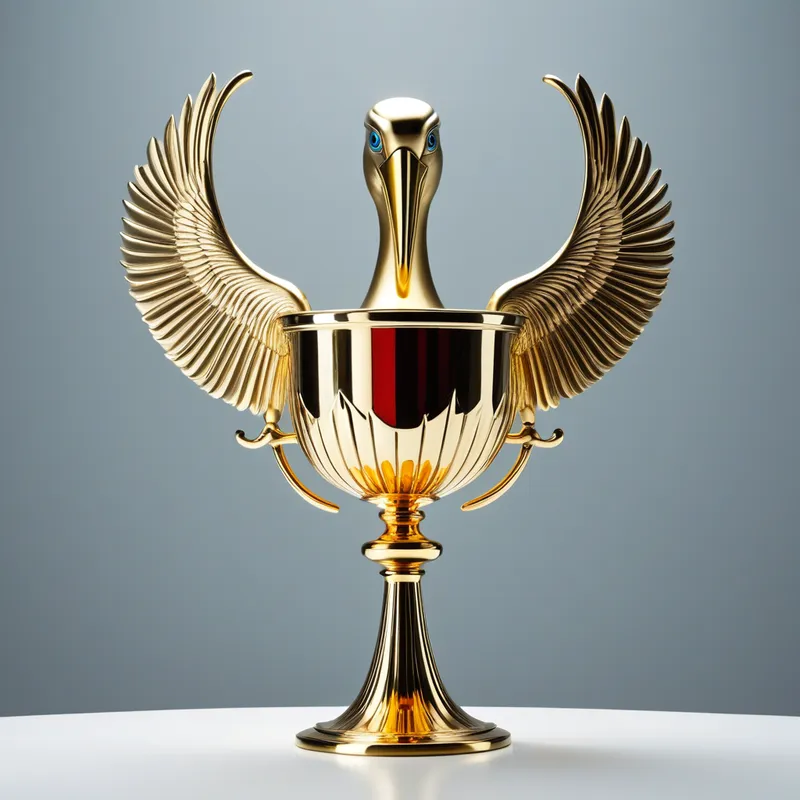
The myth was propagated by monks, theologians, and artists. It was carved into choir stalls, stained into glass windows, and etched onto chalices and patens. It served a profound societal function: to make the abstract, cosmic concept of atonement tangible, immediate, and emotionally resonant. It provided a visceral, natural image to anchor the doctrine of sacrificial love, teaching the faithful through story and symbol rather than dogma alone.
Symbolic Architecture
At its core, the Pelican of Piety is an archetypal map of love’s most radical expression. It symbolizes the principle that true nourishment, especially of a spiritual or psychic nature, often requires a rupture of the self.
The deepest revival does not come from outside provision, but from an interior wounding that releases a hidden, life-giving essence.
The pelican represents the Divine Caregiver or the ultimate parental archetype, whose identity is defined not by protection from all harm, but by the willingness to undergo harm itself to ensure the life of the other. The chicks symbolize not just offspring, but any aspect of the self or the community that has fallen into stagnation, despair, or spiritual death—the “dead” potentials within us.
The pivotal act of self-wounding is the myth’s central symbol. It is not masochism; it is alchemy. It represents the conscious, painful decision to break open one’s own defenses, ego, and stored vitality (the breast) to feed what is perishing. The blood is vita, life-force, soul-substance. It is the currency of the inner world, given freely. The subsequent revival is the symbol of transformation—what was dead to the old order of existence is resurrected into a new life, sustained by a love that is literally in-blooded.
The Dreamer’s Resonance
When this myth stirs in the modern dreamscape, it rarely appears as a literal pelican. Instead, one may dream of a parent figure performing a shocking, necessary act of self-harm to save the dreamer. One might dream of a tree bleeding sap to revive wilted flowers at its roots, or of a heart with a valve that opens inward, feeding light to shadowy internal figures.
Such dreams often surface during life phases of profound caregiving burnout, creative drought, or when a part of the dreamer’s identity feels utterly depleted or “dead.” The somatic feeling is one of hollow exhaustion in the chest, coupled with a paradoxical, urgent pressure in that same hollow space. Psychologically, the dream signals that the ego’s standard resources are exhausted. The dream is presenting the archetypal solution: a descent to a deeper, more sacrificial level of giving. It asks the dreamer, “What within you is so precious that you would break yourself open to save it? And what part of you must ‘die’ to release the nourishing blood for its revival?” The process is one of confronting the terrifying, fertile truth that our deepest renewal is often hidden behind a door we must wound ourselves to open.
Alchemical Translation
For the individual on the path of individuation, the Pelican of Piety models the critical stage of solutio followed by coagulatio—dissolution and reformation. The ego, identified as the separate, self-preserving “mother,” must undergo a voluntary sacrificium (sacrifice).
The alchemical gold of the integrated Self is forged in the furnace of necessary, self-inflicted vulnerability.
The “chicks” are the neglected, repressed, or unlived parts of the psyche—the inner child, the creative spark, the capacity for vulnerability. These aspects lie dormant, not for lack of attention, but for lack of the right quality of attention. The ego’s ordinary efforts (the fish from the marsh) cannot reach them. They require sanguis spiritualis, the spiritual blood.
The alchemical operation is thus: the conscious self (the pelican) must turn its discerning beak (awareness) inward and pierce the protective shell of persona and pride (the breast). This is the painful, ego-dystonic act of shadow work, of admitting one’s own wounds, needs, and hidden depths. The life-blood that flows is the raw, authentic emotion and psychic energy thus released—tears, confessed truths, creative impulses born of pain. This essence, once wasted or defended, is now consciously directed to nourish the dying inner figures.
The revival of the chicks is the coagulatio: the reformed psyche. The once-dead potentials are now alive, integrated, and sustained by a continuous connection to the heart-center of the Self. The pelican is wounded but whole in a new way; she is now both the source and the vessel, the sacrificer and the sacred space where the miracle occurs. The individual learns that their ultimate power lies not in invulnerability, but in the courageous, pious act of breaking open, transforming personal suffering into the very substance of soul-making.
Associated Symbols
Explore related symbols from the CaleaDream lexicon: